
The Real Cost to Run a Short-Term Rental in Orlando
Every expense, from HOA and CDD fees to taxes, insurance, and
management, broken down with real numbers from the Orlando corridor.
Mike Chen, a licensed Florida real estate broker and short-term rental property manager, has helped investors build and operate vacation rental portfolios across the Orlando corridor. One pattern stands out: investors who focus only on revenue projections get surprised by the expense side. The ones who map out every cost before closing tend to make better decisions and stronger returns.
Below is every line item involved in the cost to run a short-term rental in Orlando. Not estimates pulled from national averages, but actual expense ranges from Osceola, Polk, and Orange counties. We manage properties in these areas daily at FunStay Florida, and the numbers here reflect what our owners actually pay.
Still deciding where to buy? Our breakdown of the best areas near Disney covers revenue and home prices across four markets. The guide below picks up where that one leaves off: what happens after you close.
Year One Setup Costs
Before any rental income hits your account, you need to furnish the property, get licensed, and cover closing costs. These are one-time expenses (or close to it), and they vary depending on the property size and county.
Furnishing and Supplies
Furnishing an Orlando vacation rental typically costs $15,000 to $30,000. A 4-bedroom home runs about $18,000 to $22,000 for furniture, linens, kitchen essentials, decor, and patio setup. Themed rooms and game rooms add $3,000 to $8,000 on top, but they drive higher nightly rates and better reviews.
This is not the place to cut corners. Orlando is competitive. Guests compare listings side by side, and a well-furnished property books more nights at better rates than a bare-bones one. Our furnishing cost guide breaks this down room by room. Budget for quality upfront, because it pays back through occupancy.
Licensing and Permits
Every short-term rental in Florida needs a DBPR vacation rental license from the state. That costs $170 per year for a single unit.
County permits vary. Osceola County (Kissimmee, St. Cloud) charges $410 for the initial STRO permit, which includes a $160 inspection fee and a $250 license fee. Renewal drops to $150 per year. Polk County (Davenport, Haines City) charges $57.75 for a Class B Business Tax Receipt. The City of Orlando charges $275 for the first year of home-sharing registration, then $125 annually. Our page on Airbnb licensing walks through each county’s requirements.
💡 Operating without a license in Osceola County can cost $250 per day for a first violation and up to $500 per day for repeat offenses. In Polk County, fines reach $15,000. Get licensed before your first guest.
Closing Costs
Closing costs in the Orlando area run 2% to 3% of the purchase price. On a $400,000 property, that is $8,000 to $12,000. Investment properties in Florida do not qualify for the homestead exemption, so factor in the full assessed property tax rate from day one.
Monthly Operating Costs for Orlando Vacation Rentals
These are the recurring expenses that hit every month regardless of occupancy. Understanding them is the first step to calculating whether a property can pay for itself.
HOA Fees
Resort communities charge the most. ChampionsGate runs $250 to $500. Reunion Resort is the highest at $500 to $900+, including mandatory club fees. Solara runs $300 to $650. Non-resort areas in Davenport may charge $50 to $150 or nothing at all.
Electric
Florida summers push air conditioning hard. Larger homes cost more to cool. Budget conservatively, especially June through September.
Water and Sewer
Predictable and steady. Heavier use during high-occupancy periods, but not a major variable cost.
Pool Maintenance
Weekly service is mandatory for any property with a private pool. Guests and HOAs both expect clean water. Not optional in this market.
Internet
High-speed internet is a guest expectation. Some resort communities include it in the HOA. Most do not.
Pest Control and Lawn
Pest control runs $40 to $75 monthly. Lawn care is often included in the HOA. If not, budget $100 to $150 per month.
Pool Heating: A Line Item Worth Watching
Many guests expect a heated pool, especially from November through March. Electric heat pump pool heating adds $100 to $300 per month during cooler stretches. Gas heating warms faster but typically costs more. Solar heating cuts the ongoing expense significantly, though installation runs $3,000 to $6,000 upfront.
HOA and CDD Fees: The Orlando-Specific Expenses
This is where Orlando short-term rental expenses differ from markets like the Smoky Mountains or Gulf Shores. In most cabin and beach markets, HOA fees are modest or nonexistent. In Orlando’s resort communities, they are a major line item.
What HOA Fees Cover
Resort-style HOA fees fund the amenities that help drive bookings: community pools, water parks, lazy rivers, fitness centers, gated entry, clubhouses, and common-area landscaping.
These are the same features that allow you to charge higher nightly rates. The fees are real, but so is the revenue premium they support.
CDD Fees: The Expense Most Investors Miss
CDD stands for Community Development District. Florida uses these special taxing districts to finance infrastructure in newer developments: roads, water lines, sewer systems, and streetlights. Property owners pay off those bonds through annual CDD assessments.
CDD fees typically range from $1,500 to $4,000 per year and appear on your property tax bill, which makes them easy to overlook. They do not go away until the bonds are fully paid, usually 15 to 30 years. They can also increase if the CDD board approves new improvements.
| Community | HOA (Monthly) | CDD (Annual) | Combined Annual |
|---|---|---|---|
| ChampionsGate | $250-$500 | $2,000-$3,000 | $5,000-$9,000 |
| Reunion Resort | $500-$900 | $2,500-$4,000 | $8,500-$14,800 |
| Solara Resort | $300-$650 | $2,000-$3,500 | $5,600-$11,300 |
| Windsor at Westside | $250-$400 | $1,800-$3,000 | $4,800-$7,800 |
| Non-Resort (Davenport) | $50-$150 | Lower or paid down | $600-$1,800 |
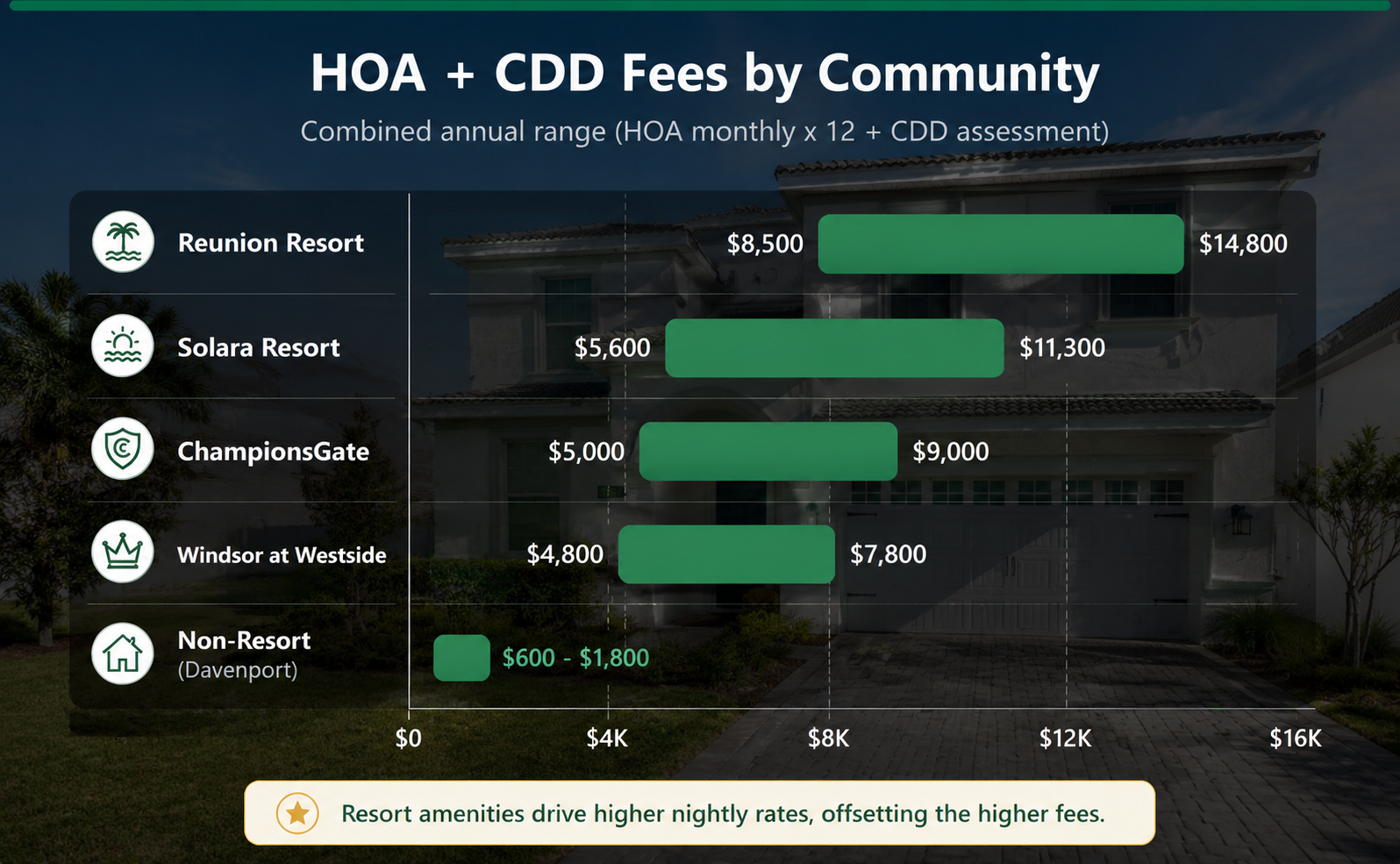
Combined HOA and CDD fees in a resort community can add $5,000 to $15,000 per year to your operating costs. That is $400 to $1,250 per month before the mortgage, utilities, or management. For a closer look at the differences between two popular resort areas, our ChampionsGate vs Reunion comparison breaks down the numbers community by community.
Cleaning, Turnover, and Per-Booking Costs
Orlando vacation rentals turn over frequently. Average stays run 3 to 7 nights, so a property earning $50,000 per year might see 50 to 70+ turnovers annually. Each turnover has a direct cost.
Cleaning Costs
Cleaning fees scale with property size. A 3-bedroom runs $125 to $200 per turnover. A 4 to 5-bedroom is $150 to $250. Larger 6 to 8-bedroom homes cost $225 to $400 per clean.
Most operators pass cleaning fees to guests as a separate line item on the booking. But the cleaning fee factors into the guest’s total cost comparison, so pricing it too high can reduce competitiveness on shorter stays.
Linen and Consumables
Linen service runs $15 to $30 per turnover if using a professional program. Consumables like soaps, toilet paper, and kitchen basics add $15 to $25 per turn. Budget another $500 to $1,000 per year for replacing worn linens, towels, and small items. For a full supply checklist, our Airbnb essentials page covers what top-performing properties keep stocked.
💡 Cleaning is not the place to cut costs. Our cleaning service teams turn properties same-day. If guests see a single negative review about cleanliness, it drags down your listing ranking fast.
Property Taxes, Insurance, and Annual Fixed Costs
Property Taxes
Property tax rates in the Orlando area range from 0.9% to 1.5% of assessed value depending on the county and community. Resort communities in Osceola County tend to run higher. For a $450,000 investment property, that comes to roughly $4,050 to $6,750 per year. Investment properties do not qualify for Florida’s homestead exemption, so you pay the full assessed rate.
When reviewing a property listing, make sure you separate the ad valorem tax from the CDD assessment. Many listings combine them into a single “tax” figure, which makes the property taxes look higher than they are while hiding the CDD fee.
Insurance
Florida insurance costs have been rising, and investment properties pay higher rates than primary residences. A typical 4 to 6-bedroom Orlando vacation rental runs $4,000 to $8,000 per year for homeowners insurance. Flood insurance adds $500 to $2,000 if the property is in a flood zone. An umbrella policy costs $300 to $600 per year for $1 million in coverage.
Get insurance quotes before closing. Rates vary significantly based on construction year, roof age, and specific location. Carriers have left Florida in recent years, so budget conservatively here.
Maintenance Reserve
Things break. Appliances fail, AC units age out, paint gets scuffed, and pool equipment wears down. Orlando homes are used heavily, often booked back to back for weeks at a time. That usage shows.
Budget 1% to 2% of purchase price annually for maintenance. On a $425,000 home, that is $4,250 to $8,500 per year. Our property maintenance team handles this proactively. Deferred maintenance leads to bad reviews, lower bookings, and bigger repair bills down the road.
Property Management Fees in Orlando
Most Orlando vacation rental investors use professional management. The market is competitive, turnover is frequent, and the volume of guest communication, cleaning coordination, and maintenance makes self-managing impractical for many owners, especially out-of-state investors.
Typical Fee Structures
Full-service property management in Orlando costs 15% to 25% of gross rental revenue. The percentage depends on the company, the level of service, and the property’s revenue potential. For a detailed breakdown of what those fees cover, our management fees page explains each component.
Our guide on full-service management explains what that covers: guest communication, dynamic pricing, listing management, cleaning coordination, maintenance dispatch, and performance reporting. Some companies bundle linen service and pool heating into the fee. Others charge them separately.
What to Watch For
A “20% management fee” with $50 per booking charges and separate linen fees can effectively become 28% to 30% once you run the math. Always ask for the full fee schedule before signing. Our guide to choosing a management company covers exactly what to look for, from per-reservation surcharges to early termination penalties.
| Service Level | Fee Range | Best For |
|---|---|---|
| Listing-only / co-host | 8%-15% | Local owners who handle cleaning and maintenance |
| Full-service | 15%-25% | Out-of-state investors, portfolio owners |
| Premium / concierge | 20%-30% | Luxury properties, high-touch guest experience |
Taxes You Collect From Guests
Short-term rental hosts in Orlando must collect and remit sales tax and tourist development tax on every booking under six months. These are not costs you absorb. Guests pay them. But you are responsible for collecting, filing, and remitting them accurately. Our Orlando STR laws guide covers the filing details.
| TAX COMPONENT | OSCEOLA COUNTY | POLK COUNTY | ORANGE COUNTY |
|---|---|---|---|
| Florida State Sales Tax | 6% | 6% | 6% |
| Discretionary Surtax | 1.5% | 1% | 0.5% |
| Tourist Development Tax | 6% | 5% | 6% |
| Total Combined Rate | 13.5% | 12% | 12.5% |
Rates verified against the Florida Department of Revenue DR-15TDT and DR-15DSS schedules for 2026.
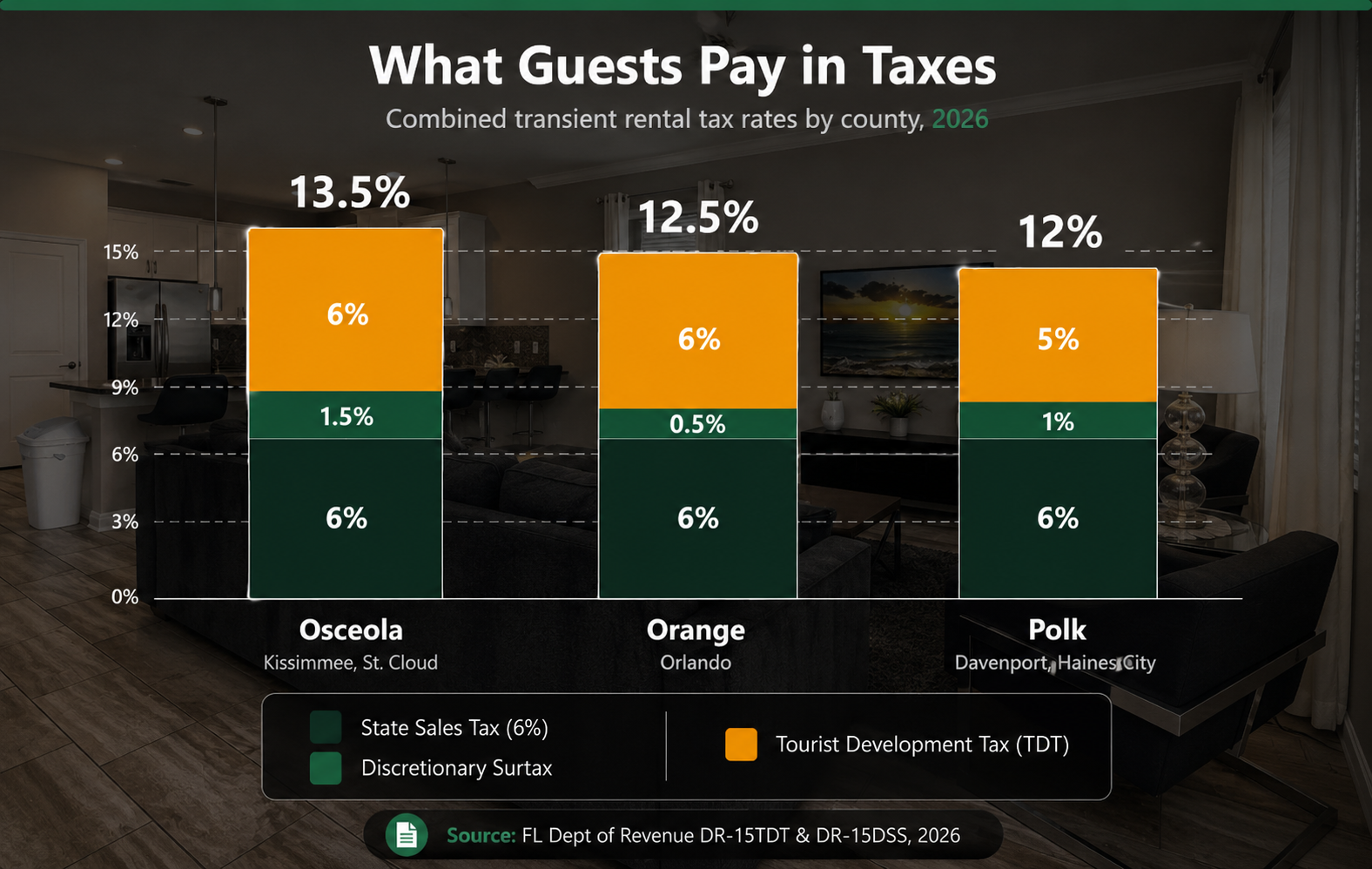
Airbnb and Vrbo collect and remit some of these taxes automatically, depending on agreements with each county. But hosts are still responsible for verifying what the platform collects and filing anything it does not. Register with the Florida Department of Revenue and your county tax collector regardless.
For a side-by-side look at how Polk and Osceola handle STR regulations differently, we broke that down in a separate guide.
Full Annual Expense Breakdown
Here is what the cost to run a short-term rental in Orlando actually looks like for a typical 5-bedroom home in a resort community like ChampionsGate, assuming a $425,000 purchase price with 25% down.
Sample: 5-Bedroom in ChampionsGate Later)
Mortgage (30yr fixed, 25% down)
$25,500
HOA fees ($350/mo)
$4,200
CDD assessment
$2,500
Property taxes
$5,100
Insurance
$4,200
Property management (25% of $55K)
$13,750
Utilities (electric, water, internet)
$3,600
Pool maintenance
$1,500
Pest control and lawn
$900
Cleaning (net of guest fees)
$1,500
Maintenance reserve
$2,000
Supplies and consumables
$1,200
Total Annual Expenses
$65,950
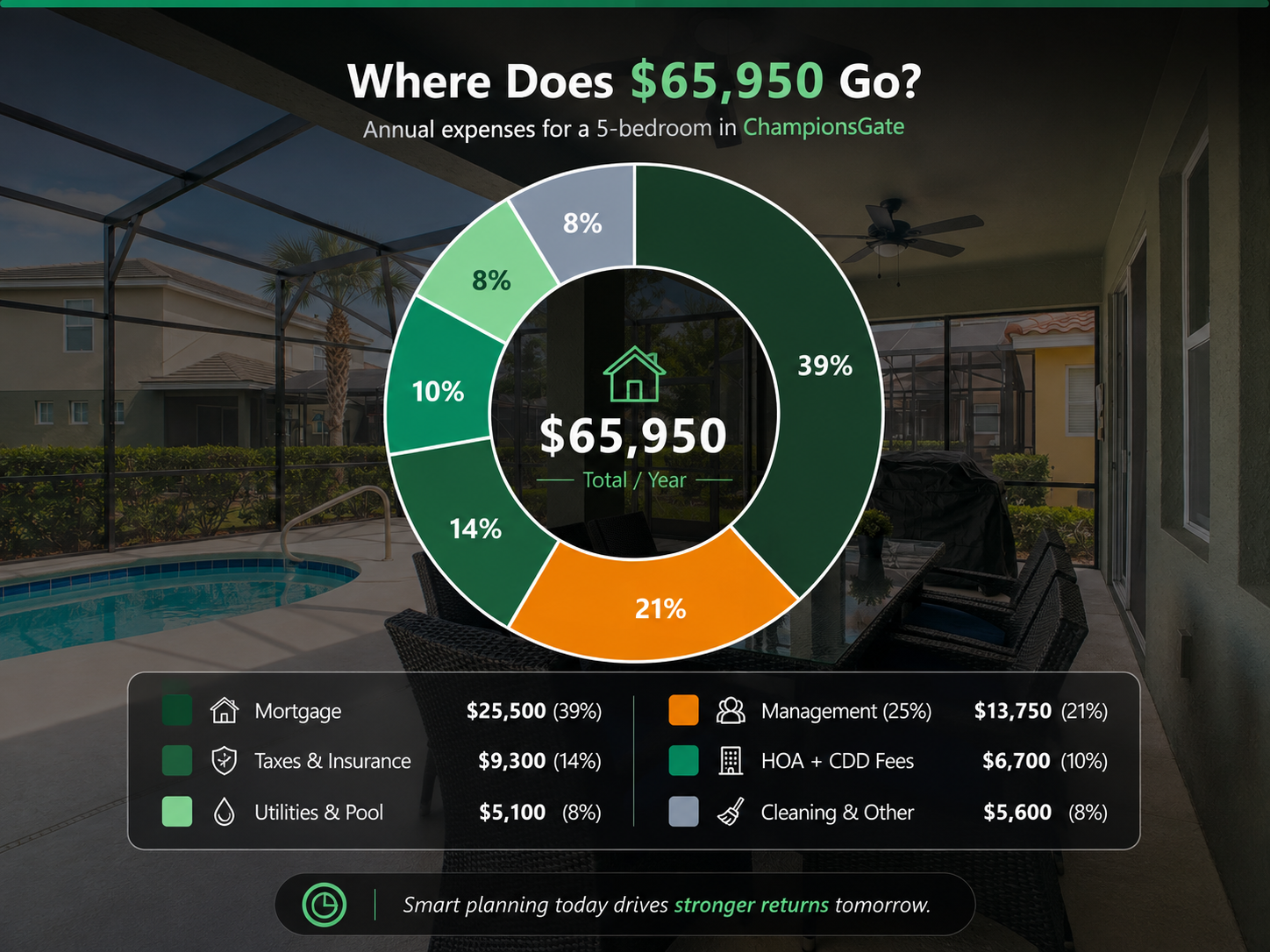
At 75th-percentile revenue of $55,000, this property runs at roughly negative $11,000 annually. At 90th-percentile performance near $82,000, net operating income turns positive at approximately $16,000. That gap is why property selection, community choice, and management quality matter so much. The margin between a solid investment and a money pit is thinner in Orlando than in lower-cost markets.
For a full walkthrough of how to calculate returns on a specific property, our vacation home ROI case study shows the math step by step.
Tax Benefits That Offset Your Costs
Florida has no state income tax, which is a significant advantage for short-term rental investors. But beyond that, there are federal deductions and strategies that can dramatically improve your after-tax returns.
Deductible Expenses
Nearly every operating expense on a short-term rental is deductible: mortgage interest, property taxes, insurance premiums, management fees, utilities, cleaning costs, supplies, repairs, and even travel to inspect the property. Furniture and appliances depreciate over time, creating additional write-offs.
Cost Segregation
Cost segregation is an engineering-based study that reclassifies components of your property (flooring, cabinetry, appliances, landscaping) into shorter depreciation schedules. Instead of depreciating the entire building over 27.5 years, a cost segregation study can accelerate tens of thousands of dollars in deductions into the first few years of ownership.
Combined with the short-term rental tax strategy, where owners who materially participate in their rental can use losses to offset other income, this can turn a property that looks marginal on paper into a strong after-tax performer. Consult a CPA who specializes in real estate before making any tax decisions.
Do not evaluate Orlando investments on pre-tax cash flow alone. The tax benefits, especially cost segregation and accelerated depreciation, can change the picture significantly for investors in higher tax brackets.
How to Keep Orlando STR Expenses in Check
The cost to run a short-term rental in Orlando is predictable once you know what to expect. Here is how experienced investors manage it.
Get real numbers before you buy. Ask for actual HOA, CDD, tax, and insurance figures for the specific property. Do not estimate. The difference in HOA and CDD fees between communities can be $3,000 to $5,000 per year.
Compare counties, not just communities. Polk County’s 12% total tax rate and $57.75 permit fee versus Osceola County’s 13.5% rate and $410 permit creates real annual savings. Our STR vs long-term comparison covers the financial tradeoffs from both angles.
Negotiate management fees. Especially if you are buying multiple properties or bringing a high-revenue listing. Portfolios with 3+ properties often qualify for lower rates.
Budget for maintenance early. Set aside 1% to 2% of purchase price annually. Deferred maintenance turns into bad reviews, which turn into lower occupancy, which turns into a downward spiral.
Understand which expenses grow with revenue. Management fees, cleaning costs, and supplies scale with occupancy. Fixed costs like HOA, CDD, taxes, and insurance stay the same whether the property is booked or empty.
Review your insurance annually. Florida’s insurance market shifts fast. Shop around every renewal. Work with agents who understand short-term rental policies specifically.
About the Author
Mike Chen is a licensed Florida real estate broker and short-term rental property manager at FunStay Florida. He works with investors daily on the expense side of Orlando vacation rentals, from reviewing HOA and CDD fee structures before closing to tracking actual operating costs across communities like ChampionsGate, Reunion, and Solara. The numbers in this guide come from that hands-on experience.
