Florida’s vacation rental market is booming, with 143 million visitors recorded in 2024 and revenue projected to reach $24.78B by 2029. However, Florida short-term rental laws 2026 remain a complex mix of state and local rules after the SB280 veto.
This guide helps property owners understand how the latest updates affect renting on platforms like Airbnb or Vrbo, what has changed, and how working with a property management company can simplify compliance while keeping hosting profitable and stress-free.

What Counts as a Short-Term Rental in Florida?
Under Florida Statutes, particularly Chapter 509, a property is considered a short-term rental if it:
- Is rented for less than 30 days or one calendar month per stay
- Is rented more than three times per calendar year
- Is primarily used by transient guests rather than long-term tenants
This applies to various property types, including:
- Single-family homes
- Condominiums
- Duplexes, triplexes, and other small multi-unit dwellings (up to four units)
Short-term rentals are classified as public lodging establishments and require a license from the Department of Business and Professional Regulation (DBPR).
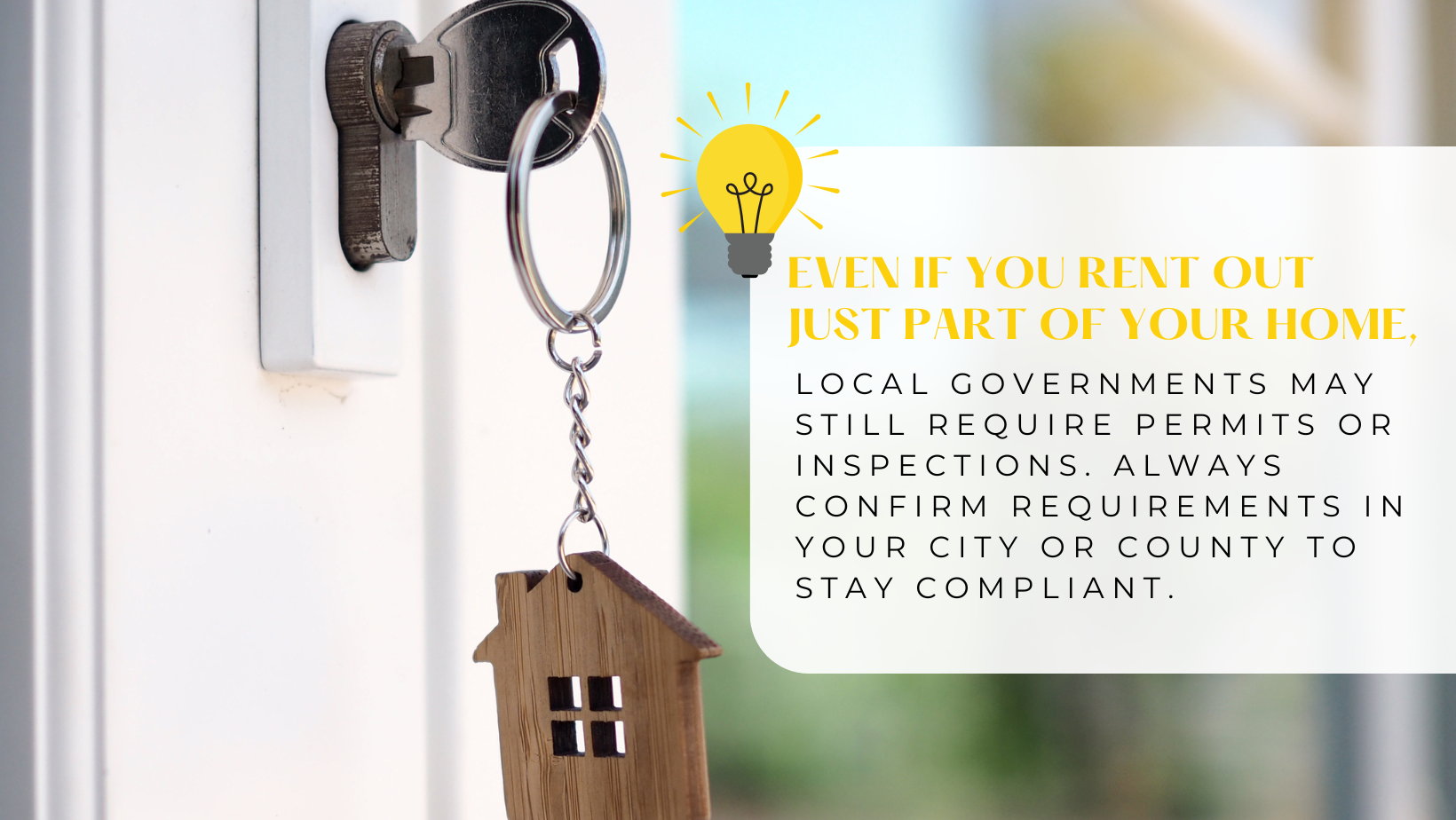
While these are statewide rules, each city or county may impose additional permits, zoning restrictions, or occupancy limits. Property owners must comply with both state laws and local ordinances.
Timeshares are excluded.
Timeshares fall under the Florida Vacation Plan and Timesharing Act, which has its own licensing, tax, and usage requirements. Because they operate under shared ownership agreements, timeshares are not treated as vacation rentals under Chapter 509 and do not require a vacation rental license in Florida.
If your property qualifies as a short-term rental, you must register with the DBPR, which issues two types of licenses:
- Vacation Rental Condos – for condo or cooperative units
- Vacation Rental Dwellings – for single-family homes or multi-unit properties (up to four units)
Home-Share Exemption
Florida law makes a distinction for home-sharing arrangements. If you are only renting out a portion of your primary residence while living on-site as the host, the state’s STR definition does not apply.
For example, if you list multiple individual rooms in your home on Airbnb, you may bypass state-level STR licensing requirements.
Do I Need a License to Rent Out My Property in Florida?
Yes. Under Florida short-term rental laws 2026, you must obtain a vacation rental license in Florida if you rent your property for less than 30 days per stay and more than three times per year.
This applies whether you list a condo in Orlando for weekend stays, manage multiple townhomes near Disney, or rent out a single-family home in Kissimmee during peak travel seasons.
As long as the property is offered for short-term stays more than three times annually, it must be licensed with the Florida Department of Business and Professional Regulation (DBPR).
Types of DBPR Licenses
The DBPR issues two main license types:
- Vacation Rental Condos – For units within a condominium or cooperative.
- Vacation Rental Dwellings – For single-family homes or multi-unit properties with up to four units.
Licenses can be set up as a single license for one property, a group license for multiple units in the same building, or a collective license that covers several properties under one management entity—ideal for owners with multiple listings.
What You Need to Apply
Owners must provide:
✅ Proof of property ownership
✅ Basic property details (address, unit type, and guest capacity)
✅ A Human Trafficking Awareness Training Certificate (required for staff involved in guest-facing services)
✅ A Balcony Inspection Certificate for properties three stories or taller
Don’t Forget Local Permits
Even with a DBPR license, local governments can require a Business Tax Receipt (BTR), zoning verification, or even a public hearing before granting approval.
Florida Short-Term Rental Compliance Checklist
Getting your DBPR license is just one step. Here’s everything you need in place before accepting your first booking.
Complete Before Your First Booking
- DBPR vacation rental license ($170 license + $50 application + $10 HEP fee = $230/yr). Apply at myfloridalicense.com. Clears in 1–2 business days online.
- Florida Department of Revenue registration (separate from DBPR). Required for collecting and remitting the 6% state sales tax. Register at floridarevenue.com.
- County Tourist Development Tax (TDT) registration. Filed separately with your county tax collector. Rates range from 2% to 6% depending on the county.
- Local Business Tax Receipt (BTR). Required by most cities and counties. Fees and requirements vary by jurisdiction.
- Human Trafficking Awareness Training for any staff involved in guest-facing services.
- Safety compliance: working smoke detectors, fire extinguishers, pool barriers (if applicable), and balcony inspection certificate (3+ stories, renewed every 3 years).
- Dedicated STR insurance. Standard homeowner’s policies do not cover short-term rental activity. Get coverage before your first guest.
⚠️ DBPR and DOR are separate.
Registering with the Florida Department of Revenue for tax purposes and getting your DBPR license are two completely different processes. Both must be active before your first booking. Treating them as one step is one of the most common (and expensive) mistakes new hosts make.
What Are the New Rules for Airbnb in Florida in 2025?
Florida short-term rental laws 2025 introduce several changes that affect Airbnb hosts statewide.
One key update is a new 24-hour cancellation window for bookings made at least seven days in advance, along with a shift from Airbnb’s “Strict” to the more flexible “Firm” cancellation policy.
Another major change is that advertising platforms like Airbnb must now collect and remit state and local taxes, including the 6% state transient rental tax and applicable county surtaxes. The Florida Department of Business and Professional Regulation (DBPR) is also developing a statewide database of licensed vacation rentals, increasing compliance checks.
Although Senate Bill 280 attempted to centralize regulations, it was vetoed in 2024, meaning local governments still control zoning, occupancy caps, and permits. These Florida Airbnb laws vary widely by city:
- Orlando: Only allows home-sharing; entire-home rentals need special approval.
- Miami Beach: STRs are limited to certain districts and require a DBPR license, Business Tax Receipt, and Resort Tax Certificate.
- Destin: Occupancy capped at two guests per bedroom plus four additional people.
- Clearwater: Prohibits STRs under 30 days in most residential zones.
Potential Future Changes
Florida’s short-term rental landscape may shift again in the coming years. Lawmakers could revisit statewide regulation efforts similar to SB280 in 2025–26, aiming to unify rules across the state.
Meanwhile, many local governments are tightening zoning, permit, and occupancy requirements each year. Because these changes can happen quickly, working with an experienced property management company helps owners stay compliant, avoid penalties, and adapt to new regulations without stress.
How Florida Vacation Rental Rules Differ by County
This is where most owners get tripped up. Florida has a three-layer regulatory system: state laws apply everywhere, state preemption limits what cities can restrict, and local rules vary wildly by location.
The 2011 preemption framework is still the baseline in 2026. Cities and counties cannot ban vacation rentals outright or regulate how often or how long you rent, unless they had ordinances in place before June 1, 2011. Those pre-2011 rules are grandfathered and still enforceable.
| Location | STR Allowed? | Key Requirements | Total Tax Rate |
|---|---|---|---|
| Osceola County (Kissimmee) | Yes, in designated overlay areas | DBPR license + county registration + local contact person. Celebration prohibits STRs entirely. | 13.5% |
| Orange County (Orlando) | Home-sharing only in city limits | DBPR license + BTR. Entire-home rentals in Orlando city need special approval. Unincorporated Orange County is more permissive. | 12.5% |
| Polk County (Davenport) | Yes, in resort communities | DBPR license + BTR. Most vacation rental communities are zoned for STR use. | 12% |
| Miami-Dade (Miami Beach) | Limited to specific zones | DBPR license + County Certificate of Use + BTR + Resort Tax Certificate. Four separate credentials are needed. | 13% |
| Okaloosa County (Destin) | Yes, with occupancy caps | DBPR license + BTR. Occupancy capped at two guests per bedroom + four additional. | 11.5% |
| Pinellas County (Clearwater) | Restricted in residential zones | DBPR license + BTR. Clearwater prohibits STRs under 30 days in most residential zones. | 12% |
📍 Central Florida owners:
If your property is in Osceola or Polk County within an established resort community—such as Reunion Resort, ChampionsGate, Solara, or Solterra—zoning is typically not an issue. These communities were built specifically for short-term rental use. But always verify your HOA rules before listing.
Taxes, Insurance & Compliance
Operating a short-term rental in Florida isn’t just about having a great listing—it also means staying on top of taxes, insurance, and safety requirements.
State & Local Taxes
Florida short-term rental laws 2025 require hosts to collect and remit several taxes:
- 6% State Sales Tax – applies to all vacation rentals.
- 0.5%–1.5% Discretionary Surtax – varies by county.
- County Tourist Development Tax (Bed Tax) – ranges from 2% to 6%, funding local tourism programs.
Airbnb and Vrbo may collect some state taxes automatically, but hosts remain responsible for local and federal filings.
⚠️ Platform tax collection is not complete.
Airbnb collects the 6% state transient rental tax in all Florida counties, but only collects the county Tourist Development Tax in 22 counties where it has direct agreements (Osceola and Orange are covered). Vrbo does not collect any Florida taxes. If you list on multiple platforms, you need to track which taxes are covered and which you owe directly to the county tax collector.
Federal Taxes and Deductions
If you rent your property for more than 14 days per year, the IRS classifies it as a business. Owners can deduct expenses like:
- Repairs and maintenance
- Utilities and insurance
- Marketing and management fees
- Depreciation through strategies like cost segregation
Keeping accurate records and consulting a tax professional can help maximize savings.
Insurance & Liability
Standard homeowner policies usually do not cover short-term rental activities. Hosts should secure dedicated STR insurance to protect against property damage, guest injuries, or lawsuits. Platforms like Airbnb provide limited protection, so personal coverage is essential.
Safety & Compliance
Florida requires hosts to meet safety standards, including:
- Smoke detectors and fire extinguishers
- Balcony inspections every three years for buildings over three stories
- Proper pool barriers and posted emergency contacts (if applicable)
5 Common Mistakes That Cost Florida STR Owners Thousands
I’ve helped over 100 property owners get compliant in Central Florida. These are the mistakes I
see most often.
How a Property Management Company Makes Compliance Easy
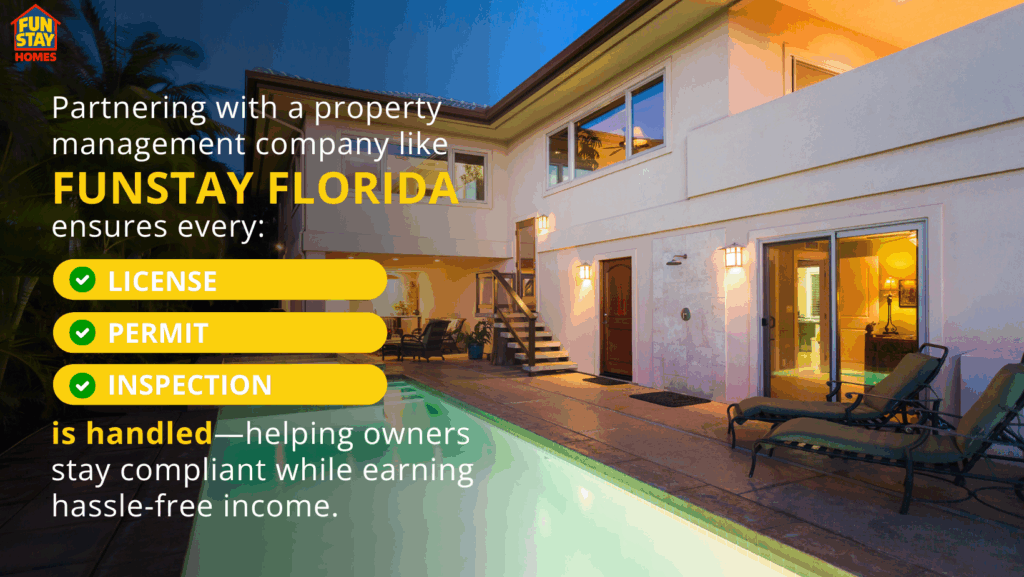
Managing a short-term rental in Florida can be overwhelming with licenses, taxes, and strict local rules. Partnering with a professional company like FunStay Florida takes the hassle out of hosting while keeping you compliant and profitable.
FunStay handles every detail that can otherwise lead to fines or permit issues, including DBPR licensing, Business Tax Receipt renewals, inspections, and tourist tax reporting.
What FunStay Does for You:
- Listing optimization across Airbnb, Vrbo, and other platforms to boost visibility and bookings.
- Dynamic pricing strategies that adjust nightly rates based on demand and seasonality.
- Guest screening, check-ins, and 24/7 support to ensure five-star stays and fewer disputes.
- Full compliance support, including license applications, BTR renewals, tax collection setup, and safety inspections.
- Maintenance and cleaning coordination so your home stays guest-ready year-round.
With a local Superhost-led team, FunStay also helps owners avoid HOA conflicts, zoning mistakes, and costly fines, making short-term rental ownership truly stress-free.
Need help staying compliant?
FunStay Florida handles DBPR licensing, BTR renewals, tax registration, safety inspections, and everything in between. Our portfolio averages 77% occupancy across Central Florida.
Frequently Asked Questions
