

The Search Is Easy. The Selection Is Hard.
Zillow shows 70+ listings tagged “short-term rental” in Orlando right now. Redfin shows over 100. The inventory is there. You can scroll through pool homes in Kissimmee, condos near the Convention Center, and brand-new townhomes in Davenport, all before lunch.
But here’s what the listing photos won’t tell you: which of those properties will actually make money, and which ones will quietly drain your savings for years.
Finding short-term rental properties for sale in Orlando is not the hard part. The hard part is knowing which ones to buy. That requires understanding zoning, community performance, amenity packages, HOA restrictions, and the difference between a listing that looks good and a property that books well.
This guide is written from the operator’s side of the business. At FunStay Florida, we manage over 100 vacation rentals across Orlando, Kissimmee, and Davenport. We see what happens after the purchase: which properties fill calendars and which ones sit empty. That perspective shapes everything you’re about to read.
Start with Zoning, Not with Zillow
The most expensive mistake in Orlando’s vacation rental market is buying a beautiful home that can’t legally operate as an Airbnb. It happens more often than you’d think.
Unincorporated Orange County is more flexible; entire-home rentals are allowed in both residential and commercial zones, and the owner-occupancy rule does not apply. Osceola County (which includes Kissimmee) restricts STRs to designated tourist zones. Polk County (which includes Davenport) requires a Class B Business Tax Receipt and DBPR license.
The safest path for investors? Buy in an STR-approved resort community. These are master-planned developments specifically zoned for vacation rentals. The HOA allows short-term guests, the community is built around amenities that attract tourists, and the infrastructure supports high-turnover rental operations. That’s where your search should begin, not on a general real estate portal.
The Three Areas That Actually Matter for STR Investors
Orlando’s vacation rental market is three markets wearing the same name. Each attracts different buyers, guests, and returns.
Kissimmee: The Premium Play
If someone says they bought a “Disney vacation home,” they almost certainly bought it in Kissimmee. It’s 10 to 15 minutes from the theme park gates, packed with world-class resort communities, and commands the highest demand from tourist guests searching Airbnb and Vrbo.
In 2026, standalone pool homes in Kissimmee resort communities average around $525,000. Established communities like Windsor Hills trade closer to $600,000. Storey Lake townhomes sit around $500,000 with condos in the $300,000s. Reunion Resort spans the full spectrum, from $300,000 condos to custom estates well over $1 million.
The top-performing Kissimmee communities for investors include Windsor Hills, Storey Lake, Windsor at Westside, Solara Resort, Reunion Resort, and Magic Village. Each has resort-level amenities, lazy rivers, water slides, and clubhouses that actively drive bookings.
Davenport: The Value Play
Drive another 15 minutes southwest on I-4, and you cross into Davenport. The trade-off is the commute of 20 to 30 minutes to Disney instead of 10, but you get significantly more house for your money. Single-family homes in Davenport resort communities average around $480,000. You can often find a newer, larger home here for the same price as an older, smaller one in Kissimmee.
ChampionsGate is the crown jewel of Davenport, with golf courses and a water park that make it a destination unto itself. Five-to-eight-bedroom pool homes typically list between $500,000 and $700,000. For entry-level investors, Regal Palms offers townhomes in the $250,000 to $270,000 range. Windsor Island Resort and Solterra Resort round out the top choices with modern construction and strong amenities packages.
Orlando Proper: The Condo Play
Orlando itself has strict zoning, which limits most vacation rental activity to condo-hotels and designated areas near Universal Studios and the Convention Center. The median price for all property types is around $372,000. Vista Cay is the standout, a rare legal STR pocket in the heart of Orlando, positioned next to the Orange County Convention Center and the upcoming Epic Universe. Three-bedroom units there list between $450,000 and $600,000.
Orlando condos are ideal for investors who want to target both vacationers and business travelers, but the trade-off is smaller units and HOA structures that require scrutiny.
What Separates a Good STR Property from a Bad One
After managing over 100 vacation rentals, we’ve seen patterns that Zillow can’t show you. The properties that consistently outperform share traits that have nothing to do with the listing price.
Amenities drive bookings
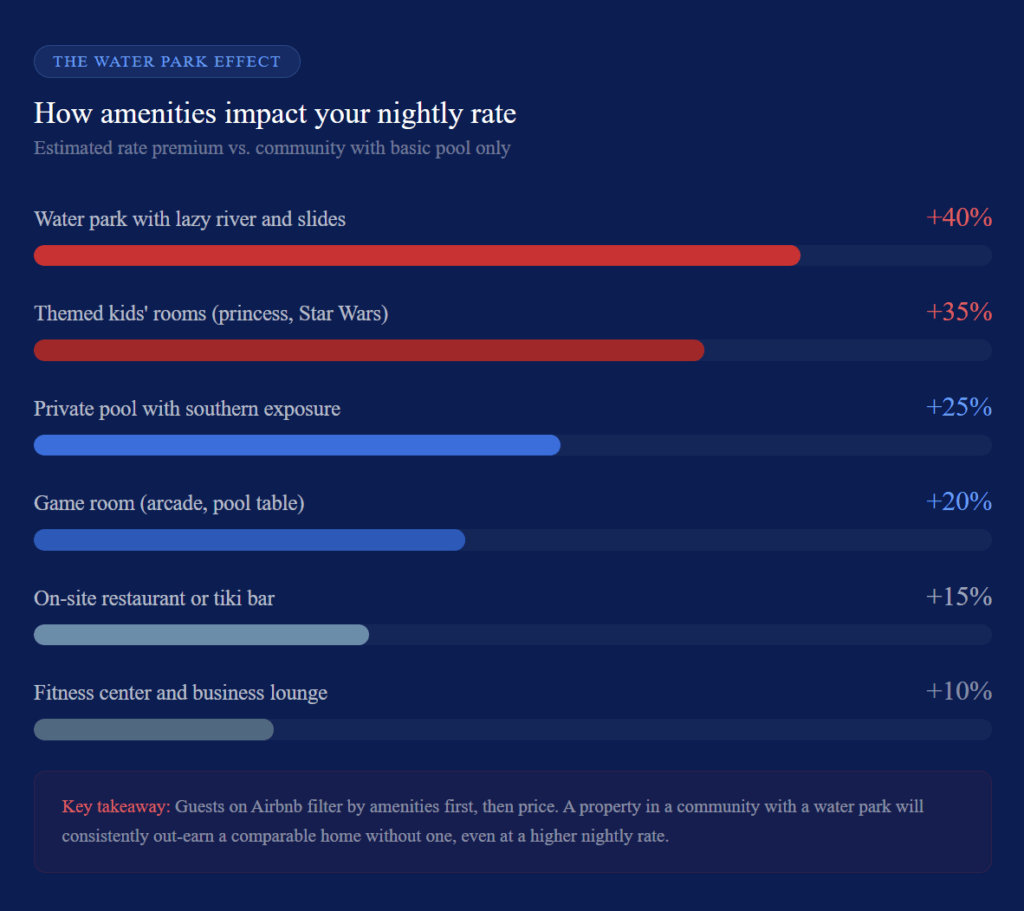
Communities with lazy rivers, water slides, and clubhouses command higher nightly rates. We call it the “water park effect”. It directly impacts your annual revenue.
Floor plan over square footage
Open-concept layouts, pool views from the living area, and themed kids’ rooms are booking magnets. A well-designed 5-bed outperforms a poorly laid out 7-bed.
Proven track record wins
A property booking 40 weeks/year with visible reviews has quantifiable value. New construction with zero rental history is a gamble with a different risk profile.
HOA rules can kill your deal
Some HOAs have buried restrictions: minimum stay requirements, guest registration processes, or rental frequency caps. Always review CC&Rs before making an offer.
The 5-Step Process for Finding and Vetting an STR Property
Whether you’re a first-time buyer or adding to an existing portfolio, this is the framework we recommend to every investor we work with.
Step 1: Confirm the community allows short-term rentals
Verify zoning district and jurisdiction. Check the HOA’s CC&Rs for STR provisions. Confirm there are no pending ordinance changes. If buying in the City of Orlando, understand the entire-home restriction.
Step 2: Run conservative revenue projections
Use actual performance data from comparable properties in the same community, not Airbnb calculator estimates. What’s the realistic ADR across all seasons? A property profitable at 80% occupancy might break even at a more realistic 65%.
Step 3: Analyze the total cost of ownership
Build a complete pro forma: mortgage, property taxes, insurance, HOA fees ($300–$600/mo), furnishing ($15K–$40K+), management fees (20–25%), utilities, maintenance, DBPR license (~$170/yr), and taxes (12–14.5% per booking).
Step 4: Visit the property and community in person
Photos lie. Check the clubhouse condition, pool area size, and actual drive time to Disney with tourist traffic. For remote buyers, work with an agent who provides honest video walkthroughs of both the property and the surrounding area.
Step 5: Set up licensing and management before your first guest
Get a DBPR license, register for state and county taxes, install safety equipment (smoke detectors, CO alarms, fire extinguishers), and invest in professional photography and listing optimization.
The Mistake That Costs Investors the Most Money
It’s not the property. It’s the agent.
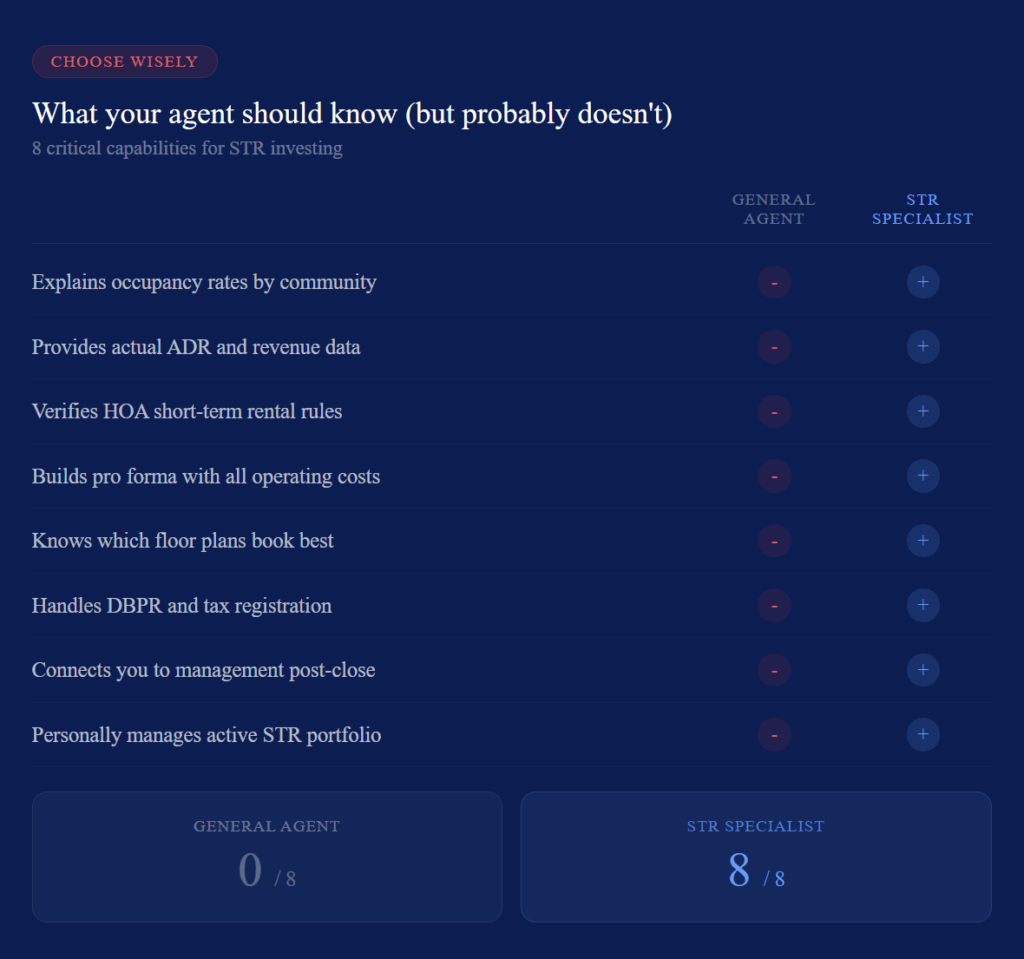
Most real estate agents in Orlando evaluate homes the traditional way: price per square foot, comparable sales, and curb appeal. But STR investors need entirely different metrics: occupancy rates, nightly rates, ADR trends, guest demand patterns, and net operating income after all expenses. If your agent can’t pull up those numbers with confidence, they’re guessing, and guessing in this market is expensive.
That last question is the one only an operator can answer. And it’s the question that separates a profitable investment from a regrettable one.
Why Investors Work with Mike Chen
Mike Chen is a Florida Licensed Realtor® at La Rosa Realty Celebration and the co-founder of FunStay Homes. He’s also an Airbnb Superhost with over 2,600 guest reviews, a 4.81-star rating, and ten years of hosting experience. He owns six vacation homes himself.
100+
Properties managed
2,600+
Guest reviews
37%
Higher revenue
19%
Higher occupancy
Frequently Asked Questions
1. How much does a vacation rental cost in Orlando in 2026?
Prices vary significantly by area. In Kissimmee, standalone pool homes in resort communities average around $525,000, with options ranging from $300,000 condos to luxury estates over $1 million. Davenport offers more houses for the money at around $480,000 on average, with entry-level townhomes starting near $250,000. Orlando proper is mostly condos, with a median around $372,000. The right price depends on your budget, target guests, and return expectations.
2. Can I buy an entire-home Airbnb in the City of Orlando?
Not in residential zones. The City of Orlando only allows owner-occupied home sharing, where you must live on-site at least 51% of the year and can only rent half your bedrooms. Entire-home vacation rentals are only permitted in commercial or mixed-use zones. However, unincorporated Orange County, Osceola County (in designated tourist zones), and Polk County all permit entire-home STRs with the proper licenses. This is why most investors buy in resort communities outside city limits.
3. What is the average ROI on an Orlando vacation rental?
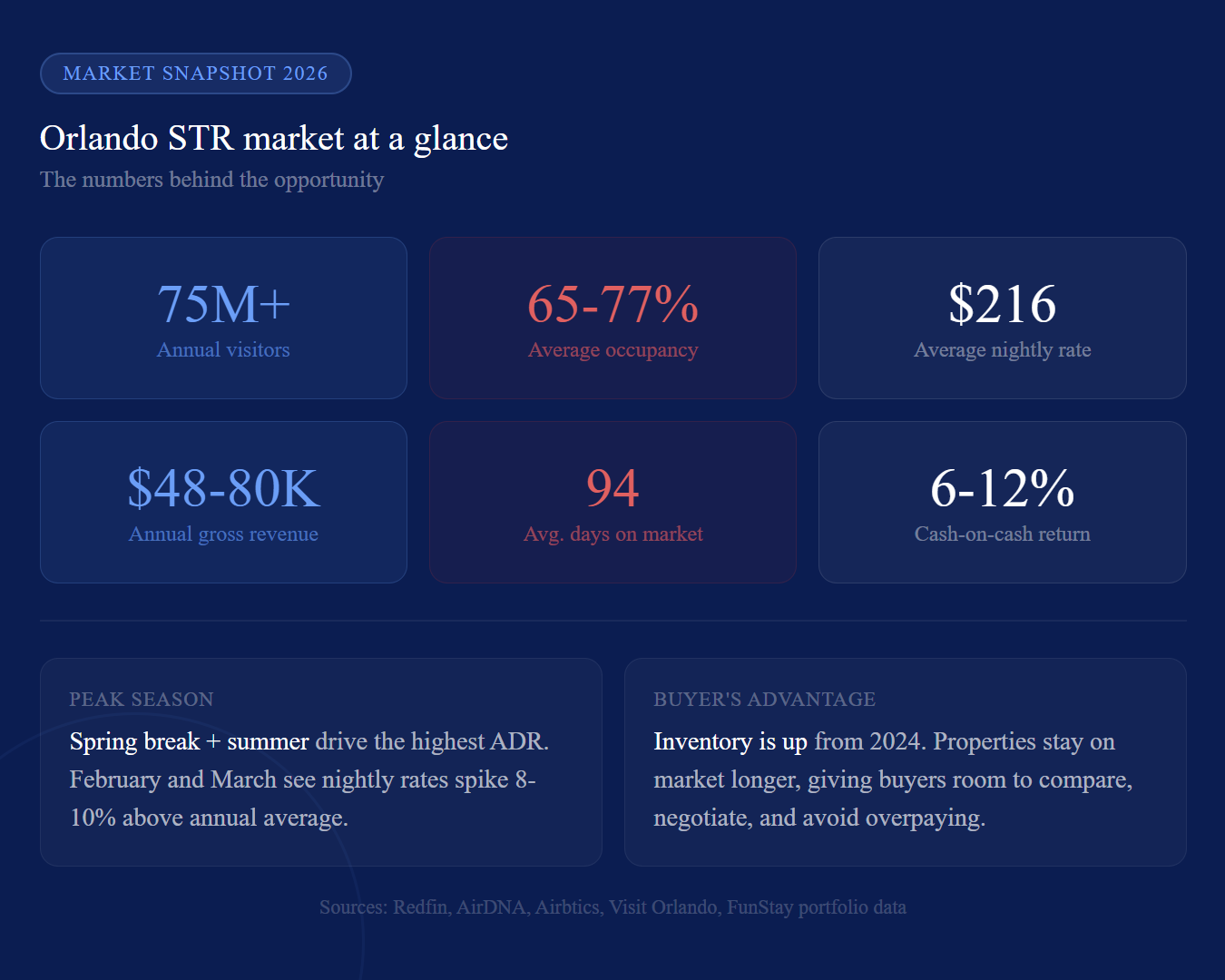
ROI depends on the property, community, and management quality. Orlando’s average STR occupancy sits around 65–77%, depending on the source and property type. Well-managed properties in top-performing communities can generate gross rental revenue of $48,000 to $80,000+ annually on a 2–to 4-bedroom property. After expenses, mortgage, HOA, management fees, taxes, insurance, utilities, and maintenance, net cash-on-cash returns of 6–12% are achievable with conservative underwriting. Properties managed by FunStay Florida consistently outperform market averages by significant margins.
4. Do I need a license to operate a short-term rental in Florida?
Yes. All vacation rentals under 30 days in Florida require a license from the Department of Business and Professional Regulation (DBPR), which costs approximately $170 per year for a single unit. You also need to register for state and county taxes, obtain any required local permits (fees vary by jurisdiction), and ensure your property passes safety inspections. Operating without proper licensing can result in fines starting at $250 per day and potential delisting from Airbnb and Vrbo.
5. Can I buy an STR property remotely from out of state?
Absolutely. A majority of Orlando’s STR investors are out-of-state or international buyers. The key is working with a Realtor who can act as your trusted representative on the ground, providing detailed video tours, handling inspections, navigating zoning verification, and managing the entire process remotely. Mike Chen’s clients include investors from across the U.S. and internationally, and he offers bilingual service in English and Mandarin for international buyers.
6. How do I find an Airbnb-specialized real estate agent in Orlando?
Look for an agent who doesn’t just sell properties but actively operates in the STR market. Ask whether they can provide real occupancy and revenue data for the communities they recommend. Ask whether they manage vacation rentals themselves. Ask whether they can build a conservative pro forma that includes management fees, HOA costs, taxes, and furnishing, not just the purchase price and a revenue estimate. An agent who answers “I’ll need to find out” to those questions is probably not the right fit for an STR investment.