
Managing Florida vacation rental pool safety is one of the most important responsibilities for short-term rental owners in Central Florida. Mike Chen, founder of FunStay Florida and a licensed property manager overseeing more than 100 vacation rentals with pools across Orlando, Kissimmee, and Davenport, developed this guide from real compliance costs and operational data across our portfolio.
Pools sell bookings. In a market where family groups of 8 to 14 need outdoor space between theme park days, a private pool is often the deciding factor. But pools also create the single largest liability and maintenance line item on any vacation rental property. Annual pool ownership costs range from $1,910 to $5,400, and a single safety violation can result in lawsuits exceeding $1 million.
QUICK ANSWER
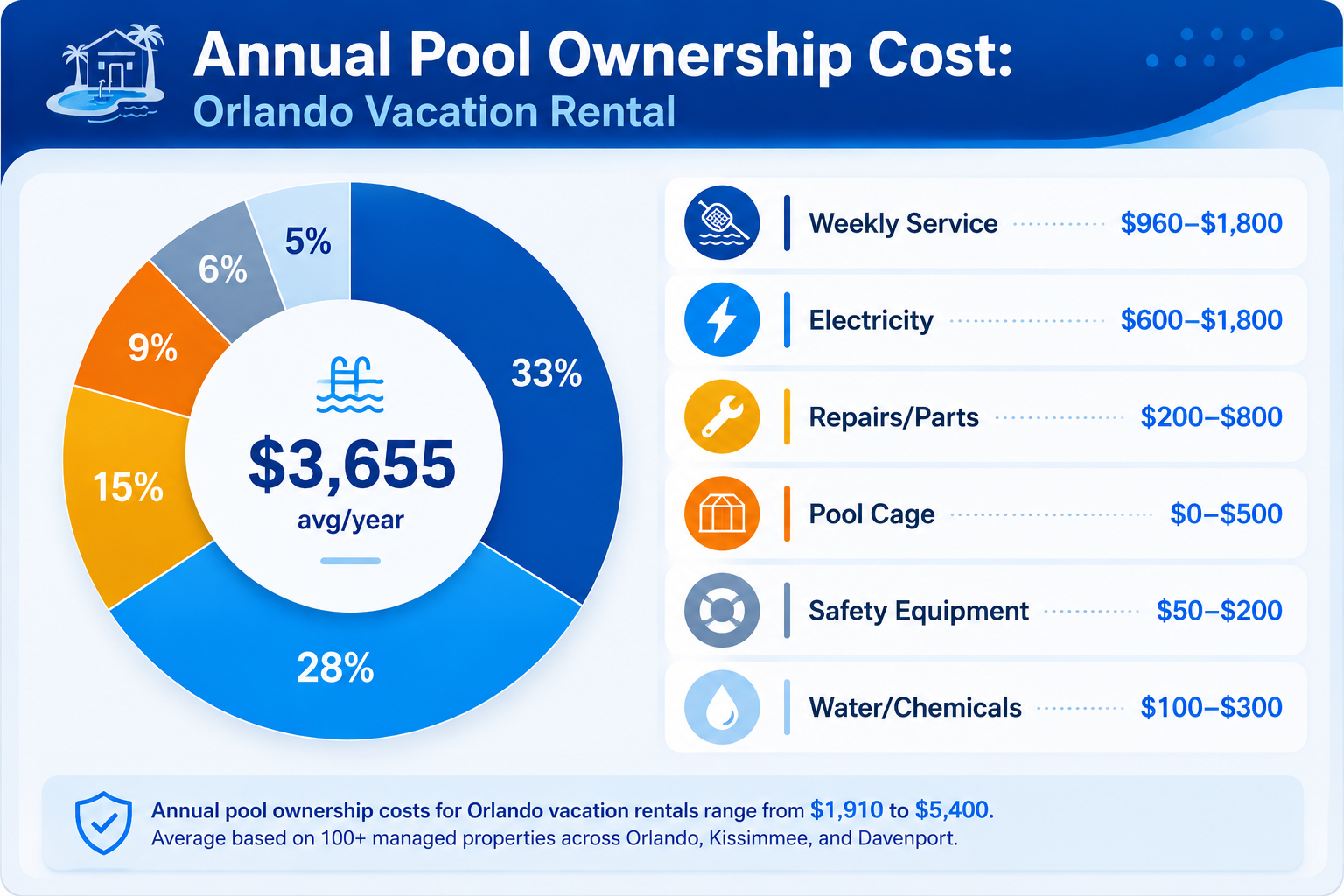
Florida vacation rental pool safety compliance requires at least one approved safety feature under Chapter 515 of the Florida Statutes. Annual pool costs for Orlando STRs range from $1,910 to $5,400, covering weekly service ($960 to $1,800/year), safety equipment ($50 to $200), electricity ($600 to $1,800), and repairs. Three proposed bills (HB 79, SB 658, SB 244) that would have expanded vacation rental pool requirements all died in the 2026 legislative session, but existing law still requires compliance and reintroduction is expected.
$1,910 – $5,400
Annual pool ownership cost for Orlando STRs
112
Fatal child drownings in Florida (2025)
$1.3M
Recent Airbnb pool lawsuit settlement
Florida Pool Safety Laws: What Applies Now and What’s Coming Next
Florida’s pool safety requirements for vacation rentals are governed by the Residential Swimming Pool Safety Act, codified in Chapter 515 of the Florida Statutes. Under Section 515.27, every residential swimming pool must have at least one of five approved safety features. Section 515.29 sets specific requirements for pool barriers, including a minimum height of 4 feet, self-closing and self-latching gates, and a latch release at 54 inches above the ground.
These requirements apply to pools permitted after October 1, 2000, when the Act took effect. For older pools, the safety features become mandatory at the point of property sale or transfer. In practice, nearly every Orlando vacation rental community built within the last 25 years falls under these requirements, and most resort-style communities like ChampionsGate, Reunion, and Solara enforce their own pool safety rules through HOA covenants that often exceed state minimums.
What HB 79 Would Have Changed
In the 2026 legislative session, Florida lawmakers introduced HB 79 and its Senate companion SB 658, which proposed new pool safety requirements targeting vacation rentals specifically. The bills would have amended Section 509.211 of the Florida Statutes to require any licensed vacation rental with a swimming pool or body of water within 150 feet to have at least one approved safety feature per Section 515.27. Critically, the bills would have tied compliance directly to the DBPR vacation rental license, creating an enforcement mechanism that does not exist under current law.
SB 658 passed the Florida Senate unanimously. However, both bills died in the House on March 13, 2026. A separate bill, SB 244, which addressed residential pool requirements at the point of sale, also died in the Senate Regulated Industries Committee on the same date.
Why this still matters:
All three bills dying in the same session does not mean the issue is going away. Florida recorded 112 fatal child drownings in 2025, the highest number on record and the highest rate in the nation. Drowning remains the number one cause of unintentional death for children ages 1 to 4 in Florida. Legislative pressure will intensify, and these bills are expected to be reintroduced. The smart approach is to comply now rather than wait for enforcement to catch up.
The Liability Reality
Even without HB 79’s expanded enforcement, the legal exposure for non-compliant pools is severe. In 2024, a Virginia family was awarded $1.3 million after 16-year-old Cameron Brown drowned in a vacation rental pool in Orange Park, Florida. The pool lacked basic safety features: no depth markers, no safety line between the shallow and deep ends (a $100 item), no exit alarms, and no protective fence. Pool-related incidents are a leading source of vacation rental insurance claims, and juries in Florida have shown increasing willingness to hold property owners and platforms accountable.
Florida Pool Safety Compliance Checklist
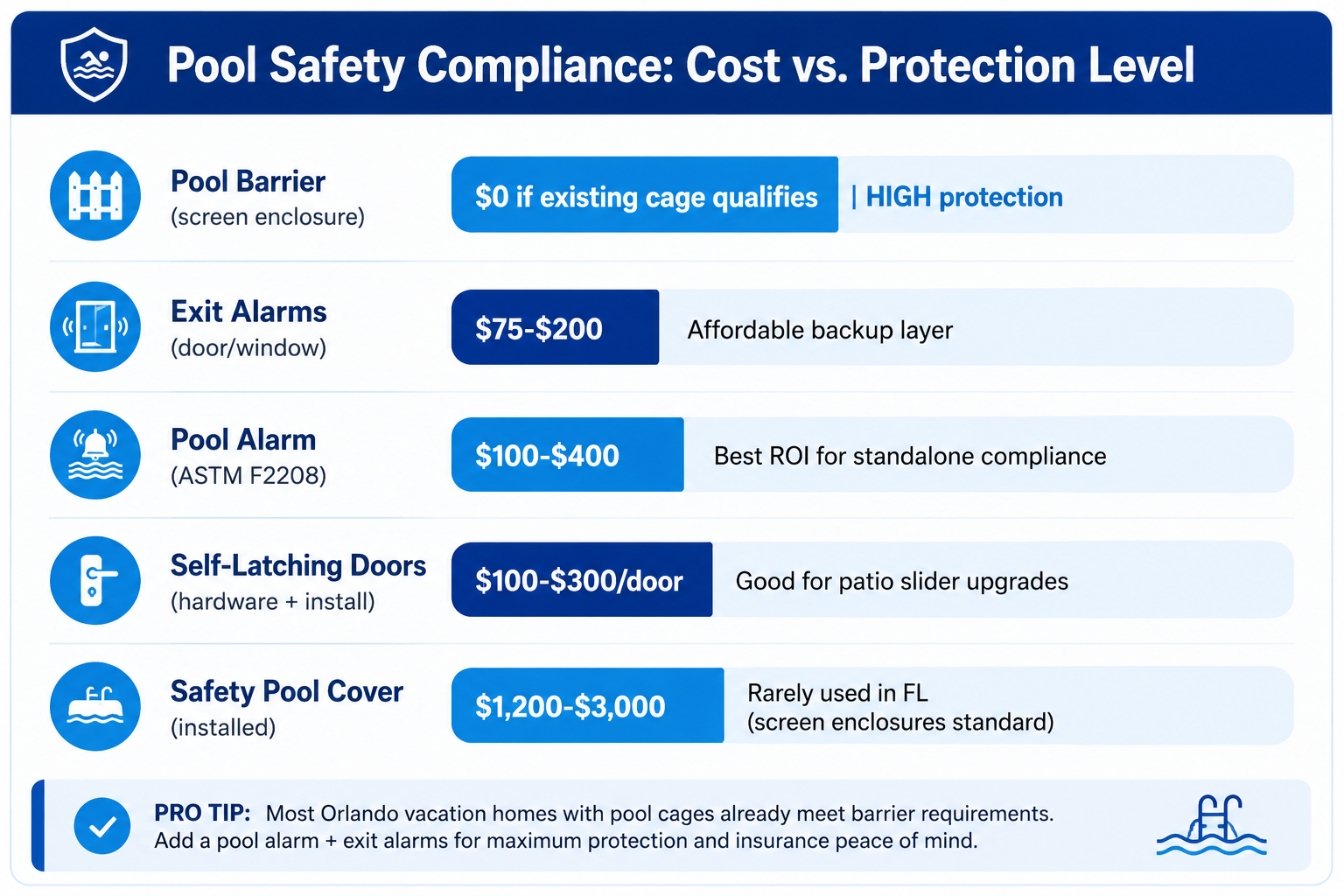
Meeting Florida vacation rental pool safety requirements starts with choosing at least one of the five approved safety features under Section 515.27. Our recommendation for vacation rental owners is to install at least two: a pool barrier (since most Orlando vacation homes with pool cages already satisfy this) plus a pool alarm for added protection and the strong signal it sends to insurers and guests.
Pool Barrier (Fence/Enclosure)
$0 (most FL homes already have pool cages)
Minimum 4 feet high, no climbable gaps, self-closing/self-latching gate, latch at 54″ minimum per Section 515.29. Florida pool screen enclosures typically satisfy this requirement.
Approved Safety Pool Cover
$1,200 – $3,000 installed
Must support the weight of a child and meet ASTM safety standards. Less common in Florida vacation rentals because screen enclosures are standard.
Exit Alarms (Doors/Windows)
$25 – $50 per door/window
Required on all doors and windows with direct pool access. Must produce minimum 85 dB at 10 feet. Affordable and easy to install as a second layer.
Self-Closing, Self-Latching Doors
$100 – $300 per door (hardware + install)
Release mechanism must be 54+ inches above the floor. Applies to all doors with direct access to the pool area.
Swimming Pool Alarm (ASTM F2208 Certified)
$100 – $400 per unit
Four types available: Type A (surface/floating), Type B (subsurface), Type C (perimeter), Type D (personal immersion). The Poolguard PGRM-SB2 ($200 to $300) is the only floating alarm with NSF certification to ASTM F2208. Lifebuoy BCONE ($250 to $400) adds Wi-Fi and smartphone alerts.
From our portfolio: We install Poolguard subsurface alarms and exit alarms on all pool-access doors as standard practice across our managed properties. Combined cost is under $400 per property, and the combination satisfies both the Florida statute and common insurance requirements. This is one of the most cost-effective safety investments an owner can make.
How Much Does Pool Maintenance Cost for an Orlando Vacation Rental?
Pool maintenance is one of the largest recurring expenses in management costs for any Orlando vacation rental. Unlike northern markets with a winter shutdown period, Central Florida pools run year-round. That means 52 weeks of chemical balancing, cleaning, and equipment monitoring with no off-season break.
Monthly Service Costs by Level
| Service Level | Monthly Cost | Annual Cost | Best For |
|---|---|---|---|
| Basic chemical balance only | $40 – $60 | $480 – $720 | Owner-occupied second homes |
| Bi-weekly cleaning + chemicals | $50 – $90 | $600 – $1,080 | Low-occupancy rentals |
| Weekly full-service | $80 – $150 | $960 – $1,800 | STR standard (recommended) |
| Twice-weekly premium | $150 – $250 | $1,800 – $3,000 | High-turnover, 8+ guest properties |
Orlando’s subtropical climate makes pool chemistry more demanding than most markets. Intense UV breaks down chlorine faster, heavy bather loads from vacation rental guests throw off pH and alkalinity within two to three days, and summer algae growth requires proactive treatment. We recommend weekly full-service as the minimum for any active STR, with twice-weekly service for properties booking back-to-back during peak season (June through August and holiday weeks). Our maintenance service coordinates pool vendors alongside turnover teams so treatments never get skipped between bookings. Owners still managing cleanings and pool scheduling solo often miss chemical treatments during high-occupancy weeks, which is exactly when water quality issues are most likely to trigger guest complaints.
Annual Total Cost Breakdown
| Category | Low Estimate | High Estimate |
|---|---|---|
| Weekly service (cleaning + chemicals) | $960 | $1,800 |
| Repairs and replacement parts | $200 | $800 |
| Electricity (pump + heater) | $600 | $1,800 |
| Pool cage/screen maintenance | $0 | $500 |
| Safety equipment (alarms, signage) | $50 | $200 |
| Water and chemicals above service | $100 | $300 |
| Total Annual Pool Cost | $1,910 | $5,400 |
Equipment Replacement Costs
Beyond monthly service, owners should budget for equipment that wears out on a predictable cycle. Florida’s heat and humidity shorten equipment lifespans compared to northern climates.
| Equipment | Lifespan (FL Climate) | Replacement Cost |
|---|---|---|
| Pool pump | 8 – 12 years | $300 – $800 |
| Heat pump | 10 – 15 years | $3,500 – $6,500 |
| Pool filter | 5 – 10 years | $200 – $600 |
| Salt cell (saltwater pools) | 3 – 7 years | $200 – $900 |
| Pool alarm (ASTM F2208) | 3 – 5 years | $100 – $400 |
| Automatic pool cleaner | 5 – 8 years | $300 – $1,200 |
BUDGET
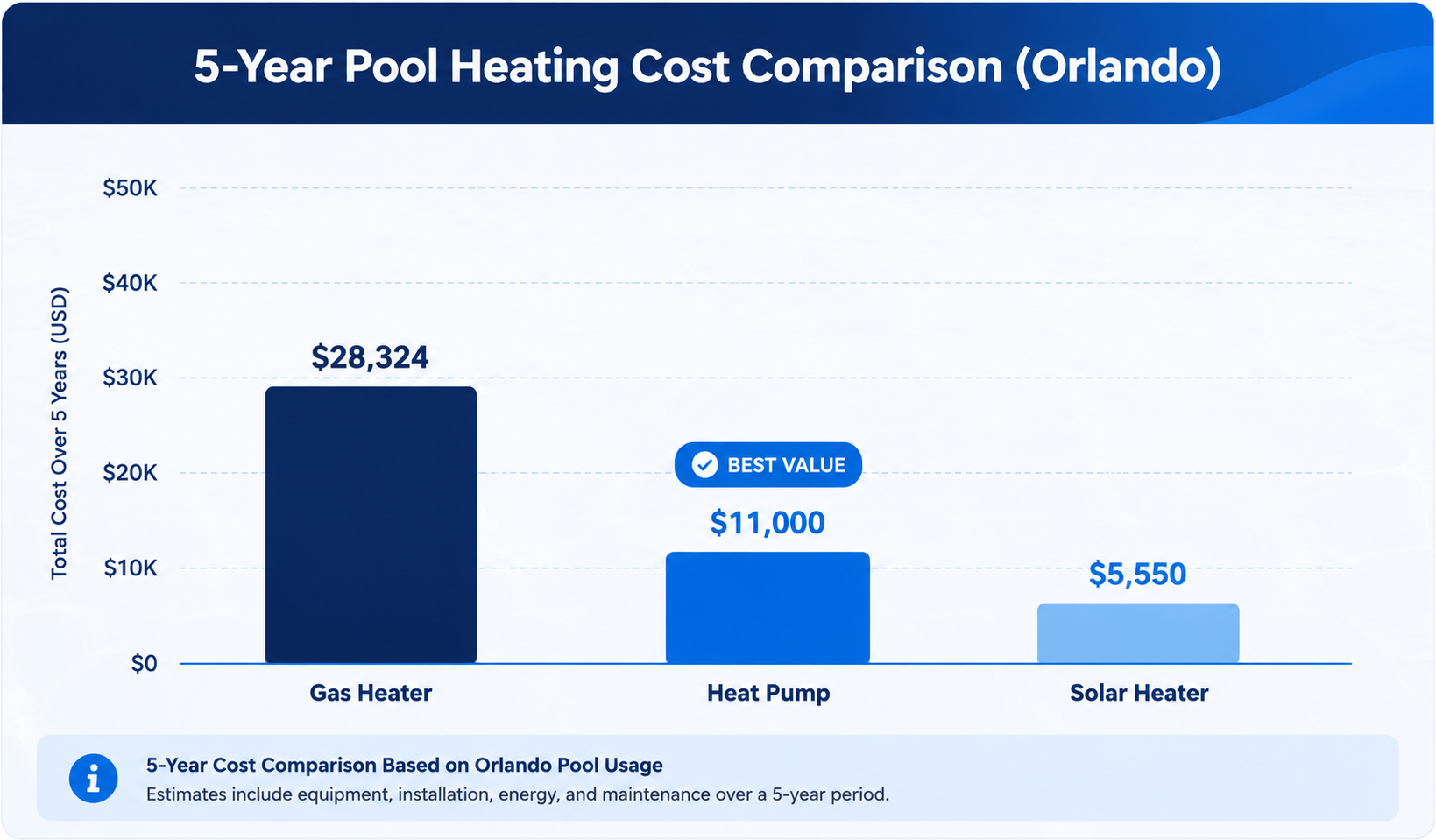
Gas Heater
Install: $1,730 – $6,918
Monthly: $200 – $600
Best for: Quick heat-up, occasional use during cooler months. Heats pool fastest but costs the most to run.
Most Popular
RECOMMENDED
Heat Pump
Install: $3,500 – $6,500
Monthly: $50 – $150
Best for: Year-round use, the standard in Central Florida. Lower operating costs offset higher upfront investment within 2 to 3 years.
LONG-TERM
Solar Heater
Install: $3,500 – $5,500
Monthly: $10 – $25
Best for: Maximum savings over 5 years. Only runs the circulating pump. Performance drops in cloudy stretches and winter months.
Guest Charging for Pool Heat
Most Orlando vacation rentals charge guests $25 to $35 per day for pool or spa heating. This is standard practice in the market and guests expect it, but the disclosure rules matter. Under Airbnb’s fee policy, pool heating charges must appear in the listing before the guest books. The charge cannot be added as a surprise fee after the reservation is confirmed. On Vrbo, the same principle applies: all fees must be disclosed upfront.
Practical tip: We list pool heating as an optional add-on in the booking process. Most guests in the October through March window opt in. During summer months (June through September), Orlando pool water temperatures typically reach 85 to 90 degrees without a heater, so the add-on is rarely needed. Spa heating remains popular year-round.
Pool Cage and Screen Enclosure Maintenance
Nearly every Orlando vacation rental with a pool has a screen enclosure, commonly called a pool cage. These aluminum-framed structures serve double duty: they satisfy the pool barrier requirement under Section 515.29 and they keep out debris, insects, and wildlife. Maintaining the cage is both a safety and a cost issue.
| Service | Cost | Notes |
|---|---|---|
| Full rescreening | $1,200 – $4,500 | $1.50 to $3.50 per square foot |
| Partial rescreening (few panels) | $200 – $800 | Common after storms or animal damage |
| Hurricane damage repair | $2,000 – $8,000+ | Structural frame damage adds cost |
| Post-hurricane wait time | 4 – 6 months | Contractor backlogs after major storms |
Hurricane season runs from June 1 through November 30 in Florida, and pool cages are among the most vulnerable structures on any property. Insurance typically covers hurricane damage under the wind/hail portion of the policy, but the separate hurricane deductible (usually 2% to 5% of the dwelling value) applies. Owners who carry proper licensing requirements and insurance can file these claims, but the 4- to 6-month contractor backlog after a major storm means lost revenue if the pool becomes unusable.
Maintenance tip: Pressure-wash pool cage frames once a year to prevent oxidation and screen deterioration. Inspect screens monthly for tears, especially at ground level where lawn equipment can nick panels. A small tear left unrepaired for a season turns into a full panel replacement.
Insurance and Liability for STR Pool Properties
Florida vacation rental pool safety is not just a compliance issue. It is an insurance issue. A standard homeowner’s insurance policy does not cover commercial rental activity, and properties with pools carry higher liability risk than those without. Here is what owners need.
Coverage Requirements
Short-term rental owners in Florida need a dedicated STR insurance policy with at least $1,000,000 in liability coverage. Properties with pools, hot tubs, and guest capacity above eight are classified in a higher general liability risk tier, which means higher premiums. An umbrella policy adding $1,000,000 in additional coverage typically costs $400 to $1,200 per year and is strongly advisable for any pool property.
What Insurers Expect
Insurance underwriters increasingly require documentation of pool safety compliance before issuing or renewing vacation rental policies. Common requirements include depth markers (even when not strictly required by local ordinance), pool fencing or barrier compliance photos, pool alarm documentation, safety signage posted at the pool, and proper disclosure language in the listing. Some carriers now request a completed pool safety inspection as part of the application, and properties without documented compliance face higher premiums or outright denial.
Our full-service management program handles pool safety documentation and insurance coordination as part of the standard service. This is one of the areas where working with property managers who understand Florida’s pool liability landscape makes a measurable difference.
Important: Airbnb’s Host Protection Insurance (AirCover) and Vrbo’s liability program are secondary coverage, meaning they only pay after the owner’s primary policy is exhausted. They also contain exclusions and caps that many owners do not read until after a claim. Relying on platform coverage alone for a pool property is a significant risk.
Seasonal Pool Care Calendar for Orlando Owners
Orlando pools run year-round, but maintenance priorities shift with the seasons. Pool decks, outdoor furniture, and tile surrounds need the same hotel-quality cleaning standards as the interior. Here is the seasonal care schedule we follow across our managed properties.
SPRING (MARCH – MAY)
Pre-peak season prep
Inspect and replace pool alarm batteries. Service heat pump before demand peaks. Deep-clean pool cage screens and frames. Test all safety features (gate latches, door alarms, barrier integrity). Schedule any needed rescreening before hurricane season backlogs begin.
SUMMER (JUNE – AUGUST)
Peak season + hurricane prep
Switch to twice-weekly pool service for high-turnover bookings. Monitor chlorine levels closely (UV breaks down chlorine faster in peak sun). Prepare hurricane pool plan: remove loose pool furniture, secure cage panels, know insurance claim process. Verify guest safety disclosures in all listings.
FALL (SEPTEMBER – NOVEMBER)
Post-hurricane assessment
Inspect pool cage for storm damage after each named storm. File insurance claims promptly for any hurricane damage. Return to weekly pool service as occupancy normalizes. Clean pool filter and backwash. Transition to pool heating add-on season (October onward).
WINTER (DECEMBER – FEBRUARY)
Holiday peak + heating season
Ensure heat pump or heater is functioning before holiday bookings. Monitor water temperature daily during cold snaps (rare freeze events can damage equipment). Reduce chemical dosing slightly for lower bather loads in January. Annual equipment inspection: pump, filter, heater, salt cell if applicable.
Pool Compliance Handled for You
FunStay Florida manages pool safety compliance, maintenance vendor coordination, and insurance documentation across 100+ properties in Orlando, Kissimmee, and Davenport. Get a free listing analysis to see how we protect your investment.
The Bottom Line on Pool Safety for Florida Vacation Rental Owners
Florida vacation rental pool safety is not optional, and the cost of non-compliance far exceeds the cost of doing it right. Annual pool ownership costs of $1,910 to $5,400 are a line item that every STR owner should budget for, and the safety equipment (under $400 for alarm and exit sensors combined) is one of the highest-ROI investments in the entire property.
The 2026 legislative session showed that stricter enforcement is a matter of when, not if. Three separate pool safety bills passed committees or full chambers before dying in the final weeks. With 112 child drowning fatalities in 2025 driving public pressure and lawsuits like the $1.3 million Orange Park settlement making headlines, the direction of regulation is clear.
After a decade of hosting in Orlando, we can confirm that owners who comply now, document their safety features, carry proper insurance, and maintain their pools to a professional standard are protected regardless of what the next legislative session brings. Those who wait are taking on risk that no rental income justifies.
For owners looking to understand the full scope of property management services that include pool compliance, or help choosing a management company that handles pool safety end to end, our team manages everything from vendor coordination to insurance documentation.
Frequently Asked Questions
What are the pool safety requirements for Florida vacation rentals?
Florida vacation rental pool safety requirements are governed by the Florida Residential Swimming Pool Safety Act (Chapter 515, F.S.). Section 515.27 requires at least one of five approved safety features: a pool barrier or fence at least 4 feet high, an approved safety pool cover, exit alarms on all doors with direct pool access (minimum 85 dB at 10 feet), self-closing and self-latching doors with hardware at 54 inches or higher, or a swimming pool alarm certified to ASTM F2208. Most Orlando vacation homes with existing screen enclosures already satisfy the barrier requirement.
How much does pool maintenance cost for an Orlando vacation rental?
Pool maintenance for an Orlando vacation rental costs $80 to $150 per month for weekly full-service cleaning and chemical balancing, which is the standard service level for short-term rentals. Total annual pool ownership costs range from $1,910 to $5,400, including weekly service, repairs, electricity, safety equipment, and pool cage upkeep. Orlando’s year-round pool season means there is no winter break from maintenance costs.
Do I need a pool alarm for my Airbnb in Florida?
A pool alarm is one of five approved safety features under Florida’s Residential Swimming Pool Safety Act. Owners must have at least one approved feature, and a pool alarm alone satisfies the requirement if it is certified to ASTM F2208. The Poolguard PGRM-SB2 ($200 to $300) is the only floating alarm with NSF certification to that standard. We recommend pairing a pool alarm with exit alarms on all pool-access doors for added protection and stronger insurance positioning.
What is HB 79 Florida pool safety?
HB 79 was a 2026 Florida bill that proposed requiring all licensed vacation rentals with a swimming pool or body of water within 150 feet to have at least one approved safety feature under Section 515.27. The bill would have tied compliance directly to DBPR vacation rental licensing and created civil liability for damages when safety features were missing. Both HB 79 and its Senate companion SB 658 died in the Florida House on March 13, 2026, but are expected to be reintroduced given that SB 658 passed the Senate unanimously.
How much does pool heating cost per month in Orlando?
Pool heating costs in Orlando range from $10 to $600 per month depending on the heating system. Electric heat pumps cost $50 to $150 per month to operate and are the most popular choice in Central Florida. Gas heaters cost $200 to $600 per month but heat water faster. Solar systems cost $10 to $25 per month in pump electricity only. Most vacation rentals charge guests $25 to $35 per day for pool heating as a disclosed optional add-on.
Does my homeowner’s insurance cover my vacation rental pool?
A standard homeowner’s insurance policy does not cover commercial rental activity, including vacation rental pool liability. Short-term rental owners in Florida need a dedicated STR policy with at least $1,000,000 in liability coverage. An umbrella policy adding $1,000,000 in additional coverage costs $400 to $1,200 per year and is strongly recommended for pool properties. Airbnb’s AirCover and Vrbo’s liability programs are secondary coverage only and should not be relied upon as primary protection.
What are the pool fence requirements in Florida?
Florida pool fence requirements under Section 515.29 of the Florida Statutes mandate a minimum height of 4 feet on the outside of the barrier, no gaps or openings that allow a child to crawl under or climb over, self-closing and self-latching gates that swing outward away from the pool, and a latch release mechanism at 54 inches minimum above the ground on the pool-facing side. Florida pool screen enclosures typically meet these requirements, but the gate latch height and self-closing mechanism should be verified.
How often should a vacation rental pool be cleaned?
Vacation rental pools in Orlando should be serviced at least once per week by a professional pool service, with twice-weekly service recommended for high-turnover properties during peak season. Orlando’s subtropical climate breaks down chlorine faster than northern markets, and heavy bather loads throw off pH and alkalinity within two to three days. Year-round pool use means there is no off-season for maintenance.
Can I charge guests for pool heating on Airbnb?
Charging guests for pool heating is standard practice in the Orlando vacation rental market, with most properties charging $25 to $35 per day. Under Airbnb’s fee policy, the charge must be disclosed in the listing before the guest books and cannot be added after the reservation is confirmed. The same disclosure rules apply on Vrbo and other booking platforms. Many owners list pool heating as an optional add-on during the booking process.
What happens if my vacation rental pool doesn’t meet safety code?
Non-compliance with Florida’s pool safety requirements creates both criminal and civil exposure. Violating Chapter 515 is a second-degree misdemeanor under Sections 775.082 and 775.083 of the Florida Statutes. Civil liability is the larger concern: in 2024, a $1.3 million settlement was awarded after a teenager drowned at an Orange Park, Florida Airbnb that lacked basic safety features like depth markers and exit alarms. Pool safety equipment typically costs under $400 total, making compliance far less expensive than a single claim.
