
I run 10+ Orlando vacation rentals across ChampionsGate, Windsor Hills, Reunion, and Davenport. Every single one is governed by the same invisible system: the Airbnb algorithm. Most owners think it’s a black box. It isn’t. After 10 years of testing what moves rankings (and what doesn’t), here’s the operator-level breakdown of how the Airbnb algorithm works in 2026, what Airbnb changed this year, and what owners need to do to actually rank.
QUICK ANSWER
How does the Airbnb algorithm work?
The Airbnb algorithm is a personalized machine-learning system that ranks listings based on each guest’s individual search behavior plus universal quality signals. The biggest universal factors in 2026 are: review quality and volume, response speed (sub-1-hour beats 24-hour), pricing competitiveness vs. similar listings, listing completeness (photos, amenities, description), wishlist saves, click-through rate, booking conversion rate, and the new Guest Favorites badge. Two guests searching the same dates and city will see different listings.
I’m going to skip the parts every other “Airbnb algorithm” guide covers in the first ten paragraphs. You don’t need another generic blog telling you to “respond fast” and “use good photos.” You need to understand how the Airbnb search algorithm actually decides which listings get shown, what changed in 2026, and what an experienced operator actually does about it. That’s what this is.
The Airbnb Algorithm Isn’t One Thing. It’s a Funnel.
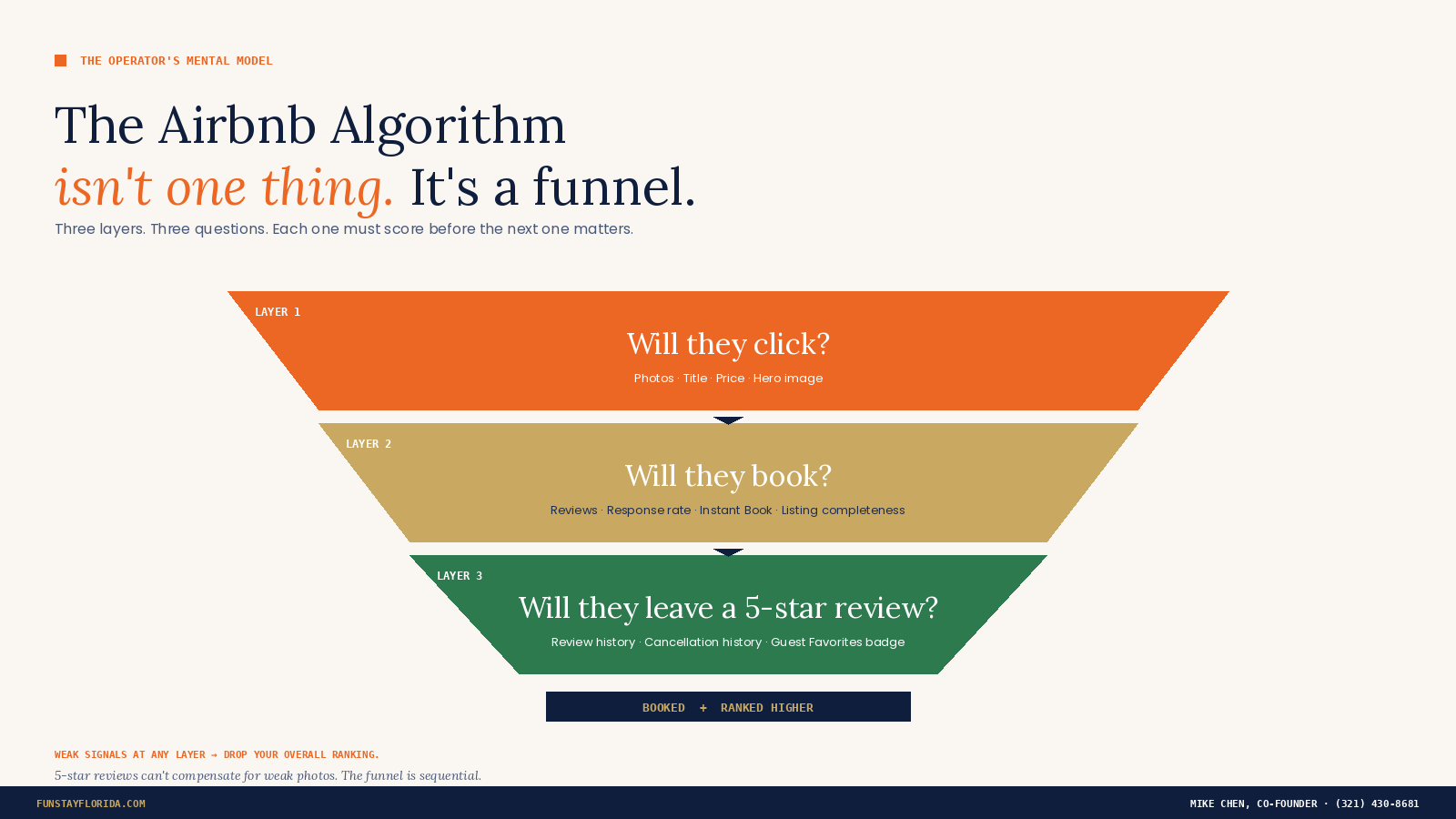
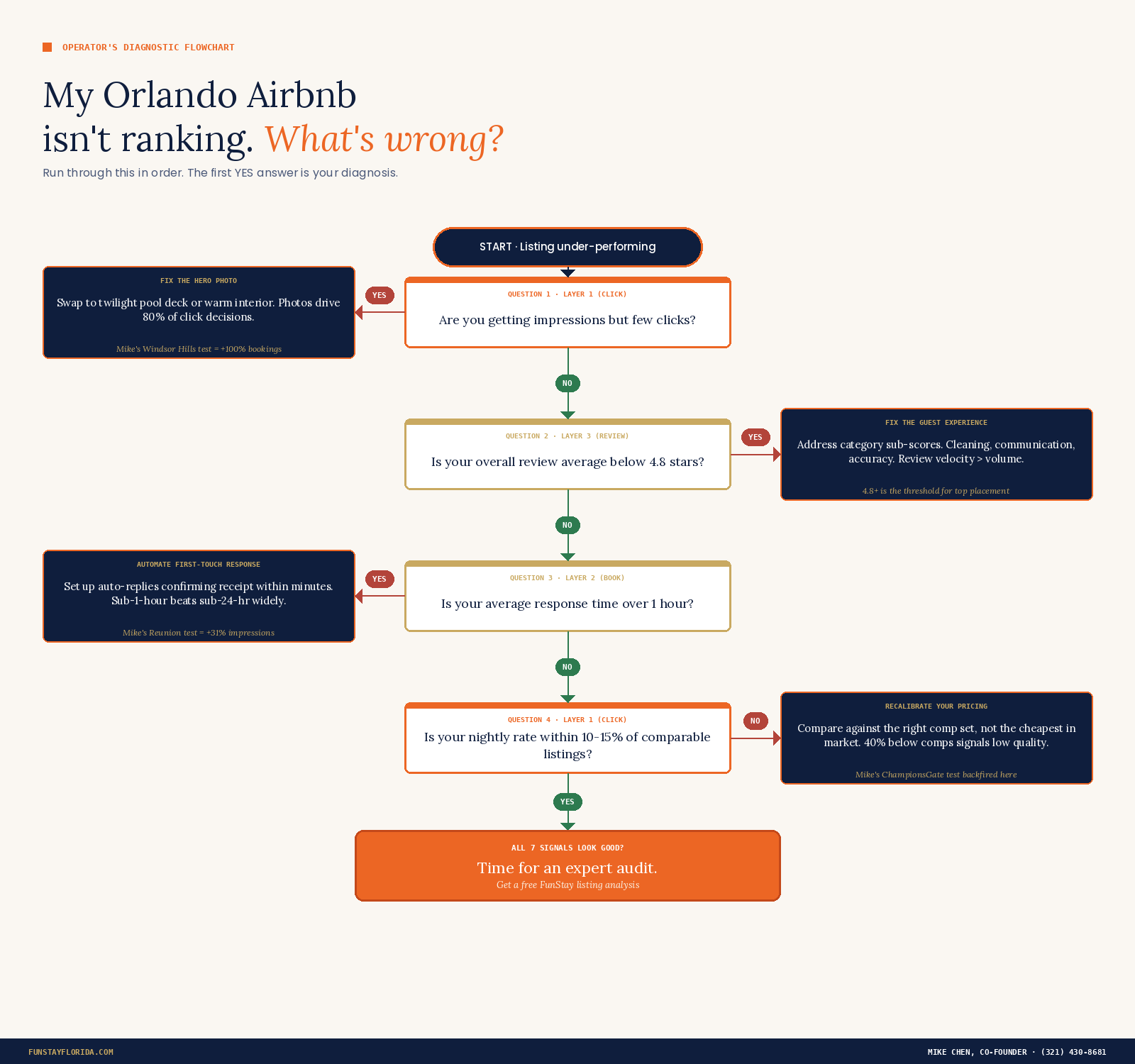
Here’s the mental model that took me years to build, condensed into one paragraph. The Airbnb search algorithm doesn’t rank listings from “best” to “worst.” It’s a funnel that scores every listing on its predicted probability of completing a successful booking for the specific guest doing the search. Three layers of evaluation happen in milliseconds:
- Layer 1: Will they click? Photos, title, price, hero image, location relevance.
- Layer 2: Will they book? Reviews, response rate, Instant Book status, calendar availability, listing completeness, amenities matching their filters.
- Layer 3: Will they leave a 5-star review? Review history, host cancellation history, Guest Favorites badge, response time consistency.
Your listing scores at every layer. Weak signals at any layer drop your overall ranking. This is why “I have 5-star reviews and I’m still not getting bookings” happens: strong Layer 3 signals can’t compensate for weak Layer 1 signals. If guests don’t click, the algorithm never gets to the booking decision.
The Big 2026 Changes Every Orlando Host Needs to Know
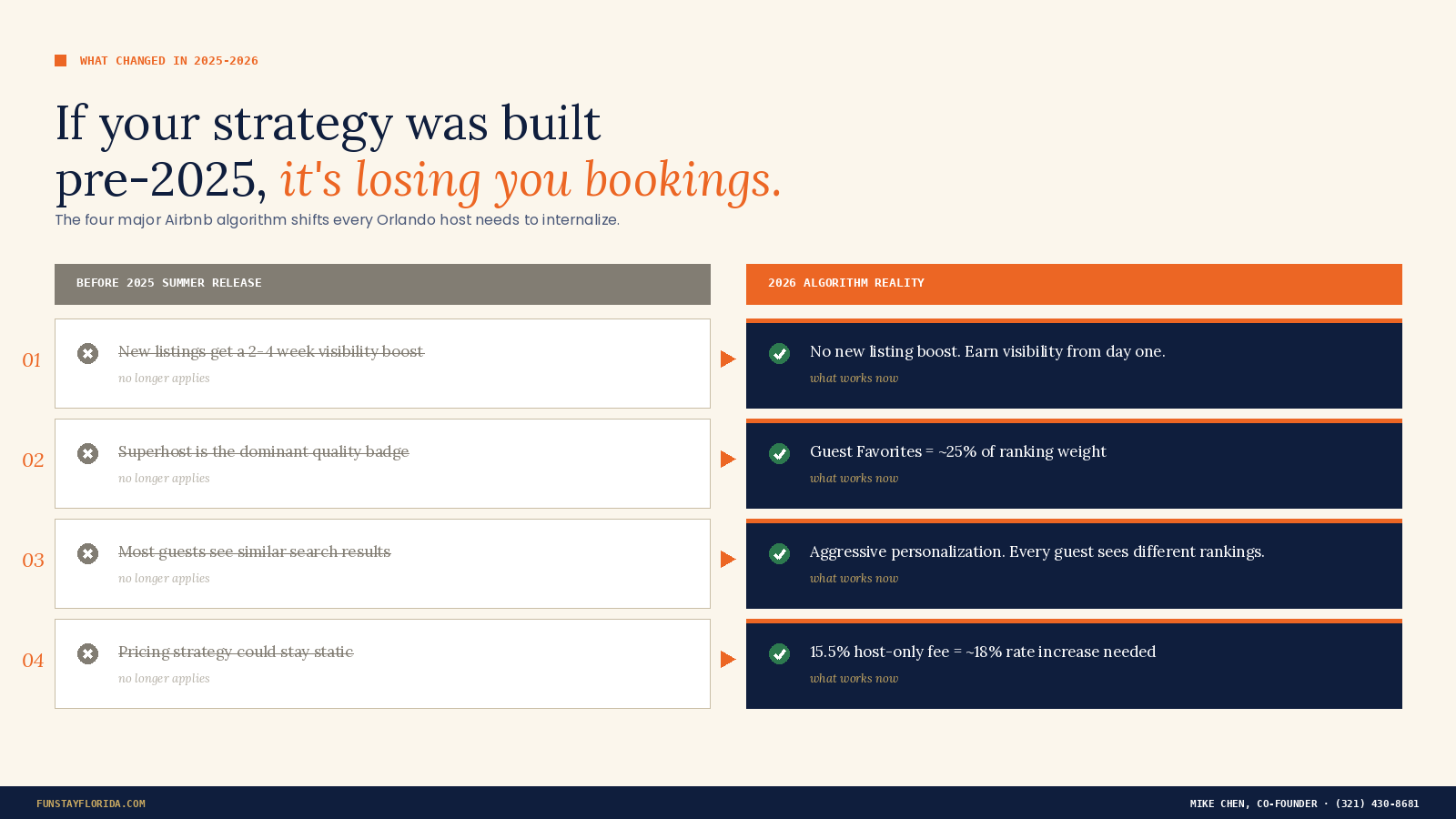
Airbnb made several material changes in their 2025 Summer Release that flipped the script on what was working. If your strategy was built on pre-2025 best practices, it’s actively losing you bookings right now. Here’s what changed.
1. The “new listing boost” is gone
For years, brand-new listings got a temporary visibility boost in their first 2-4 weeks to help them earn initial reviews. As of the 2025 Summer Release, that boost was eliminated. New listings now have to earn visibility from day one through the same signals as established listings.
The practical implication for Orlando owners: you cannot rely on the algorithm to “discover” your new listing. You need professional Airbnb listing optimization from day one, aggressive pricing in your first 30-60 days, and active promotion to drive your first 5-10 bookings before reviews carry their normal weight.
2. Guest Favorites replaced Superhost as the dominant badge
Superhost still exists, but the gold-heart Guest Favorites badge is now the algorithm’s preferred signal. Why? Because Guest Favorites updates dynamically based on recent guest behavior, while Superhost evaluates quarterly and rewards consistency over recency. Airbnb’s algorithm now prioritizes recency over historical performance.
3. Personalization is now ruthless
Two guests searching “Orlando vacation home, Aug 1-7, 8 guests” will see two completely different first pages. The Airbnb algorithm now considers every guest’s: past booking history, click patterns, wishlist contents, search history, device type, and even browsing time of day. Your listing might rank #3 for a family of four searching 90 days out, and #47 for a solo traveler booking same-day.
4. The 15.5% host-only fee changed pricing dynamics
As of December 1, 2025, most listings were standardized to a 15.5% host-only fee structure. This means hosts effectively absorbed what used to be split between host and guest. To maintain the same net revenue, hosts had to raise rates roughly 18%: and the algorithm immediately recalibrated what “competitive pricing” means in every market. If you didn’t update your rates strategy in late 2025, you’re either losing revenue or losing rank.
The 7 Universal Airbnb Ranking Factors That Still Drive Everything
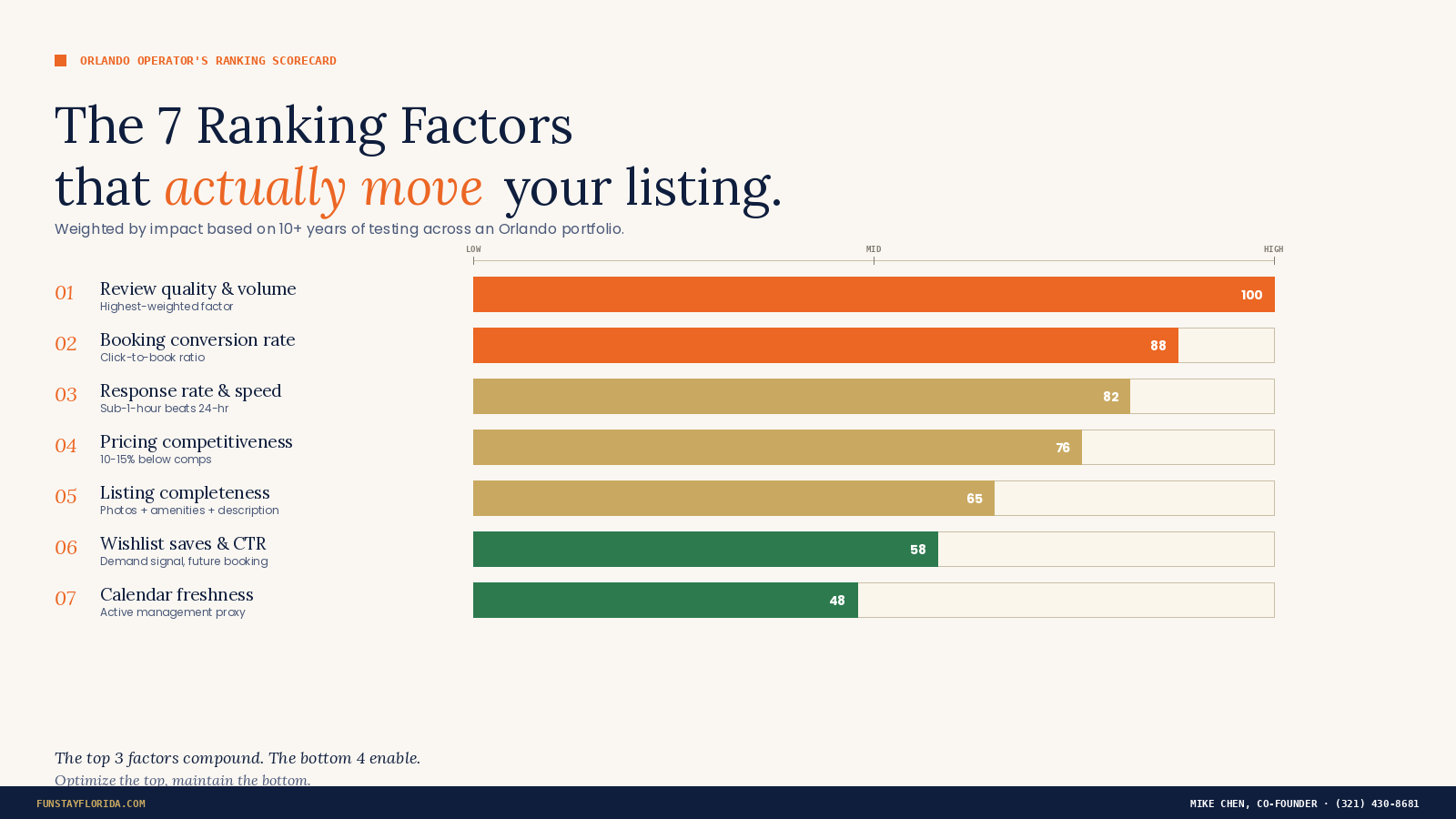
Strip away the personalization layer, and there are 7 universal factors every listing in every market needs to hit. These are the Airbnb ranking factors I optimize across all my Orlando properties.
1. Review quality and volume
The single highest-weighted factor. Both volume and rating matter, and they trade off: a listing with 80 reviews at 4.85 stars typically outranks one with 30 reviews at 5.0 stars. Category subscores (cleanliness, accuracy, communication) are evaluated independently and can suppress ranking even when overall rating looks strong. Airbnb also reads review text now and weights listings where guests mention specific amenities or experiences.
2. Response rate and speed
Airbnb’s stated threshold is 24 hours. The algorithm’s actual reward curve is much steeper. Response within 1 hour gets significantly more ranking weight than response within 23 hours, even though both qualify as “responded.” This is why our 24/7 booking management matters so much: automated initial responses preserve the speed signal even when humans aren’t available.
3. Pricing competitiveness
The algorithm benchmarks your nightly rate against similar listings in your specific community. Being 10–15% below comparable listings on peak dates significantly boosts ranking. But “comparable” is the key word: pricing too low (below 30% of comps) actually hurts because Airbnb interprets it as a low-quality signal. This is why dumb price-cutting fails. Real dynamic pricing strategy calibrates against the right comp set, not against the cheapest listing in town.
4. Listing completeness
Every blank field is a missed ranking opportunity. The algorithm uses listing completeness as a proxy for quality. Specifically: at least 20 high-quality photos, every amenity field filled in, detailed property description with searchable terms, complete house rules, accurate sleeping arrangement details, and accessibility features properly tagged. Missing amenity tags mean missing filtered search results.
5. Wishlist saves and click-through rate
This is the demand signal most owners ignore because Airbnb doesn’t show it directly. Wishlist saves indicate that guests are interested in your listing even when they don’t book immediately. The algorithm reads this as future demand and ranks the listing higher. Click-through rate (impressions vs. clicks) measures whether your hero photo and price are working. Low CTR with high impressions = your photo isn’t stopping the scroll.
6. Booking conversion rate
Of guests who click on your listing, what percent book? Airbnb measures this and rewards listings that convert. A listing that gets 200 impressions, 20 clicks, and 5 bookings outranks a listing that gets 200 impressions, 30 clicks, and 2 bookings. This is why people who obsess over click count miss the point: booking velocity is what compounds.
7. Calendar availability and freshness
Stale calendars (no updates in 30+ days) signal to the Airbnb algorithm that the listing isn’t actively managed. Open availability windows of 30-180 days into the future signal active management. Frequent owner-blocked dates without bookings between them signal unreliability. The algorithm now interprets calendar “vitality” as a quality proxy.
Real Operator Examples: What I’ve Actually Seen Move Rankings
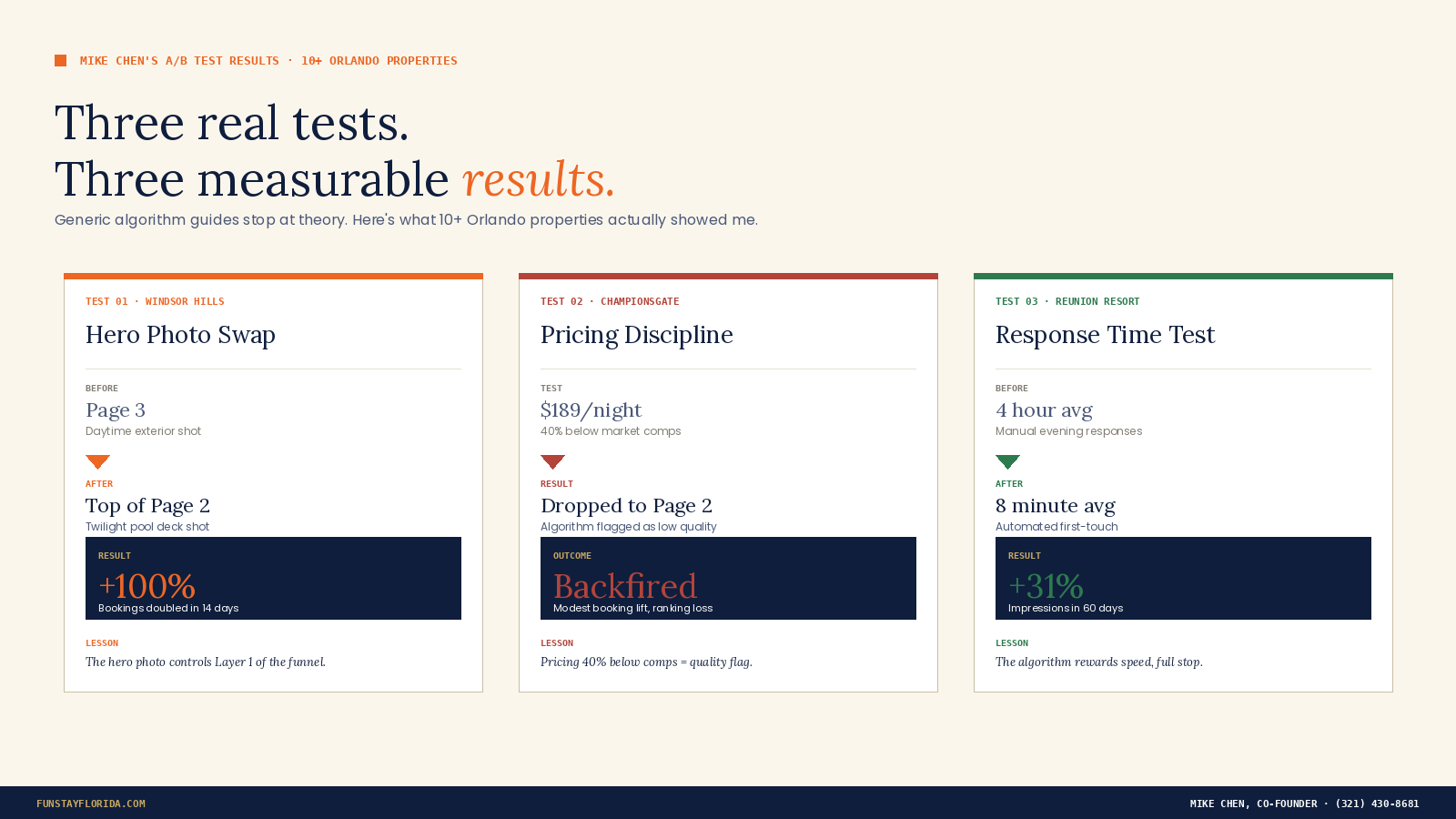
Generic algorithm guides stop at theory. Let me show you three specific real-world tests I’ve run across my Orlando portfolio. These are the moves that actually moved rankings: and the moves that didn’t.
The Windsor Hills Hero Photo Test
I had a 5BR Windsor Hills home that sat on page 3 for “Orlando Aug 5-12, 8 guests” for six months. Not a single change to anything except swapping the hero photo from a daytime exterior shot to a twilight pool deck shot showing the lit-up screen enclosure. Within 14 days, the listing moved to top-of-page-2. Bookings doubled the following month. Same pricing, same reviews, same description. The hero photo controls Layer 1 of the funnel.
The ChampionsGate Pricing Discipline Test
I dropped one of my 6BR ChampionsGate homes to $189/night for two weeks during shoulder season, thinking aggressive discounting would fill the calendar. It backfired. Bookings ticked up modestly, but the listing dropped from page 1 to page 2 because the algorithm interpreted the dramatic price gap as a low-quality signal. Pricing 10–15% below comps works. Pricing 40% below comps signals “something is wrong with this property.”
The Reunion Resort Response Time Test
I switched from manual evening responses (3-6 hour avg) to automated first-touch responses through our messaging platform. Average response time dropped from 4 hours to 8 minutes. Listing impressions in Reunion Resort searches increased 31% over 60 days: same listing, same reviews, no other changes. The algorithm rewards speed, full stop.
What Doesn’t Move Rankings (Despite What You’ll Read)
Almost as important as knowing what works is knowing what doesn’t. After 10 years of testing, here’s what I’ve found does NOT meaningfully impact how the Airbnb algorithm works in your favor:
- Title keyword stuffing. Adding “Best Orlando Vacation Home Near Disney” to your title doesn’t beat a clean, benefit-led title. The algorithm reads keywords from your description and amenities, not your title.
- Listing on every platform. Cross-platform listing helps revenue (covered in our multi-platform strategy guide) but doesn’t directly boost Airbnb ranking.
- Daily price tweaks. The Airbnb algorithm doesn’t reward micro-adjustments. It rewards being competitively priced over time. Smart Pricing or quality dynamic pricing tools work; daily manual tweaks don’t.
- Adding more photos beyond 25-30. Diminishing returns. The first 20 high-quality photos matter; photos 30-50 don’t move the needle.
- Replying to every guest review. Reply to negative reviews and notable positive reviews. Replying to every “great stay” review doesn’t impact rankings.
The Personalization Layer: Why Your Listing Ranks Differently for Different Guests
If you’ve ever searched for your own listing and gotten a different rank than what your friend sees, you’ve encountered Airbnb’s personalization layer. The system tracks every guest individually:
- Past booking history: Cabin bookers see more cabins. Luxury bookers see luxury options first.
- Search and click patterns: Time spent on listings, what they save, what price ranges they browse.
- Device and location: Mobile users see slightly different rankings than desktop. European searchers see different weighting than US searchers.
- Group composition: Family of 4 sees different rankings than couple booking same dates.
This is why “where do I rank?” is the wrong question. The right question is: “do I match the kind of guest the algorithm thinks will love my property?” An Orlando Airbnb listing targeting families needs to lean into family-specific amenities, photos, and language. A listing targeting business travelers needs different signals entirely. Trying to be everything to everyone makes the algorithm rank you for nothing.
The Algorithm Math Most Owners Get Wrong
Here’s the counter-intuitive reality of how the Airbnb algorithm works: getting more bookings makes the algorithm show you to more people. Getting fewer bookings makes it show you to fewer people. The system reinforces winners and starves losers.
This means there’s a critical first-30-days window for any new or stale listing. If you go 30 days without bookings, the algorithm has already decided you’re not converting and quietly drops your impression count. Recovery takes 60-90 days of correct signals to reverse. This is why poor listing optimization compounds: every week of underperformance makes the next week harder.
The flip side: a properly optimized listing that books well in its first 30-60 days enters a positive feedback loop. More bookings → more impressions → more bookings. This is why aggressive launch pricing and professional description optimization matter most in the first two months.
What the Best Airbnb Property Management Orlando Operators Actually Do
The best Airbnb property management Orlando operators don’t have algorithm secrets. We have systems. The systems are:
- Pre-launch optimization: Professional photography, complete amenity tagging, market-tested description, calibrated launch pricing.
- First-60-days monitoring: Daily impression and click tracking, weekly pricing recalibration, aggressive review-velocity push.
- Steady-state operations: Sub-15-minute response times, dynamic pricing managed weekly, photo refreshes quarterly, review request automation.
- Guest experience excellence: Because nothing else matters if reviews aren’t 4.8+. Cleanliness, communication, accuracy. Every stay.
This is what separates an Orlando Airbnb management services partner from a glorified booking agent. The algorithm doesn’t reward effort. It rewards signal quality. And signal quality requires systems.
MIKE CHEN, 18+ YEAR AIRBNB SUPERHOST
The Bottom Line on the Airbnb Algorithm in 2026
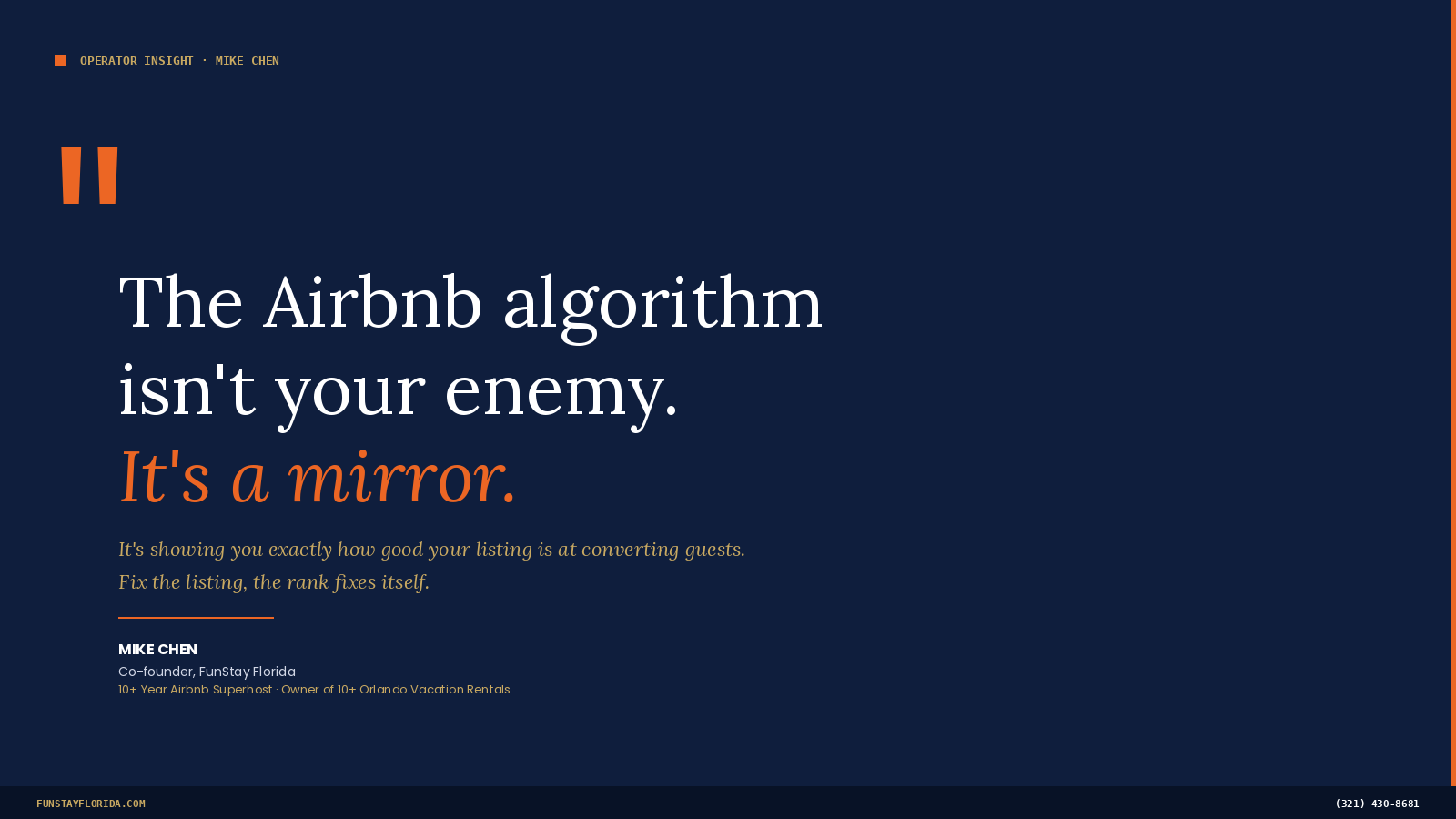
Here’s what 10 years of operator-level testing has taught me about how the Airbnb algorithm works: the Airbnb algorithm rewards listings that earn the click, earn the booking, and earn the 5-star review, in that order. Everything else is supporting signals. The 2026 changes (no new listing boost, Guest Favorites dominance, ruthless personalization, 15.5% fee structure) all reinforce the same principle: Airbnb wants to show guests the listings most likely to deliver excellent stays.
You can’t trick the algorithm. You can only optimize for the signals it measures. Photos that earn the click. Pricing that earns the booking. Operations that earn the 5-star review. Do those three things consistently across an Orlando portfolio, and the Airbnb search algorithm will reward you with consistent Airbnb search ranking growth. Skip any of them, and no amount of keyword stuffing or daily price tweaks will save your Airbnb search ranking. Once you understand how the Airbnb algorithm works at the operator level, the path forward is mechanical: align your operations with what the system actually measures.
If you’d rather not run all of this yourself, that’s exactly what we do for owners through FunStay Florida’s full-service vacation rental management. From listing optimization to dynamic pricing to 24/7 guest communication, we run the entire algorithm signal stack so you don’t have to. Every Orlando Airbnb listing we manage gets the same treatment: pre-launch optimization, first-60-days monitoring, steady-state operations, and continuous review-velocity work. We covered the full service breakdown in what’s included in full-service Airbnb property management if you want to dig deeper into how each Orlando Airbnb listing in our portfolio is managed.
FAQs: The Airbnb Algorithm in 2026
How does the Airbnb algorithm work in 2026?
The Airbnb algorithm in 2026 is a personalized machine-learning system that scores every listing on its predicted probability of converting a specific guest into a successful booking. It evaluates universal signals (review quality, response speed, pricing, listing completeness, wishlist saves, click-through rate, booking conversion) plus personalized signals (the guest’s booking history, search patterns, device, group composition). Two guests searching the same dates and city see different rankings.
What changed in the Airbnb algorithm in 2025-2026?
Four major changes hit in late 2025 and 2026. First, the “new listing boost” was eliminated. New listings no longer get temporary visibility advantages. Second, the Guest Favorites badge replaced Superhost as the top quality signal, now worth roughly 25% of ranking weight. Third, personalization became dramatically more aggressive. Two guests searching identical queries see different results. Fourth, the 15.5% host-only fee was standardized December 1, 2025, recalibrating what “competitive pricing” means in every market.
What are the most important Airbnb ranking factors?
The 7 universal Airbnb ranking factors are: review quality and volume, response speed (sub-1-hour beats 24-hour), pricing competitiveness vs. similar listings, listing completeness (photos, amenities, description), wishlist saves and click-through rate, booking conversion rate, and calendar availability and freshness. Review quality is the single highest-weighted factor. Response speed has a steeper reward curve than most hosts realize.
Does the Airbnb algorithm favor Superhosts?
As of the 2025 Summer Release, Superhost status no longer carries the dominant ranking weight it once did. The Guest Favorites badge replaced it as the top quality signal because Guest Favorites updates dynamically based on recent guest behavior while Superhost evaluates quarterly. Both badges still help, but Guest Favorites is now worth significantly more in the Airbnb search algorithm.
How long does it take a new Airbnb listing to rank?
Since the 2025 Summer Release eliminated the new listing boost, fresh listings have to earn visibility from day one. Most properly-optimized listings start ranking competitively within 30-60 days, but only if they accumulate strong signals quickly: 5-10 bookings in the first 30 days, 4.8+ review average, sub-1-hour response time, complete listing fields. Listings that fail to book in their first 30 days often face an uphill battle for 60-90 days afterward.
Can I beat the Airbnb algorithm with hacks or tricks?
No. There are no shortcuts that meaningfully outsmart the Airbnb algorithm. The system is sophisticated enough that it heavily penalizes anything that looks artificial: review manipulation, price gaming, fake amenity claims, host cancellations to game availability. The only durable strategy is optimizing the signals the algorithm legitimately measures: better photos, faster responses, competitive pricing, complete listings, and excellent guest experiences. Hacks lose. Systems win.
