
If you own an Orlando vacation rental and you’re ready to list, the difference between a good sale and a great sale often comes down to one thing: how you position the property. Most owners treat their STR like a house when they sell. Investor buyers pay for a business. Here’s how to bridge that gap and sell an existing short-term rental for what it’s actually worth.
Selling your Orlando vacation home is not the same as selling your primary residence. Not even close. When you decide to sell an existing short-term rental, you’re not just offloading a property. You’re selling an operating business with revenue, a guest base, documented systems, and transferable cash flow. Most sellers underprice their property by tens of thousands of dollars because they don’t understand that distinction.
At FunStay Florida, we work with Orlando vacation home owners every week who are ready to exit. Some need to sell because life changed. Some are cashing in equity they’ve been sitting on since 2020. Some are consolidating into fewer, larger assets. The reasons vary. The strategy to maximize sale value does not.
This is the exact framework we walk owners through when they want to sell an existing short-term rental in Orlando and get every dollar the market will pay. Let’s get into it.
Why selling an existing short-term rental is different from a regular home sale
When buyers are shopping for a traditional house, they care about square footage, finishes, school zones, and curb appeal. When buyers shop for an existing short-term rental, they care about a different list entirely:
- Revenue history. What did this property actually earn last year?
- Cap rate. What’s the return on investment based on net operating income?
- Forward bookings. How much cash flow transfers to them on day one?
- Turnkey status. Do they walk in and start earning, or face 90-180 days of setup?
- Community performance. Is the resort trending up or down?
- STR zoning compliance. Will they be able to keep operating the way you did?
None of that shows up in a standard residential comparable market analysis. Which is exactly why a general Realtor running a traditional CMA typically underprices existing short-term rentals. When you sell an existing short-term rental in Orlando, you need someone who can position it as an investment asset, not a house.
For more on this, see our deeper dive on how Airbnb performance impacts sale price.
The 3 biggest mistakes owners make when they sell an existing short-term rental
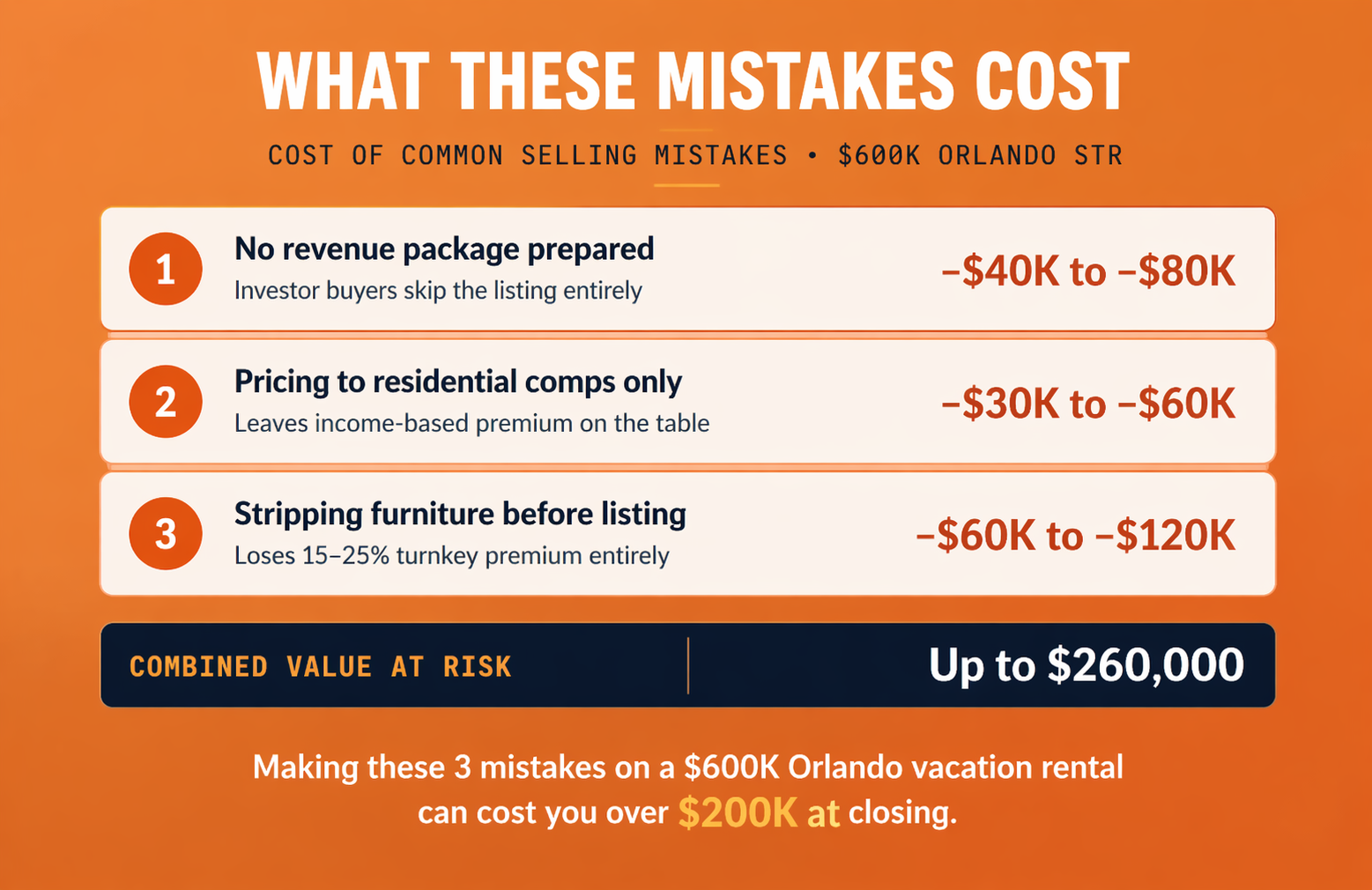
Before we get to the framework, let’s cover what kills sale prices. These three mistakes are the most common reasons Orlando vacation home sellers leave money on the table in 2026.
Mistake 1: Listing without a revenue package
Investor buyers want to see 24 months of monthly revenue statements, occupancy data, ADR trends, and expense breakdowns. If your agent lists the property without a revenue package prepared, serious investor buyers skip you entirely. They assume there’s nothing worth showing.
Mistake 2: Pricing to residential comps only
If your Realtor is pricing your 5-bedroom Orlando vacation home the same as the 5-bedroom primary residence that sold two streets over, you’re getting underpriced. Existing short-term rentals in strong communities with proven revenue should be valued using an income-based approach layered on top of the traditional comp analysis.
Mistake 3: Stripping the furniture before listing
Unless you’re specifically targeting a second-home buyer (rare in STR zones), removing furniture before listing is almost always a mistake. A fully furnished, operationally-ready home sells for a 15-25% premium over an empty shell, according to AvantStay’s 2026 analysis. Strip the furniture and you drop right out of the investor buyer pool.
The FunStay framework to sell an existing short-term rental for maximum value
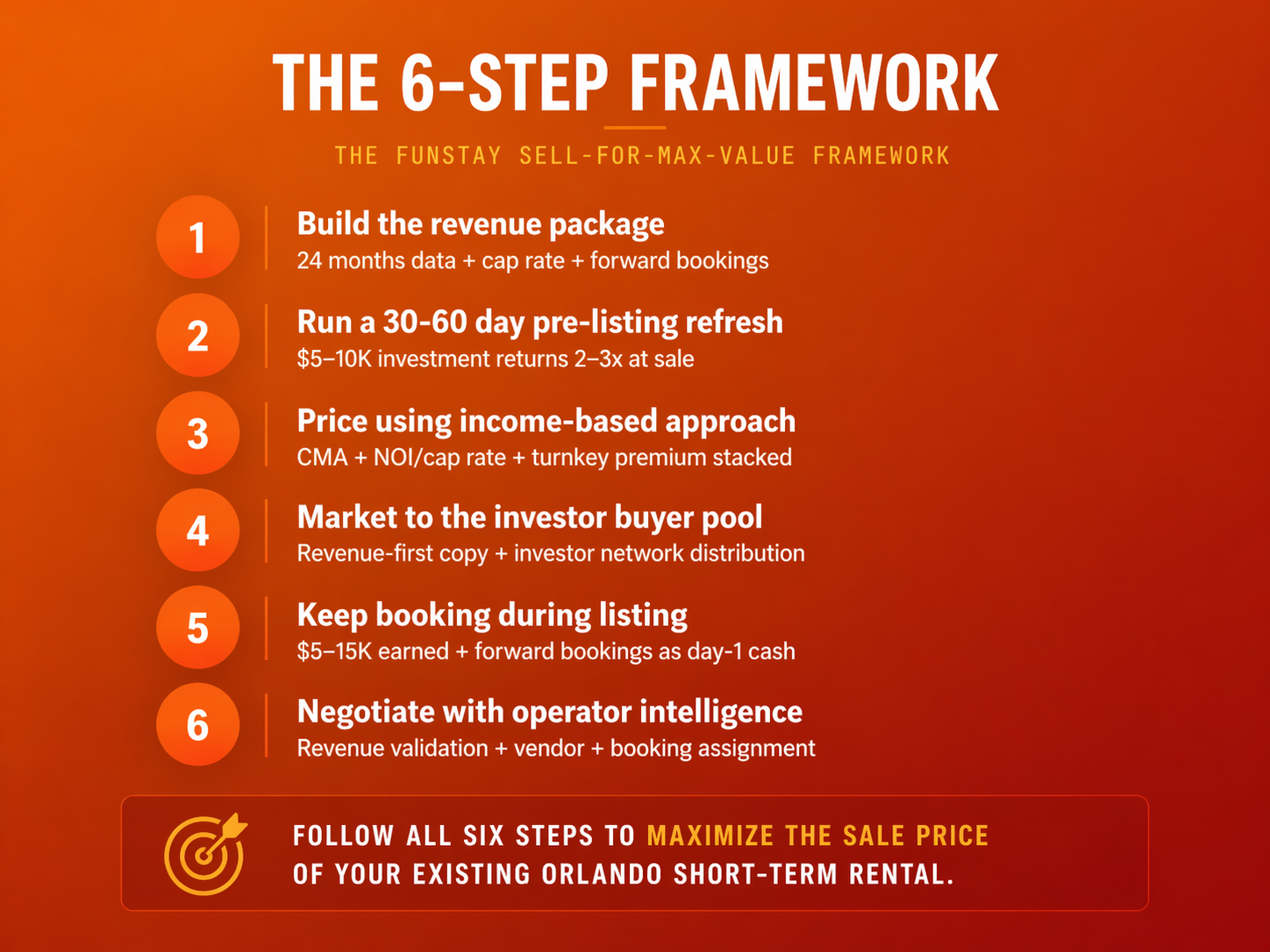
Here’s the exact framework we use when an owner comes to us ready to sell an existing short-term rental. These are the six steps that consistently produce higher sale prices and shorter days on market.
Step 1: Build the revenue package first
Before a single photo is taken, before the listing goes live, before you even talk about price, we build the revenue package. That includes:
- Trailing 24 months of monthly revenue statements
- Occupancy percentages by month and season
- Average Daily Rate (ADR) trends
- Expense breakdown (HOA, utilities, management, maintenance, taxes)
- Net Operating Income calculation
- Forward booking calendar (in dollars and nights)
- Review and rating screenshots
This package becomes the single most persuasive document you have when marketing to investor buyers. Properties with a clean, complete revenue package sell an existing short-term rental in 30-90 days, compared to 90-180+ days for properties without one.
Step 2: Set a pre-listing optimization window
Give yourself 30-60 days before listing to make targeted improvements that move the needle on price. This isn’t about a full renovation. It’s about the specific upgrades that increase buyer perception:
- Refresh worn furniture in high-traffic rooms
- Deep-clean and repaint scuffed walls
- Update outdated decor in the master and main kids’ rooms
- Fix small maintenance items (cracked tile, loose fixtures, worn cabinet pulls)
- Ensure pool equipment, HVAC, and major appliances are running well
- Refresh the professional photos with a new shoot
A $5,000-$10,000 pre-listing refresh often returns 2-3 times that amount at sale. A tired-looking property sells for far less than a property that photographs well and shows strong in person. If your existing listing is underperforming, listing optimization can also help freshen the presentation before you go to market.
Step 3: Price using an income-based approach
This is where most Orlando vacation home sellers get underpriced. A proper pricing approach combines:
- Residential CMA: Recent sold comps in the same community, adjusted for bedroom count, square footage, and upgrades
- Income-based valuation: Your actual NOI divided by the current Orlando STR cap rate (usually 5-10% based on our selling guide)
- Turnkey premium: 15-25% lift for fully operational, furnished homes with documented performance
When those three methods align, you’ve got a defensible price. When they diverge significantly, you’ve got a pricing discussion worth having before listing. Without running all three, you’re guessing.
Step 4: Market to the investor buyer pool
Traditional residential listings reach traditional residential buyers. That’s not who pays top dollar for an existing short-term rental. You need to specifically reach the investor buyer pool, which has its own language, channels, and expectations.
Effective investor-focused marketing includes:
- Listing descriptions that lead with revenue and cap rate, not square footage
- Photography that emphasizes themed rooms, amenities, and guest-ready presentation
- Distribution through investor networks, not just the MLS
- Direct outreach to qualified investor buyer lists
- Clear framing of what transfers (furniture, bookings, vendor contracts, systems)
Step 5: Keep the calendar booking during listing
Most traditional Realtors will tell you to pause new bookings while the property is listed. That’s usually wrong for an existing short-term rental. Continued bookings during the listing period produce three benefits:
- You keep earning revenue (often $5,000-$15,000 during a 60-90 day listing period)
- Forward bookings on the calendar transfer as real day-one cash flow to the buyer
- The listing maintains its review velocity and ranking on booking platforms
Showing windows can be coordinated between stays. Our property management team handles this coordination regularly for owners who want to sell an existing short-term rental without losing income during the sale process.
Step 6: Negotiate with operator intelligence
When offers come in from investor buyers, the questions they ask will be operational, not structural. They’ll want to discuss revenue normalization, expense validation, vendor transfer, property management transition, and forward booking assignment. A traditional Realtor negotiating on your behalf often struggles here because they don’t speak that language.
Working with a team that understands both sides of the STR transaction produces meaningfully better outcomes. That’s exactly why we built our seller-side service to work hand-in-hand with Mike Chen on the real estate side.
Should you fix operational issues before you sell an existing short-term rental?
This question comes up in almost every seller conversation. If the property is underperforming, should you fix the problem and sell later, or sell as-is now?
The honest answer depends on the problem.
Fix first, then sell if the issue is operational:
- Low occupancy due to poor listing optimization (fixable in 60 days)
- Stale pricing strategy (fixable immediately with dynamic pricing)
- Slow response times or bad guest reviews (fixable with proper management)
- Worn furnishings that hurt photos (fixable with a refresh)
Six months of improved performance before listing can add $30,000-$80,000 to your sale price. That’s a real return on the time investment.
Sell as-is if the issue is structural:
- HOA rule changes that restrict short-term rentals
- Community trajectory declining with no reversal in sight
- Major capital expenses coming (roof, HVAC, pool equipment)
- Lifestyle change that makes holding the property untenable
In these cases, acting quickly often preserves more value than trying to fix the unfixable. The longer you hold a structurally-challenged property, the more the market catches up to the reality.
The Orlando 2026 market for existing short-term rental sellers
Current market conditions for owners looking to sell an existing short-term rental in Orlando are more favorable than a lot of headlines suggest. The macro picture:
$2.1B+
Annual revenue generated by Orlando’s ~47,000 active vacation rental listings, making it one of the most liquid STR investor markets in the U.S. Source: AirROI Orlando 2026
Here’s what’s driving investor buyer demand right now:
- Tourism strength: Orlando is projecting 162+ million visitors in 2026, supported by FIFA World Cup events and the U.S. Semiquincentennial
- Supply pressure: New construction hasn’t oversaturated the resale market for established communities
- Investor appetite: Operational turnkey properties with documented revenue are in high demand
- International buyer return: Foreign buyer activity is picking back up after a slower 2023-2024
For owners with a well-performing property in a top-tier community, 2026 is a solid window to sell an existing short-term rental. For owners in weaker communities or with thin revenue history, the window may be narrower, which is why getting a realistic valuation first matters so much.
The owners who maximize value when they sell an existing short-term rental are the ones who treat the sale like a business transfer, not a real estate transaction. Package the income. Document the systems. Price the cash flow. Market to the investor pool.
Mike Chen, Co-founder FunStay Homes
What transfers when you sell an existing short-term rental?
One of the most common questions from sellers is what actually transfers in an existing short-term rental sale. The short answer: whatever you negotiate. The specific list usually includes:
- The real estate (land, structure, permanent fixtures)
- Furniture and furnishings (everything shown in listing photos)
- Kitchen, linen, and guest supplies inventory
- Electronics and smart home devices (TVs, smart locks, thermostats)
- Pool and outdoor equipment
- Current DBPR short-term rental license (subject to transfer rules)
- Listing photos and marketing assets (rights transfer)
- Forward bookings on the calendar (dollar value + nights)
- Vendor contracts (cleaners, maintenance, pool service, etc.)
- Property management agreement (assumable or replaceable)
The more of these items you transfer cleanly, the higher the premium a buyer will pay. A well-documented, comprehensive transfer package is one of the strongest tools you have when you sell an existing short-term rental in Orlando.
Timeline: what to expect when you sell an existing short-term rental in Orlando
The typical timeline from decision to closing, when done properly:
- Weeks 1-2: Valuation, revenue package prep, seller consultation
- Weeks 3-6: Pre-listing refresh, professional photography, listing copy
- Weeks 7-8: List on MLS + investor channels, begin showings
- Weeks 9-14: Offers, negotiation, due diligence
- Weeks 15-16: Closing and operational handoff
All in, expect 3-4 months from decision to closed. Properly-packaged turnkey Orlando vacation homes regularly close in 30-90 days of active listing time, compared to 90-180+ days for unoptimized listings.
The bottom line on selling your existing Orlando vacation rental
If you’re ready to sell an existing short-term rental in Orlando, the strategy matters as much as the decision. Owners who treat the sale like a standard residential transaction routinely underprice their property by $40,000 to $150,000. Owners who package it as an income-producing business asset, market to the investor buyer pool, and negotiate with operator intelligence consistently hit higher sale prices and faster closings.
The six-step framework above is what we use every week across FunStay Homes. It works because it aligns your property with how investor buyers actually value Orlando short-term rentals in 2026.
If you want help applying this framework to your specific property, that’s exactly what we’re here for. Whether you need a valuation, operational support through the sale, or full-service listing representation, we can plug in where you need us.
Frequently asked questions about selling an existing short-term rental in Orlando
How long does it take to sell an existing short-term rental in Orlando?
Well-packaged turnkey Orlando vacation rentals typically close in 30 to 90 days of active listing time. Unoptimized listings (no revenue package, residential-only pricing, stripped furniture) can sit 90 to 180+ days before closing. Total timeline from initial decision to closed keys is usually 3 to 4 months when done properly, including pre-listing prep, marketing, negotiation, and due diligence.
What documents do I need to sell my Orlando vacation rental?
At minimum: 24 months of monthly revenue statements, occupancy and ADR data, expense breakdown for the trailing year, current DBPR short-term rental license, forward booking calendar, HOA rules and compliance documents, vendor contracts, and a full inventory of transferring furniture and fixtures. We help FunStay owners compile this package before their property goes to market.
Should I sell my Orlando short-term rental furnished or unfurnished?
Almost always furnished. Turnkey vacation rentals command 15-25% premiums over unfurnished equivalents because investor buyers pay for the ability to start earning on day one. The only times unfurnished makes sense are when you’re specifically targeting a second-home buyer (rare in STR zones) or when the furniture is so dated it would subtract value.
Can I keep renting my property while it’s listed for sale?
Yes, and in most cases you should. Continued bookings during the listing period generate real income ($5,000 to $15,000 over a 60-90 day listing), keep your listing ranking strong on booking platforms, and transfer forward bookings as day-one cash flow to the buyer. Showings are coordinated between stays. Our management team handles this coordination regularly for sellers.
Do I need a special Realtor to sell an existing short-term rental?
You need a Realtor who understands both residential real estate and short-term rental business operations. Most traditional Realtors underprice STR properties because they only run residential comps. Working with an agent who can layer an income-based valuation on top of the CMA, market to investor buyers, and negotiate operational transfer terms produces meaningfully better results.
What are the tax implications of selling my Orlando vacation rental?
Orlando vacation rentals typically don’t qualify for the $250K/$500K primary residence exclusion. Expect federal long-term capital gains tax (0%, 15%, or 20% depending on income), plus depreciation recapture up to 25%, plus potentially the 3.8% Net Investment Income Tax. A 1031 exchange into another investment property can defer these taxes if structured properly. Always consult your CPA for property-specific tax planning before listing.

Mike Chen, P.A.
Co-founder, FunStay Homes · Realtor® · Superhost
Mike Chen is the co-founder of FunStay Homes, managing 100+ Orlando vacation rentals across Kissimmee, Davenport, and the Disney corridor. As a Superhost with 2,600+ guest reviews and 10+ years of hosting experience, Mike personally owns 6+ Disney-area vacation homes and brings an operator’s lens to every seller transaction. He’s also a licensed Realtor® at La Rosa Realty Celebration, bilingual in English and Mandarin. More insights on the FunStay Florida blog.
