
Mike Chen, a licensed Florida real estate broker and vacation rental manager at FunStay Florida, tracks seasonal booking patterns across the Orlando corridor every year. One thing stays consistent: owners who price around the Orlando Airbnb peak season calendar outperform those who set a flat rate year-round. The gap between a property earning $55,000 and one stuck at $32,000 often comes down to how well the owner plays the seasonal calendar. Owners who calculate ROI before buying see that pattern immediately.
Here is how Central Florida vacation rental seasonality works, month by month, along with the pricing strategy that matches each season.
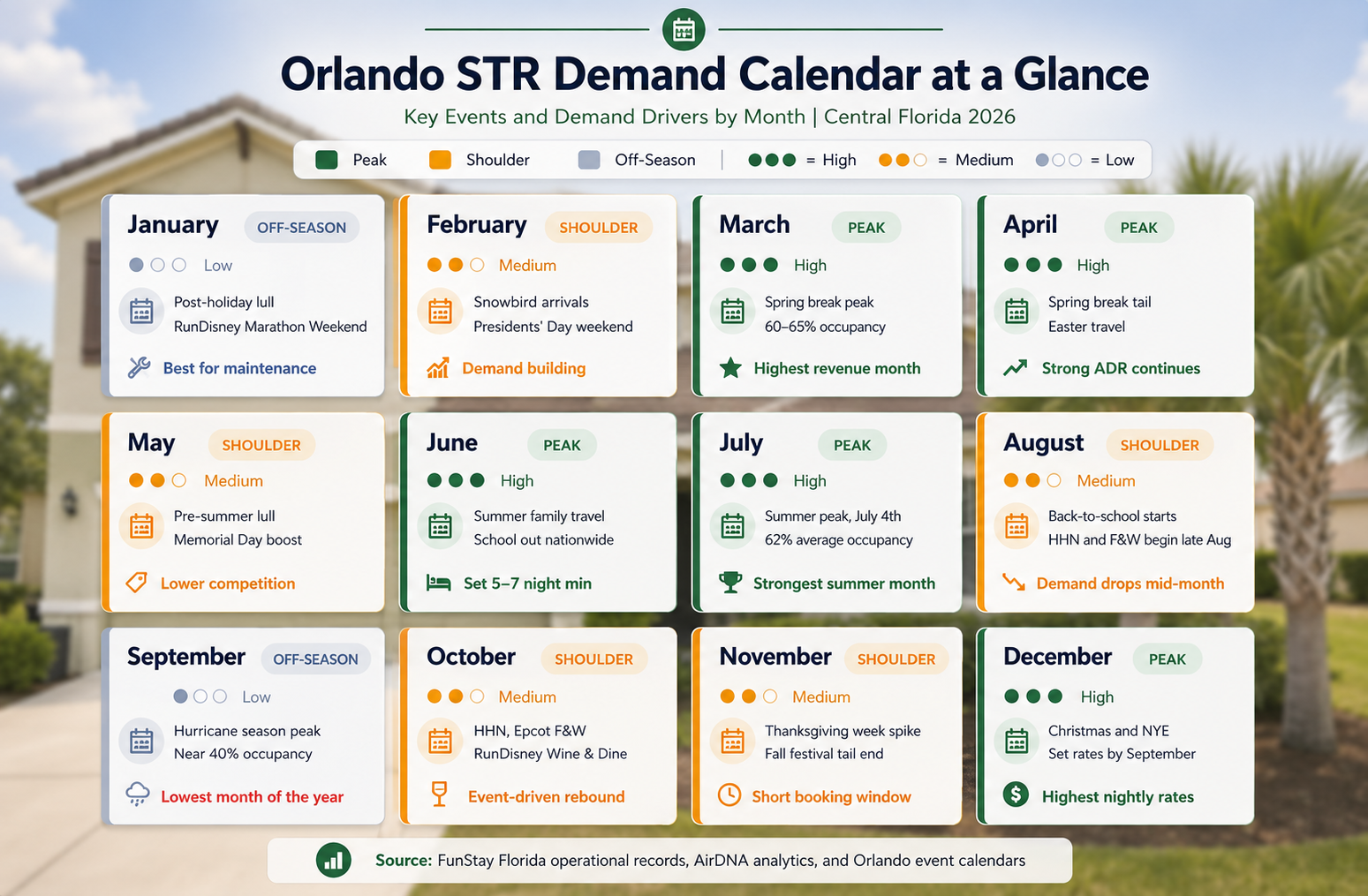
The Orlando STR Calendar at a Glance
Orlando does not follow the same seasonal pattern as beach or mountain markets. Theme parks, conventions, school breaks, and snowbird migration all create demand at different points. The table below shows the Orlando Airbnb peak season rhythm across the full year.
| Month | Season | Demand | What Drives It |
|---|---|---|---|
| Jan | Off-Season | Low | Post-holiday lull, school in session |
| Feb | Shoulder | Medium | Snowbirds, Presidents’ Day weekend |
| Mar | Peak | High | Spring break; highest revenue month |
| Apr | Peak | High | Spring break continues, Easter travel |
| May | Shoulder | Medium | Pre-summer lull, lower competition |
| Jun | Peak | High | Summer family travel begins |
| Jul | Peak | High | Summer peak, July 4th |
| Aug | Shoulder | Medium | Back-to-school starts mid-month |
| Sep | Off-Season | Low | Hurricane season, lowest occupancy |
| Oct | Shoulder | Medium | HHN, EPCOT festivals, RunDisney |
| Nov | Shoulder | Medium | Thanksgiving week spike |
| Dec | Peak | High | Holiday travel, highest nightly rates |
Peak Season: Summer and Holidays
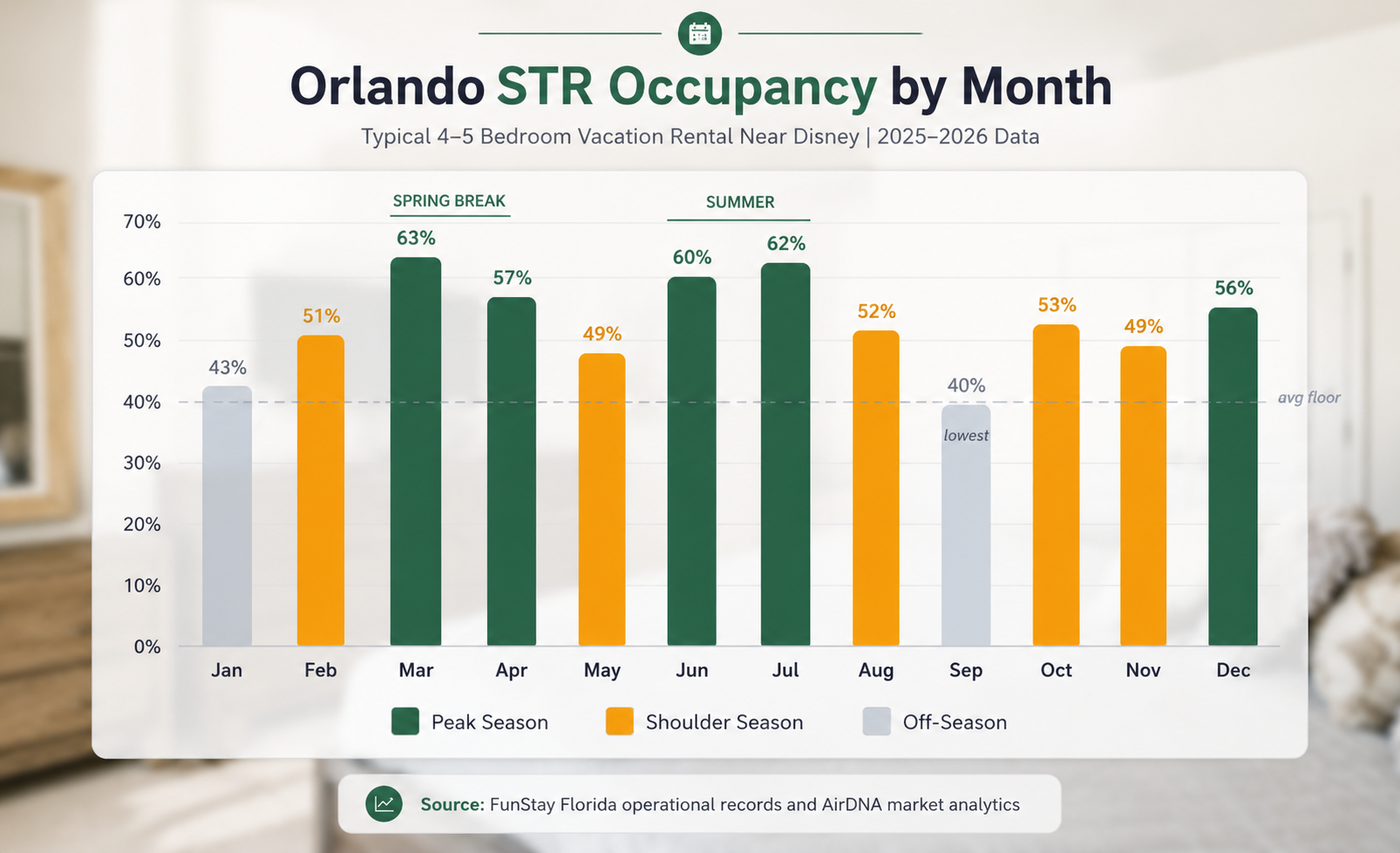
The Orlando Airbnb peak season centers on three windows: summer (June and July), spring break (mid-March through mid-April), and holiday travel (mid-December through early January). March regularly hits 60 to 65% occupancy with the strongest average daily rates of the year.
During peak months, set minimum stays at 5 to 7 nights. Families booking Orlando rarely stay less than five nights, and longer minimums reduce turnover costs. Raise rates 15 to 25% above your base, and do it 3 to 4 months in advance. Properties in resort communities like ChampionsGate and Reunion Resort see the strongest summer numbers because of proximity to Disney and on-site amenities.
Holiday pricing is its own tier. Christmas week and New Year’s command the highest nightly rates of the year. Thanksgiving week is strong but shorter. Set those rates by September at the latest.
Shoulder Season: Where Smart Owners Win
The shoulder months (February, May, August, October, and November) separate average performers from top earners. February brings snowbirds and Presidents’ Day weekend. October draws visitors to Halloween Horror Nights, the Epcot Food and Wine Festival, and the RunDisney Wine and Dine Half Marathon. November brings Thanksgiving week travel and the tail end of fall festival season.
Shoulder rates typically sit 10 to 20% below peak pricing. Drop minimum stays to 3 or 4 nights. Weekday discounts of 10 to 15% help fill midweek gaps without undercutting weekend rates.
Dynamic pricing tools like PriceLabs and Beyond earn their fee during shoulder months. They adjust rates daily based on local demand, competitor pricing, and booking pace. Flat pricing during shoulder season leaves money on the table or blocks bookings by pricing too high on slow weeks.
Off-Season: September and January
September is the softest month on the Orlando Airbnb peak season calendar. Back-to-school timing, hurricane season, and Florida heat all push occupancy near 40%. January after New Year’s follows a similar pattern as holiday travel ends and school resumes.
These months are not wasted time. Drop minimum stays entirely. Offer weekly and monthly discounts to attract remote workers and snowbirds. A 30-night booking at $80 per night still produces $2,400 with zero turnover costs.
September and January are also the best months for maintenance: deep cleans, repainting, furniture swaps, updated listing photos, and insurance reviews. A listing analysis can flag what needs attention before peak season returns. Properties that invest during the off-season come back stronger when demand returns in February and March. Owners who map out every operating cost ahead of time handle these slow stretches without stress.
Pricing Strategy by Season
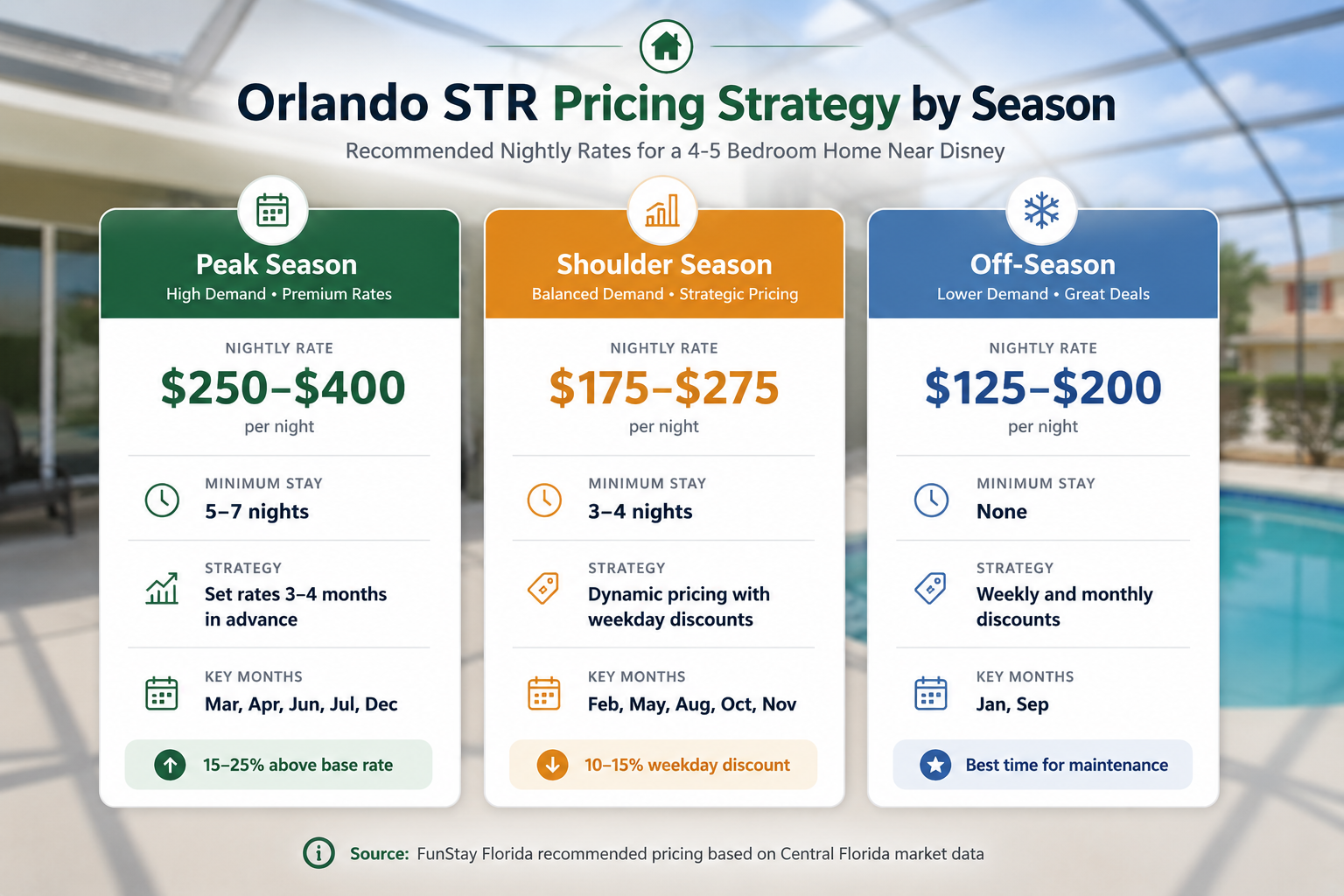
Pricing is the most controllable factor in how well a property performs across Orlando Airbnb peak season and off-season months. Here is a simplified rate structure for a typical 4 to 5-bedroom home near Disney.
| Season | Nightly Rate | Min Stay | Strategy |
|---|---|---|---|
| Peak | $250-$400 | 5-7 nights | Set rates 3-4 months ahead |
| Shoulder | $175-$275 | 3-4 nights | Dynamic pricing, weekday discounts |
| Off-Season | $125-$200 | None | Weekly/monthly discounts |
The key is not just adjusting the nightly rate. Minimum stays, cleaning fee presentation, and marketing angle all shift by season. Smart pricing accounts for all of it. A property that can pay for itself needs to maximize peak months and minimize vacancy when demand drops.