Why Knowing Orlando Short-Term Rental Laws Matters
Orlando draws millions of visitors each year, making it a prime market for Airbnb and Vrbo hosts. But Orlando’s short-term rental laws are far stricter than many owners expect. Without the right permits and tax registrations, hosts risk hefty fines, delisting, or even legal action.
This guide breaks down everything you need to know about obtaining a vacation rental license in Orlando, zoning rules, occupancy limits, and taxes across Orange, Osceola, and Polk counties, plus how to stay compliant with ease.

What Counts as a Short-Term Rental in Orlando?
In Orlando, a short-term rental (STR) is defined as renting a property for less than 30 consecutive days, more than three times per year. This applies to listings on Airbnb, Vrbo, Booking.com, and direct bookings.
Under Orlando short-term rental laws, STRs are considered “home shares” when the owner or tenant lives on-site for at least 51% of the year. Entire-home rentals in residential zones are generally not permitted unless zoned commercial or mixed-use.
To operate legally, hosts must obtain a vacation rental license in Orlando, register for state and county taxes, and comply with strict occupancy limits—2 guests per bedroom plus 2 extra, max 4 total.
Can You Legally Airbnb Your Orlando-Area Property?
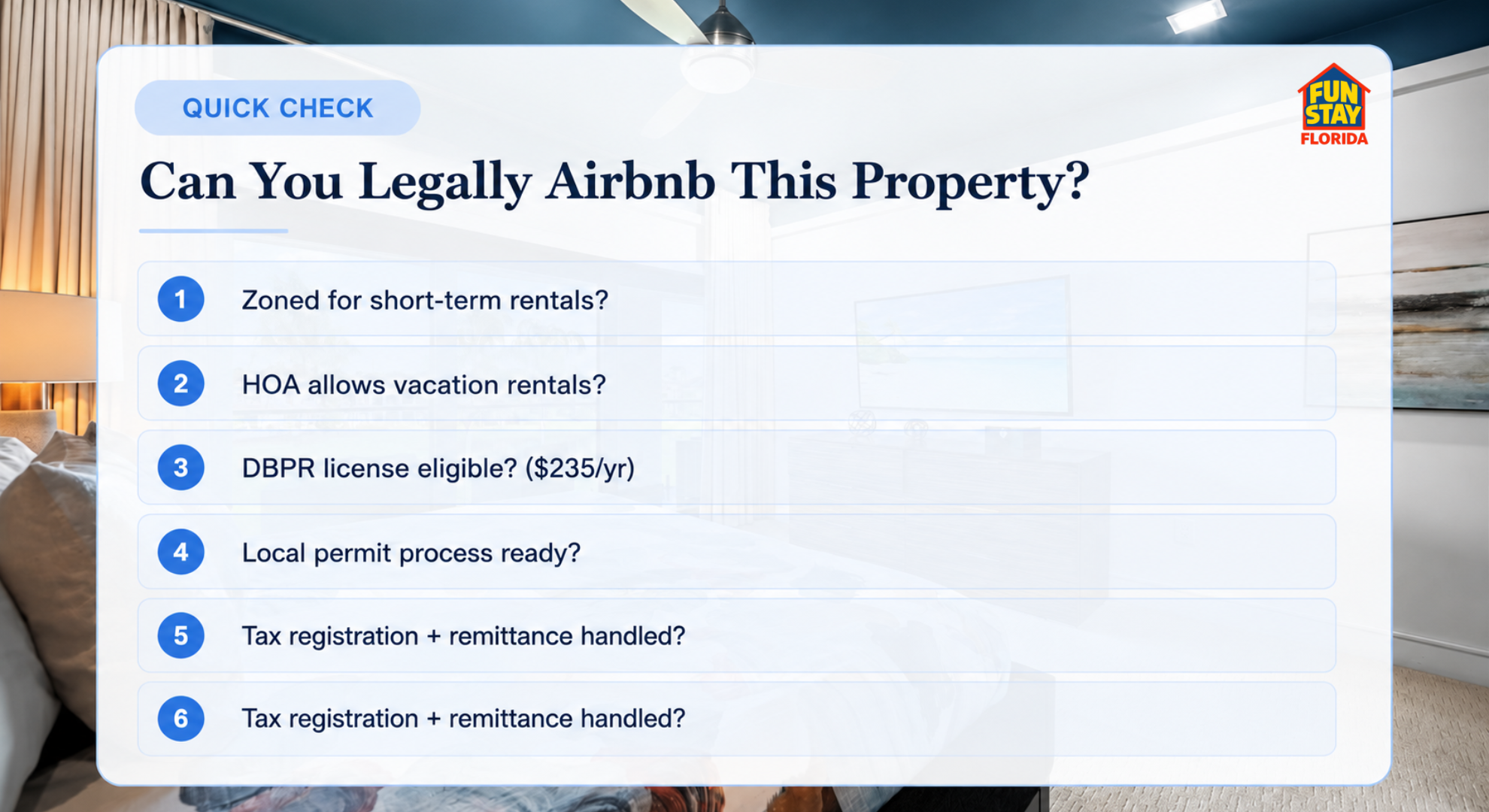
Before you read the detailed county rules below, run through these five questions. If you can’t answer “yes” to all of them, you have a compliance issue to resolve first.
If you answered “no” to any of these: Don’t list yet. Get the compliance sorted first. Fines range from $250/day in Orlando to $500/day in Osceola to $15,000 in Polk County. We help owners navigate this process every day. Learn about our licensing service.
City of Orlando STR Rules: Permits, Zoning & Occupancy
Thinking of hosting in the City of Orlando? Read this first.
Here’s what every host needs to know about getting a vacation rental license in Orlando—no fluff, just the facts:
Permit Required
You must register at orlando.gov/homeshare.
- Initial fee: $275
- Annual renewal: $125
- Requires inspection and proof of a valid DBPR vacation rental license.
Owner-Occupied Rule
You must live on-site for at least 51% of the year.
- This is called home sharing
- Entire-home rentals in residential zones? Not allowed unless it’s zoned commercial
Occupancy Limits
- Max 2 guests per bedroom
- +2 additional guests
- Example: 1 bedroom = 4 guests max
- Only one booking at a time is permitted.
Zoning & Location Restrictions
- STRs are only allowed in specific zones
- Check the Orlando STR zoning map to confirm
- Prohibited in most single-family residential zones
- HOA or condo board approval may also be required.
Quiet Hours
- 10 PM to 7 AM—violations = fines
- No parties or events without city approval
- Fines: $250/day, up to $5,000, plus risk of permit revocation
Taxes You Must Pay
- 6% Florida Sales Tax
- 0.5% Local Surtax
- 6% Tourist Development Tax
- Total = 12.5%
Note on Orange County taxes:
The 12.5% total above does not include the 2% Convention Development Tax (CDT) that applies in Orange County. When you factor in the CDT, total taxes on Orlando-area bookings can reach 14.5%. See the full tax breakdown later in this guide.
Orange County Airbnb Regulations
Yes, you need a permit—and no, you can’t rent just anywhere. Orange County has its own rules separate from the City of Orlando. Here’s what hosts must know:
STR Permit Required
To operate legally in unincorporated Orange County:
- Apply online via orangecountyfl.net
- $63 application fee
- Valid for 2 years
- Required docs: floor plan, lease sample, proof of ownership, STR use letter
Zoning & Restrictions
- STRs allowed in residential and commercial zones—but not in accessory dwelling units
- The owner-occupied requirement applies only in the City of Orlando
- Entire-home rentals allowed in the county—but not in the city residential zones
- Always verify HOA rules first
Occupancy & Parking
- 2 guests per bedroom + 2 extra
- 1 vehicle per bedroom, up to 2 per unit
- 2 off-street parking spots required
Fines & Enforcement
- $250 first offense → $500 second → $1000+ after
- Two violations = 1-year STR ban at the address
- Code enforcement is complaint-driven—don’t assume you’re under the radar
Taxes You Must Collect
- 6% Florida Sales Tax
- 0.5% County Surtax
- 6% Tourist Development Tax (TDT)
- Total: 12.5% per booking
- Register with FL Dept. of Revenue + Orange County Comptroller
Osceola County Airbnb Rules
If you plan to host on Airbnb or Vrbo in Kissimmee or St. Cloud, you must follow Osceola County Airbnb rules to stay compliant. These include obtaining a short-term rental license in Osceola, paying all required taxes, and meeting strict safety standards.
STR License Required
Every host must apply for a short-term rental license in Osceola County through the Community Development Department.
- Initial inspection fee: $160
- License fee: $250 (valid for 1 year)
- Renewal fee: $150/year
- Documents needed: property deed/tax bill, government-issued ID, floor plan, and proof of $1M liability insurance.
Zoning Rules
STRs are only allowed in designated tourist zones listed in the Osceola Land Development Code. Rentals in standard residential areas are not permitted.
Occupancy Limits
- 3 guests per bedroom + 2 additional guests.
- Hosts must keep a guest registry with names and stay dates.
Vacation Rental Tax in Osceola
Hosts must pay:
- 6% Florida State Sales Tax
- 6% Tourist Development Tax (TDT)
- 1.5% Discretionary Surtax
- Combined total = 13.5% vacation rental tax in Osceola.
Fines & Enforcement
Operating without a license can cost up to $500/day, and repeat violations may lead to license revocation.
Polk County Vacation Rental Permit Rules
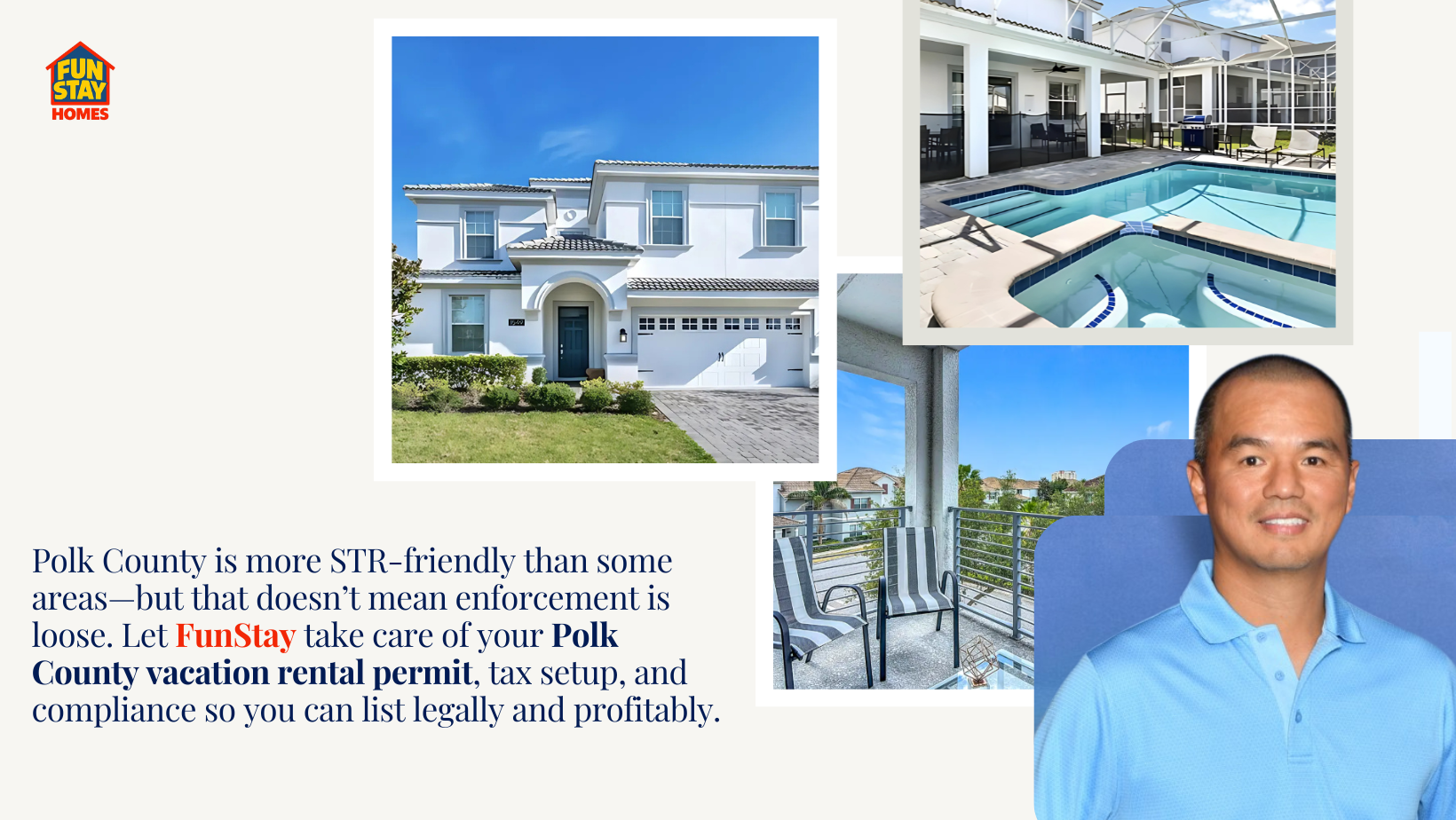
Hosting in Polk County can be simpler than in Orlando, but you still need the right permits and tax setup to stay compliant. Here’s what every host must know:
Class B Business Tax Receipt Required
To legally operate a short-term rental in Polk County, hosts must obtain a:
- Class B County Local Business Tax Receipt (applies to rentals under 6 months)
- Must be obtained for each rental location
- Fee includes:
- $50 application fee
- $10 Hospitality Education Program (HEP) fee
- License fee based on size + renewal cycle
- $50 application fee
Renewal is due by September 30 each year.
State License Is Mandatory
- You must first obtain a DBPR license from the Florida Dept. of Business and Professional Regulation
- Required before the county will issue your business tax receipt
Zoning & HOA Approval
- STRs must follow county zoning laws
- HOA approval is often required
- Contact Polk County Code Enforcement for zoning questions
Tax Breakdown: 12% Total
- 6% Florida Sales Tax
- 5% Tourist Development Tax (TDT)
- 1% Discretionary Sales Surtax
- Combined = 12% tax per booking (including cleaning fees)
- Hosts must register with both:
- Florida Dept. of Revenue
- Polk County Tax Collector
- Florida Dept. of Revenue
Penalties for Non-Compliance
- Fines up to $15,000 for operating without a license
- Incidents are flagged by the Polk County Sheriff’s Office for enforcement
- Repeat violations may lead to suspension of rental activity
Best Markets Near Orlando for STR Investment
Orlando’s 51% owner-occupancy rule makes it tough for pure investors. But several nearby markets have more permissive STR rules, lower tax rates, and strong vacation rental demand driven by Disney, Universal, and the 2025 Epic Universe opening.
Here’s how the top Central Florida STR markets compare:
| Market | STR Friendly? | Total Tax | Why Investors Choose It |
|---|---|---|---|
| Kissimmee (Osceola) | Yes, tourist zones | 13.5% | Closest to Disney. Established resort communities. Strong year-round occupancy. |
| Davenport (Polk) | Yes, resort areas | 12% | Lowest tax rate in the area. Growing market. Close to both Disney and Epic Universe. |
| Reunion Resort | Yes, zoned for STR | 13.5% | Premium community. Jack Nicklaus golf. Higher ADR. Attracts luxury guests. |
| ChampionsGate | Yes, zoned for STR | 13.5% | Large resort homes, up to 14 BR. Group/family bookings. Oasis waterpark. |
| Storey Lake | Yes, zoned for STR | 13.5% | Closest resort to Disney. Lennar-built. Townhomes and single-family options. |
For investors looking at the Orlando metro: The City of Orlando itself is designed for home-sharing, not investment rentals. If you’re buying specifically to Airbnb, look at Kissimmee, Davenport, or one of the established resort communities. These are zoned for short-term rental use and have proven track records. Get a free rental projection for any of these markets.
Taxes You Must Pay as an Orlando STR Host
Before you collect your first booking, make sure you’re tax-ready. Orlando short-term rental laws include strict tax obligations, and Orlando Airbnb tax requirements are more complex than many hosts expect. Getting them wrong could cost you hundreds in fines.
Here’s what you need to pay (and why it matters):
Florida State Sales Tax: 6%
Applies to all short-term stays under 6 months, including nightly rates, cleaning fees, and any other guest charges.
County-Level Taxes
Depending on your property’s location, you must also pay:
- Tourist Development Tax (TDT): 5–6%
- Discretionary Surtax: 0.5%–1.5%
- Convention Development Tax (Orlando/Orange County only): 2%
Orlando Example (Orange County):
- 6% State Sales Tax
- 0.5% County Surtax
- 6% TDT
- 2% Convention Tax
👉 Total: 14.5% tax on every short-term stay
Sample Tax Calculation (3-Night Stay @ $130/night + $45 cleaning):
- Total listing = $435
- Total taxes: $63.08
- Final guest payment: $498.08
Breakdown:
- State Tax (6%): $435 × 0.06 = $26.10
- Surtax (0.5%): $435 × 0.005 = $2.18
- TDT (6%): $435 × 0.06 = $26.10
- Convention Tax (2%): $435 × 0.02 = $8.70
Does Airbnb or Vrbo Collect These for You?
Yes—and no. Platforms like Airbnb and Vrbo may collect the state tax and some local taxes, depending on agreements with your county.
BUT:
- Hosts are still responsible for checking what’s collected vs. what needs to be manually filed.
- In most cases, you must register with the Florida Department of Revenue + your county tax office to remain compliant.
What About Deductions?
When you treat your rental like a business, you can deduct expenses to offset your taxable income:
- Repairs and maintenance
- Depreciation of furniture or structure
- Insurance premiums
- Utilities, supplies, and internet
- Professional services (e.g., cleaning, accounting)
Licensing & Compliance Checklist for Orlando-Area STR Hosts
Thinking of listing your property on Airbnb or Vrbo? Don’t skip this step. To meet Central Florida Airbnb compliance rules, you must secure licenses, permits, and tax IDs at both the state and local levels. Here’s your all-in-one checklist to avoid fines, delisting—or worse.
1. Get Your DBPR License (State Requirement)
All vacation rentals under 30 days must be licensed with Florida’s Department of Business and Professional Regulation (DBPR).
- Cost: $170/year (1 unit) or $180 (2–25 units)
- Apply online at myfloridalicense.com
- This is your official vacation rental license for Orlando
2. Register for State & Local Taxes
- Florida Sales Tax Number from the Dept. of Revenue
- County Tax Receipt (from Orange, Osceola, or Polk)
- You’ll pay 12–14.5% in combined taxes, depending on county
- Even if Airbnb collects some taxes, you’re still responsible for remittance in most cases
3. Apply for Local STR Permits
Each county has its own rules:
- Orange County/Orlando: $275 first-year fee, must live on-site ≥51% of the year
- Osceola County: License + safety inspections + $1M liability insurance
- Polk County: Class B Business Tax Receipt + HOA approval
4. Confirm Zoning + HOA Approval
Use orlando.gov/zoning to check if STRs are allowed in your neighborhood. If your home is in an HOA, you may need written permission to operate legally.
5. Pass Safety & Compliance Inspections
Most counties require:
- Floor plan with emergency exits
- Smoke detectors, CO alarms, fire extinguishers
- Proof of vacation rental insurance
Estimated Startup Costs for an Orlando-Area Airbnb
Nobody talks about the real upfront cost of getting a vacation rental off the ground. Here’s a realistic breakdown for a 3-bedroom property in the Orlando metro area.
| Expense | Estimated Cost | Notes |
|---|---|---|
| DBPR vacation rental license | $230/yr | $170 license + $50 app + $10 HEP. Required statewide. |
| Local STR permit | $63–$410 | Orange County: $63, 2-year. Orlando city: $275. Osceola: $410 first year. |
| County tax registration | Free–$50 | Register with county tax collector. Some charge a small filing fee. |
| Safety equipment | $200–$400 | Smoke detectors, CO alarms, fire extinguishers, pool barriers if needed. |
| STR insurance | $1,500–$3,000/yr | Standard homeowner’s doesn’t cover STR activity. Osceola requires $1M liability. |
| Furniture & supplies, 3BR | $15,000–$25,000 | Beds, linens, kitchenware, towels, decor. Can be lower for condos. |
| Professional photography | $200–$500 | Listings with pro photos earn 20–40% more per night. |
| Smart lock + lockbox | $150–$300 | Essential for self check-in. Most guests expect this. |
| Initial deep clean + setup | $300–$500 | One-time cleaning before your first guest. |
| Total Estimated Upfront | $18,000–$30,000 | For a fully furnished 3BR. Ongoing: about $2,500–$4,500/yr in licenses, insurance, taxes. |
Already furnished?
If you’re buying a turnkey vacation home in a resort community, the property often comes with furniture. That drops your upfront cost to $2,500–$5,000 for licensing, insurance, photography, and supplies. Our listing optimization service handles the photography and listing setup.
How FunStay Homes Makes Compliance Easy
Staying compliant in Central Florida isn’t just about filling out paperwork. It’s about keeping your property legal, profitable, and stress-free. That’s where FunStay Homes comes in.
As one of the best Airbnb property managers in Orlando, we handle every detail of short-term rental compliance across Orange, Osceola, and Polk Counties so you don’t have to.
Here’s how we make it easy:
Permit & Tax Filing
- We handle your DBPR license, city, and county permit applications, and monthly tax remittance, including short-term rental license requirements, so you never miss a deadline.
Zoning Verification
- We confirm your property is located in a legal STR zone and guide you through HOA restrictions if needed.
Safety & Inspections
- We install required safety equipment (smoke detectors, fire extinguishers, etc.) and coordinate inspections for fast approvals.
Guest Support & Revenue Optimization
- We provide 24/7 guest communication, screen bookings, and use dynamic pricing tools across Airbnb, Vrbo, and Booking.com to increase your earnings.
Get a free rental income projection today from the best Airbnb property managers in Orlando.
Thinking about investing in Orlando-area vacation rentals?
FunStay Florida manages 100+ properties across Orange, Osceola, and Polk counties. We handle
licensing, tax registration, cleaning, maintenance, and guest management so you focus on the
returns.
Frequently Asked Questions
