
The Orlando vacation rental market is shifting fast heading into summer 2026. Booking lead times are stretching, guests expect more flexibility, and quality signals matter more than ever. Here’s the data shaping the summer, plus the strategies we’re actively using across 100+ managed Orlando vacation rentals at FunStay Homes to stay ahead of it.
Orlando vacation rental trends in 2026 look very different from even two years ago. The market has matured. Supply has caught up. And the operators who used to win by simply owning a Disney-area pool home now have to actually run the business well to stay booked.
That is not a bad thing. It just means the playbook has changed.
Across the 100+ Orlando vacation rentals we operate at FunStay Florida, we see the same patterns repeating. The owners who outperform the market in 2026 are doing a handful of specific things right. The owners who are falling behind are still operating like it is 2022. This guide breaks down exactly what is working, what is not, and what Orlando vacation home owners should prioritize for summer 2026 and into the fall.
If you would rather skip the reading and just find out how your own Orlando vacation home is performing against the market, you can request a free rental performance review here. Otherwise, let’s dig in.
The 6 Orlando vacation rental trends shaping summer 2026
Before we get to strategy, here is the context. These are the six macro trends actually driving performance in the Orlando short-term rental market right now. If your strategy is not matching these, you are working against the market instead of with it.
1. Booking lead times are stretching
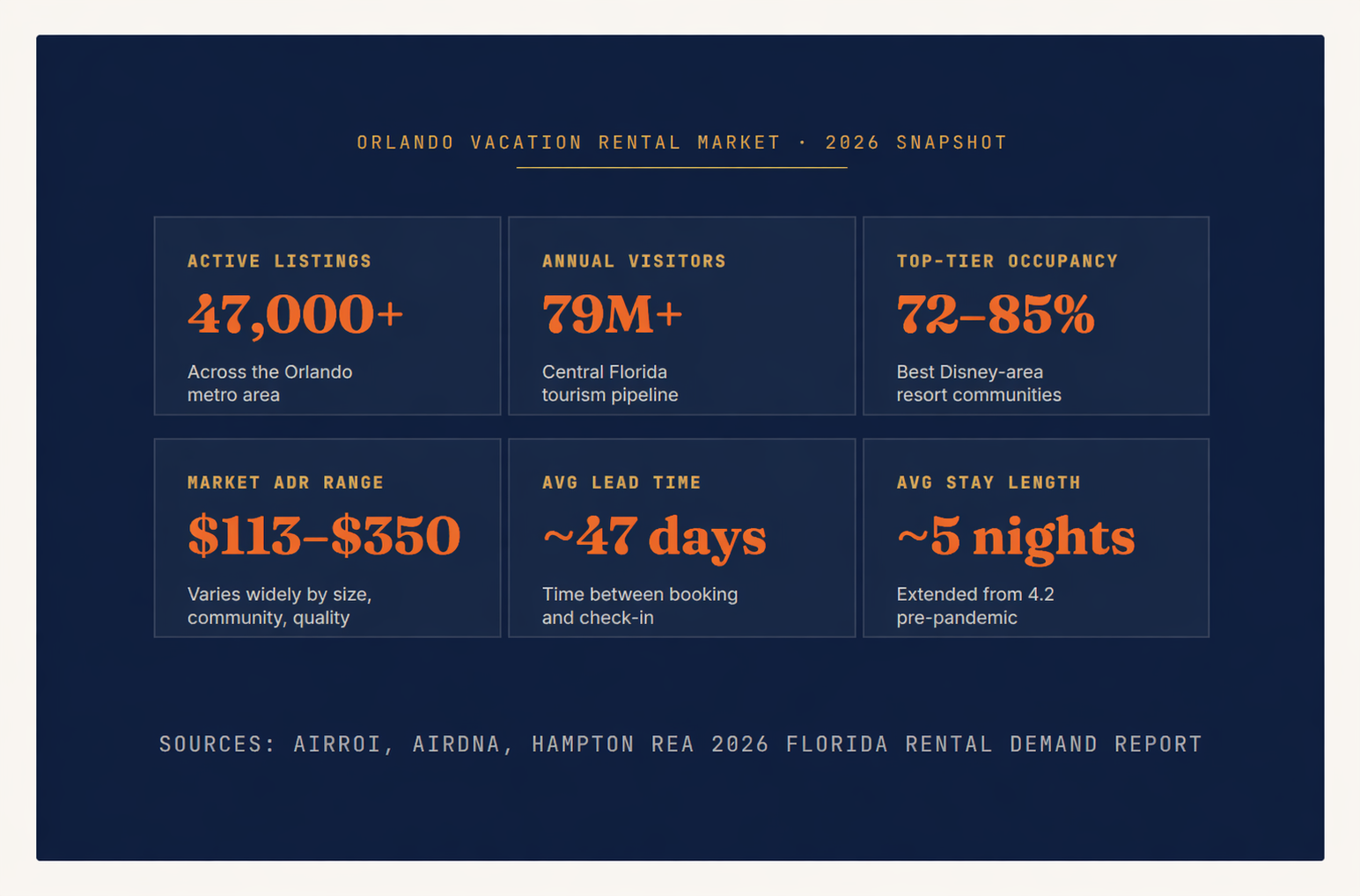
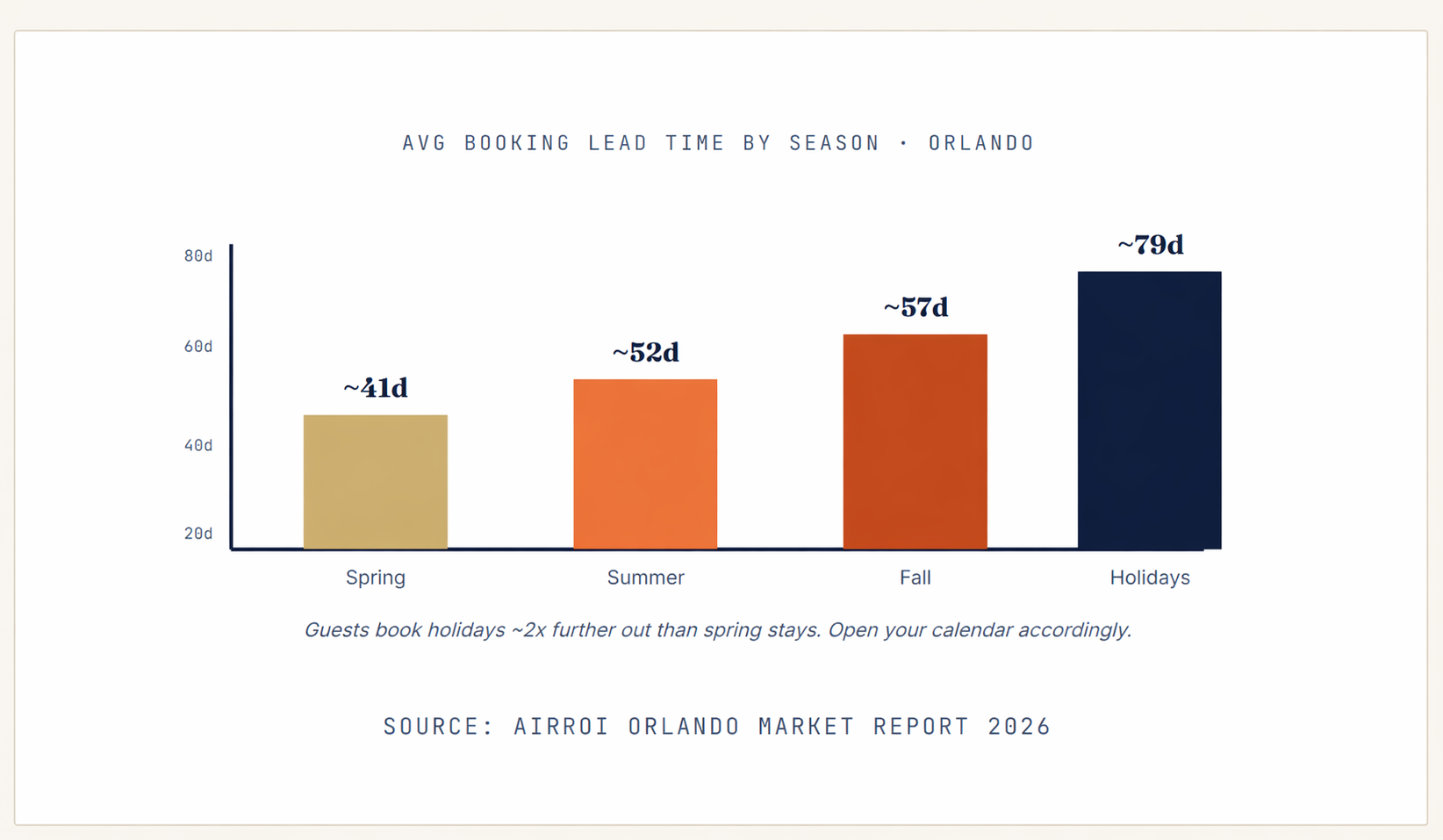
Through the first half of 2026, we have seen average booking lead times in Orlando trend upward. Published market data puts the Orlando average around 47 days, with fall and holiday stays being booked even further out. For family-sized properties (five or more guests), lead times are often longer still because families plan trips months in advance.
This is a double-edged sword. Longer lead times reward operators who open their calendars further out and who price appropriately for those far-out dates. They penalize operators who only publish availability a few months ahead or who leave summer and fall dates priced as if the booking is coming in next week.
2. Guests want more flexibility, not less
Cancellation flexibility is one of the clearest winners in the 2026 Orlando vacation rental market. Market-wide data shows that moderate and flexible cancellation policies are accounting for a disproportionate share of total bookings compared to their share of active listings. In simple terms: stricter policies are getting skipped.
Why? Because guests are more economically cautious in 2026 than they were two years ago. Rising credit card debt, travel-budget pressure, and competition from the expanding Orlando hotel supply mean guests are shopping harder. A property with an inflexible cancellation policy loses to a comparable property with a more forgiving one, all else equal.
3. Hotel competition is intensifying
Orlando accounts for roughly a quarter of all new hotel rooms under construction in Florida. Universal’s Epic Universe has added another major attraction and a wave of nearby hotel inventory. That means your Orlando vacation home is no longer just competing against other vacation rentals. It is competing against hotel packages with free breakfasts, easy cancellations, and Disney/Universal partnerships.
The winning response is not to chase hotel pricing. It is to lean harder into the things hotels cannot offer: space, themed experiences, private pools, full kitchens, and genuinely memorable guest experiences.
4. Quality is pulling farther ahead
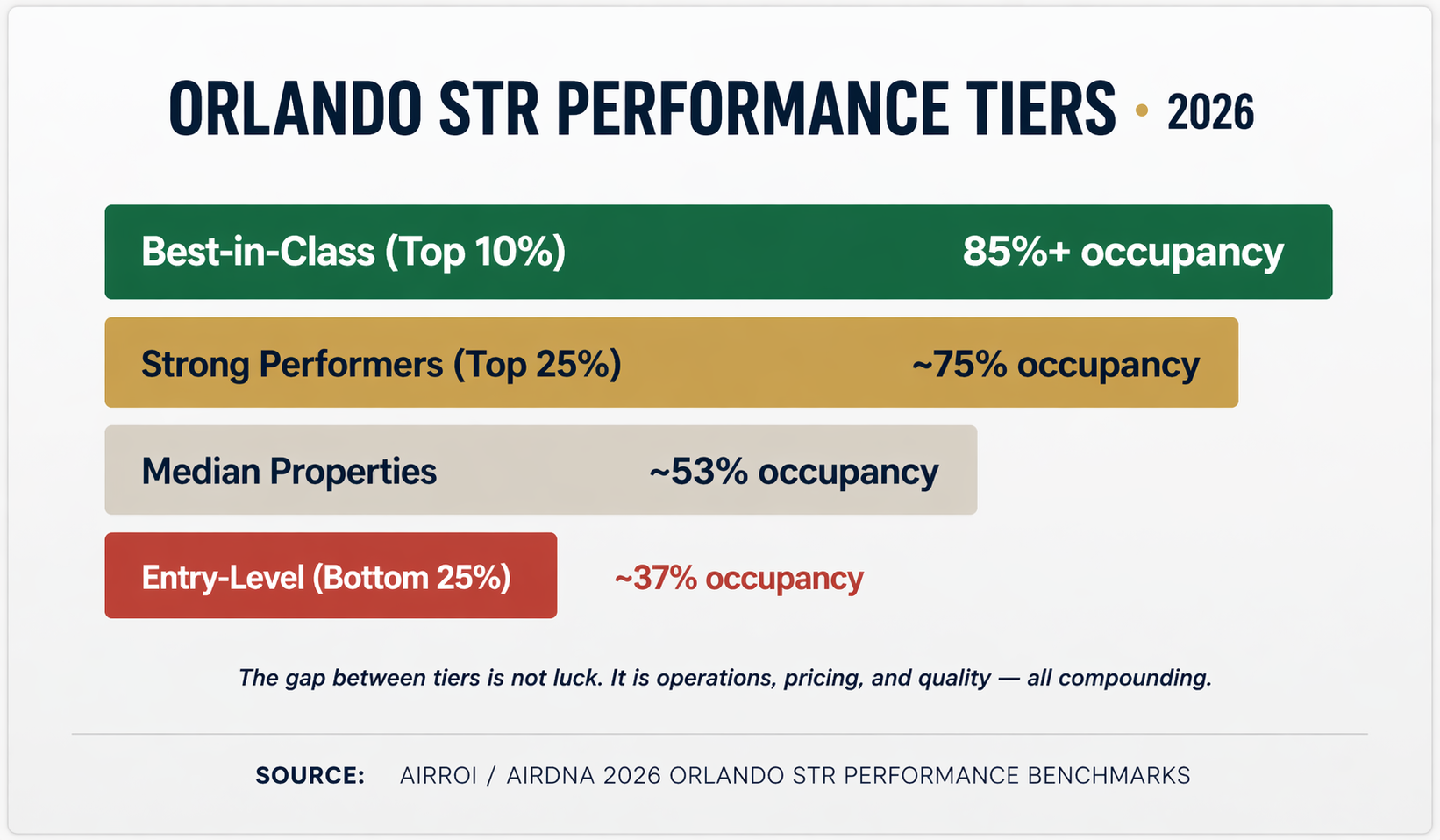
The gap between top-performing Orlando vacation rentals and median performers keeps widening. Industry data consistently shows that best-in-class properties hit 85 percent or higher annual occupancy while median listings sit around 53 percent. Same city, same guests searching, vastly different outcomes.
What drives the difference? Consistently high review scores, fast host responsiveness, professional photography, complete listing content, and an operational setup that actually delivers what the listing promises. This is exactly why our listing optimization and SEO service is one of the most-requested things we do for owners who are stuck in the middle tier.
5. Length-of-stay patterns are fragmenting
The old “seven-night Saturday-to-Saturday booking” is no longer the majority of Orlando vacation rental stays. In 2026, a large share of bookings are three to four nights, with a meaningful cluster of two-night weekend stays as well. This matters because properties with rigid seven-night minimums are invisible to the majority of the market.
The flip side is that longer stays still exist, especially for international guests, who now average over eight nights per trip. The smart play is dynamic minimum stays that shorten during slower windows and expand during peak weeks.
6. Summer 2026 has unique demand drivers
Summer 2026 brings FIFA World Cup matches to the region and a general surge of event-driven travel. While the direct halo effect on Orlando from tournament locations like Miami is more limited than people expected, Orlando itself is still one of the strongest family-travel markets in the country, and 2026 is tracking to be a strong summer for vacation rentals broadly.
Orlando short-term rental strategies that are working right now
With the market context set, here are the specific Orlando short-term rental strategies we are running across our managed portfolio in 2026. These are the moves actually producing measurable revenue lift, not theoretical best practices.
Strategy 1: Open your calendar further out (and price it)
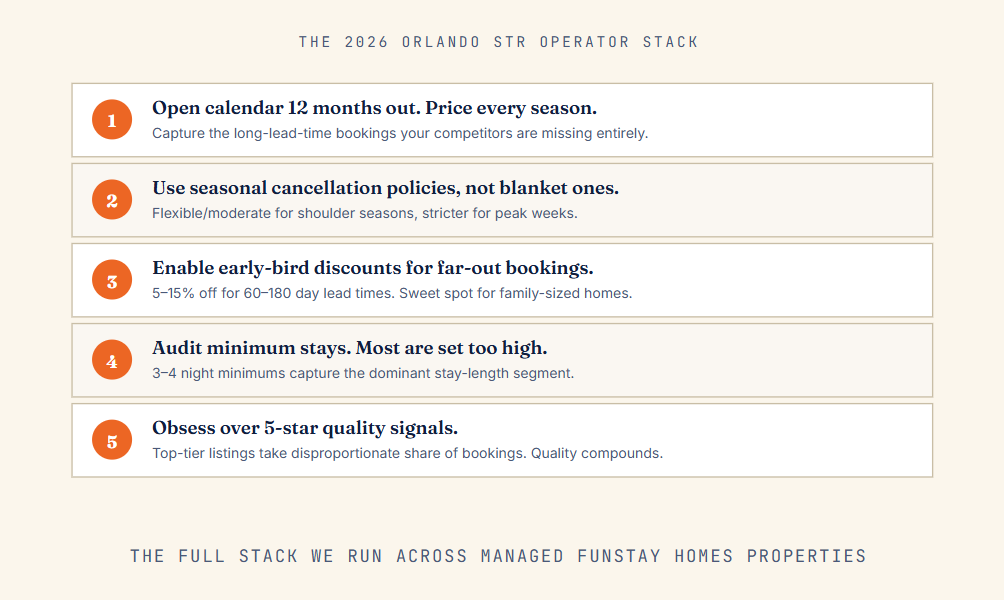
If your calendar only shows availability 60 to 90 days out, you are invisible to the roughly half of the Orlando summer and fall guests who book further in advance. Open your calendar at least 12 months ahead. For holiday weeks (Thanksgiving, Christmas, New Year, spring break), open 18 months ahead if your platform allows.
Opening the calendar is only half of the play though. The other half is pricing those far-out dates correctly. Our dynamic pricing service layers in historical data, upcoming event demand, and community-specific factors to set prices that capture early bookings without leaving money on the table.
Strategy 2: Revisit your cancellation policy
For many Orlando vacation home owners, switching from a strict cancellation policy to a moderate or flexible one is the single highest-ROI change they can make. The bookings shift is meaningful, and the actual cancellation rate rarely offsets the lift. Guests are not cancelling more just because you give them the option. They are just more willing to book you in the first place.
A smart middle-ground approach: use stricter policies only for your highest-demand weeks (New Year, spring break, Christmas) and use flexible policies for the rest of the year. Seasonal cancellation flexibility captures conversion when demand is softer without risking peak-week revenue.
Strategy 3: Add early-bird discounts strategically
Early-bird discounts are underused in Orlando. Small incentives (5 to 15 percent off) for guests booking 60 to 180 days out pull in the exact audience that is already shopping early. Even better, early-bird bookings tend to have longer lead times, which means less volatility in your calendar and more forward revenue visibility.
Early-bird discounts are especially effective for three property types:
- Large-group homes (six-plus bedrooms) where trips require more advance coordination
- Properties with availability at least one month ahead of time
- Properties that have been historically slower to book
We layer early-bird merchandising into our managed listings carefully. Too aggressive, and you train your guest base to always wait for a discount. Too passive, and you miss the competitive edge. The sweet spot is usually a modest early-bird combined with firm pricing closer to arrival.
Strategy 4: Audit your minimum length of stay
Here is a stat that surprises most owners: around 43 percent of Orlando vacation rental bookings are 3 to 4 nights, and roughly 17 percent are just 2 nights. Yet a huge share of Orlando listings still have 7-night or 5-night minimums locked in across the entire calendar.
Those minimums are silently killing bookings during shoulder weeks. The smart approach is dynamic minimums: 5-plus nights for holiday weeks and peak summer, 3 to 4 nights for shoulder weeks, and 2 nights for last-minute gap-fill windows. Opening up shorter stays during slower periods often fills calendar gaps that would otherwise remain empty and revenue-free.
Strategy 5: Invest in 5-star quality signals
This is the one owners avoid because it feels qualitative rather than quantitative. But the quality gap in Orlando is real and it is measurable. Listings with consistently high review scores get outsized shares of bookings. It is the single biggest compounding advantage in the 2026 market.
Quality signals include: professional photography refreshed annually, a complete and optimized listing description, fast guest communication (ideally under an hour), spotless cleaning, thoughtful welcome touches, and real attention to maintenance before small issues become bad reviews.
Our full-service Orlando property management covers all of this, but even owners who self-manage can move the needle by prioritizing these items one at a time.
+37%
Higher earnings on FunStay-managed Orlando vacation rentals vs. the Orlando market average, with +19% higher occupancy. The strategies above are how we get there.
Orlando vacation home summer 2026: what to watch month by month
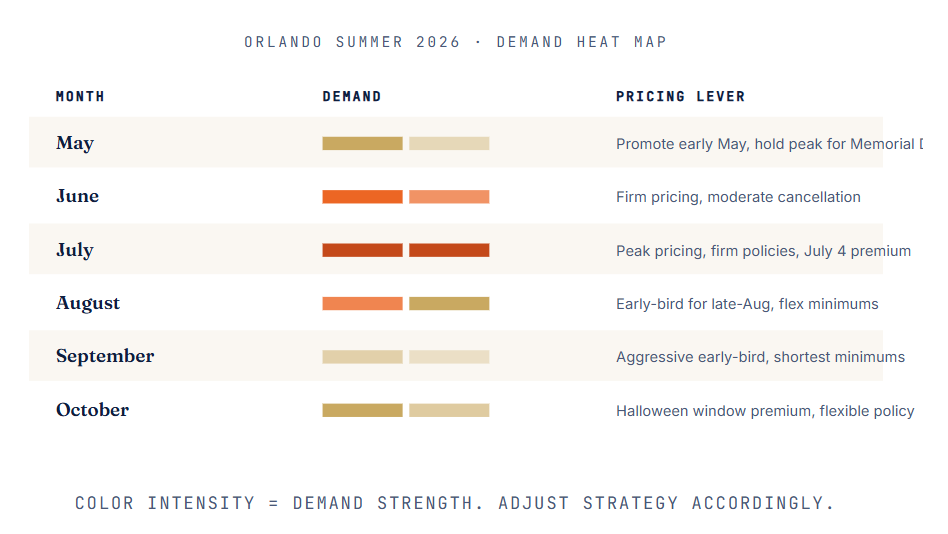
Summer 2026 is not uniform. Different months behave differently, and your pricing and availability strategy should reflect that. Here is what we are seeing play out across our managed Orlando vacation rentals, and what every Orlando vacation home owner should plan for.
May 2026
May is a key shoulder-season month that has been quietly growing in importance. With many school districts ending classes earlier, late-May family travel has expanded. Memorial Day weekend anchors the month, but the week before also performs well. Early-May is softer and is a good window to use promotional pricing or shorter minimum stays to fill.
June 2026
June kicks off the true peak family season. Demand is strong across family-sized homes, particularly in Reunion Resort, ChampionsGate, and the Windsor resort family. Watch for Juneteenth (June 19) as a mid-month anchor. Summer 2026 also brings international event-driven travel, though Orlando’s halo from tournament host cities is more limited than some forecasts expected.
July 2026
July is historically Orlando’s biggest month for family bookings and 2026 is tracking consistent with that. The July 3-4 holiday window books up earliest. Properties without their pricing optimized for the Independence Day peak leave meaningful revenue on the table every single year.
August 2026
August is the pivot month. Demand softens in the second half as families return to school, but remote-work families continue to book shoulder weeks into the last half of the month. This is prime territory for early-bird discounts and flexible minimum-stay windows.
September and October 2026
September is the lowest-demand month of the fall, and October picks up with Halloween demand. Pricing and promotional merchandising matter more here than in the summer because you are competing harder for a smaller pool of guests. The good news: lead times for fall and holiday bookings are longer, so what you set in spring and summer determines your fall occupancy.
Orlando vacation rental pricing strategy for the 2026 season
An Orlando vacation rental pricing strategy for 2026 needs three layers working together: a base rate that reflects your property and community, dynamic adjustments for daily demand shifts, and promotional merchandising that adds a competitive edge at the listing level.
Layer 1: Right-sized base rates
Every community has a different going rate. A three-bedroom in Windsor Hills is not priced the same as a three-bedroom in Paradise Palms, even if the physical footprint is similar. Base rates should reflect your specific community’s tier, your home’s quality level, and your amenity package (pool, hot tub, themed rooms, theater rooms, game rooms all add measurable premium). Getting this layer wrong is why many self-managed Orlando vacation homes underperform regardless of what they do with dynamic pricing on top.
Layer 2: Dynamic adjustments
On top of the base, dynamic pricing tools adjust nightly rates based on demand signals: upcoming local events, conference windows, theme park special events, competitor occupancy, and more. These adjustments happen constantly, every day, across the full forward calendar. Operating without them in 2026 is like running a hotel with a single rate card for the whole year.
Layer 3: Promotional merchandising
This is the layer most owners miss entirely. Booking platforms reward listings that use discounts with additional visibility: strikethrough pricing in search results, callouts on the listing page, inclusion in targeted guest emails. A 10 percent discount often generates far more than 10 percent lift in bookings because of the merchandising benefits attached to it, not just the lower price.
If you are running Orlando vacation rental pricing strategy without all three layers, you are leaving measurable revenue on the table. Our booking management service and price optimization service combine all three for our managed portfolio.
Get a free vacation rental performance review
Want to know how your Orlando vacation home compares to 2026 market trends? Get a free, no-obligation rental performance review from FunStay Florida. We’ll benchmark your current ADR, occupancy, and booking velocity against comparable properties in your community, and flag the top 3 gaps you can close this summer.
dian is dramatic. Median Orlando properties hit occupancy rates around 53 percent. Top-quartile properties consistently hit 75 percent or higher. And the very best performers exceed 85 percent. That gap is not random. It is the direct result of specific, repeatable operational decisions.
Here is what the top performers in our portfolio consistently do differently:
- They refresh listing content quarterly. Photos, descriptions, amenity lists, and seasonal positioning all get reviewed every 90 days, not left on autopilot.
- They respond fast. Median hosts take hours to respond. Top performers respond in under 60 minutes, every time.
- They price dynamically across the full calendar. No stale rates, no flat-priced months, no forgotten holiday weeks.
- They use every discount layer available to them. Early-bird, length-of-stay, last-minute, and targeted promotions each earn their own lift.
- They operate in the best communities. Community choice alone creates a 20 percent occupancy gap. Properties in top Orlando resort communities simply book more.
- They treat guest experience as the compound-interest asset it is. Every 5-star review today produces more bookings next month. Bad reviews compound in the opposite direction.
This is also why the community your property sits in matters so much. We manage properties across most of the top-performing Orlando resort communities, including Orlando, Kissimmee, Davenport, and luxury Orlando vacation rentals. We can tell you, from daily operational data, exactly how your specific community is performing and what that means for your summer strategy.
Short-term rental occupancy Orlando: how to move up a tier
If you are currently in the median tier of short-term rental occupancy in Orlando and want to move into the top 25 percent (or top 10 percent), the playbook is clear. It is not about spending $50,000 to renovate. It is about closing the operational gaps one by one.
The fastest wins we see when we take over a median property:
- Listing optimization. Rewriting the title, description, and amenity list for the platforms’ current algorithms. This alone often lifts click-to-book ratios by 15 to 25 percent within 60 days.
- Professional photography. Professional photos book faster than amateur photos. Full stop. This is the highest-ROI single investment most Orlando vacation home owners can make.
- Cancellation policy softening. Moving from strict to moderate (or moderate to flexible for shoulder seasons) almost always lifts bookings.
- Dynamic pricing implementation. Replacing flat or seasonal pricing with true dynamic pricing typically lifts revenue 10 to 20 percent in the first full year.
- Minimum-stay audit. Cutting rigid 5 or 7-night minimums outside peak weeks fills the calendar gaps other operators cannot reach.
- Response-time improvement. Getting response times under an hour lifts both bookings and review scores, a true compounding win.
Every one of these is something we handle inside our full-service property management. But owners who self-manage can still move the needle by tackling them systematically, one at a time.
Orlando Airbnb market 2026: what summer will look like for self-managing owners
If you self-manage your Orlando vacation home, summer 2026 will separate the owners who adapt from the ones who do not. The operators staying competitive this summer are already doing these things:
- Reviewing and updating their listing content every quarter
- Checking competitor pricing at least weekly
- Adjusting minimum stays by season, not running one-size-fits-all
- Using at least one form of early-bird or length-of-stay discount
- Responding to guest messages within an hour
- Investing in seasonal photo refreshes (pool in summer, cozy interiors in winter)
- Tracking their actual performance metrics (occupancy, ADR, RevPAR) monthly
If any of those sound like a heavier lift than you have bandwidth for, that is exactly why full-service Orlando vacation rental management exists. We run this playbook every day across 100+ properties, so owners do not have to.
The Orlando vacation rental market in 2026 rewards operators, not owners. The good news is operational excellence is learnable. The better news is you can also just hire it.
Mike Chen, Co-founder, FunStay Homes
Your Orlando vacation rental cancellation policy: small change, big impact
One of the simplest and most overlooked levers in 2026 is your Orlando vacation rental cancellation policy. Let me break down why this matters so much for summer 2026 specifically.
Guests in 2026 are shopping with more financial caution than they were in 2022 or 2023. A rigid cancellation policy is read as a risk factor. A moderate or flexible one removes that friction at the moment of decision. Because cancellation rates in practice are not dramatically higher on flexible policies, the lift in bookings almost always outweighs the cost of the occasional cancelled reservation.
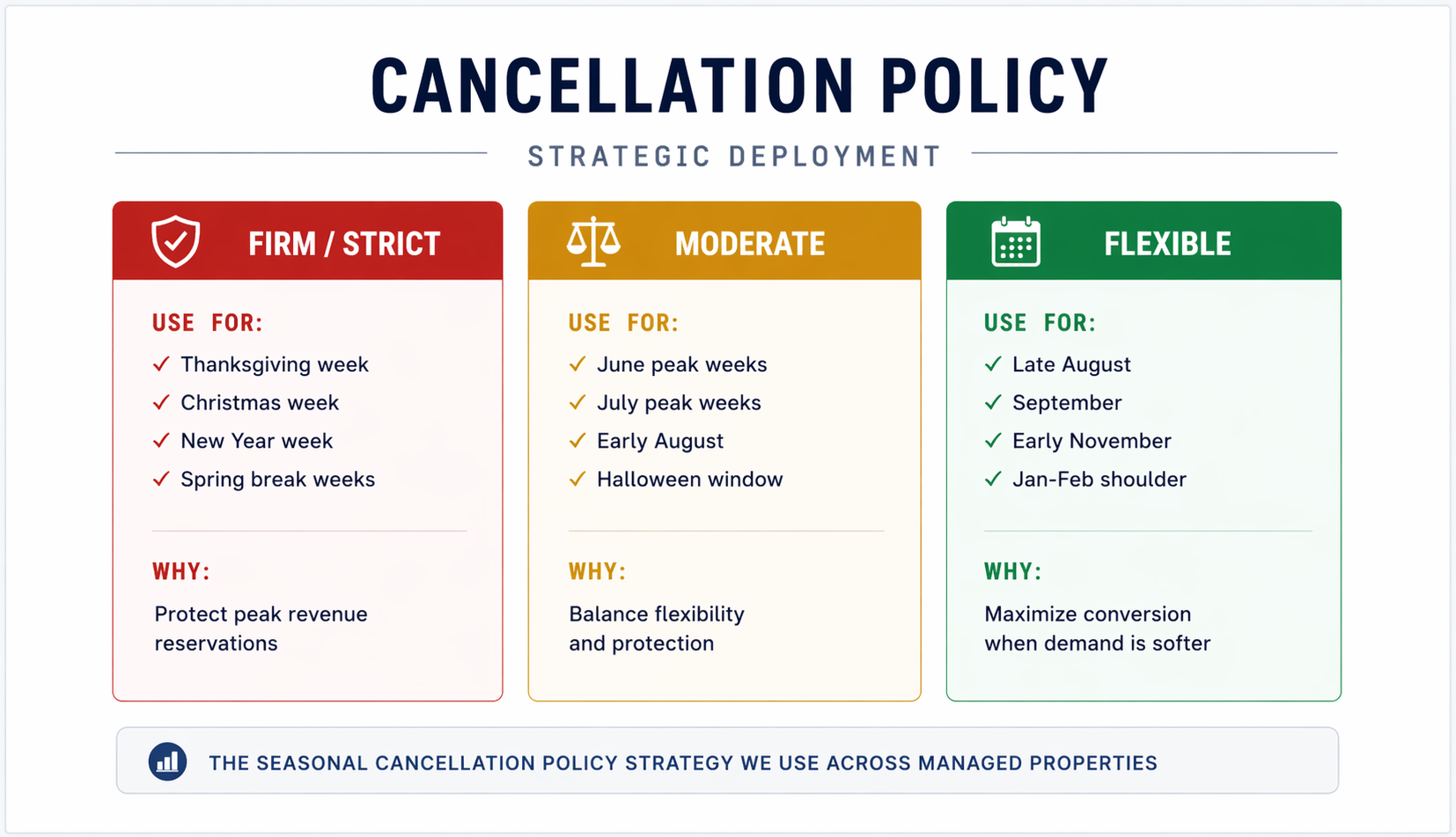
For Orlando vacation home owners who are nervous about going fully flexible, the seasonal approach we recommend works like this:
- Firm or strict policy on Thanksgiving week, Christmas week, New Year week, and spring break weeks
- Moderate policy on the rest of peak summer (June to mid-August)
- Flexible policy on shoulder weeks and slower months (late August to early November, January to February)
This approach protects your peak revenue dates while capturing the conversion lift on the rest of the calendar. It is the single change I recommend most often to owners who reach out asking how to improve results.
Get a free vacation rental performance review
Want to know how your Orlando vacation home compares to 2026 market trends? Get a free, no-obligation rental performance review from FunStay Florida. We’ll benchmark your ADR, occupancy, and booking velocity against the top performers in your community, and tell you exactly what to change for summer 2026.
Frequently Asked Questions about Orlando vacation rental trends in 2026
How is the Orlando vacation rental market performing in 2026?
The Orlando vacation rental market in 2026 is more mature and more competitive than in previous years. Top-tier properties in the best resort communities continue to hit 75 to 85 percent annual occupancy, while median properties sit closer to 53 percent. The performance gap between top and median has widened, meaning operational excellence, dynamic pricing, and quality signals now matter more than ever. The overall market remains one of the strongest in the U.S. thanks to Central Florida’s 79+ million annual visitors and the opening of Universal’s Epic Universe.
What is the best cancellation policy for my Orlando vacation home in summer 2026?
For summer 2026 specifically, the strongest approach is a seasonal cancellation policy. Use firm or strict policies for peak holiday weeks (Christmas, New Year, spring break) to protect high-revenue dates. Use moderate policies during core summer peak weeks. Use flexible policies for shoulder weeks and slower months like September. This approach captures the conversion lift that flexible policies deliver without sacrificing peak-week revenue protection.
How far in advance should I open my Orlando vacation rental calendar?
At minimum, open your calendar 12 months out. For peak holiday weeks, open 18 months out if your booking platform allows. In 2026, Orlando vacation rental guests are booking further in advance than in previous years, with fall and holiday travelers averaging 60 to 80 days of lead time. Short calendar windows make you invisible to a large share of the market.
Should I offer early-bird discounts on my Orlando vacation home?
Yes, especially for properties that accommodate larger groups, properties with availability at least one month out, and properties that have historically been slower to book. A modest early-bird discount (5 to 15 percent off for guests booking 60 to 180 days ahead of arrival) tends to attract early planners, stabilize your forward revenue, and unlock additional visibility benefits on booking platforms like strikethrough pricing and promotional merchandising.
What minimum-stay length works best for Orlando vacation rentals in 2026?
Dynamic minimum stays work best in 2026. For peak holiday weeks and core summer, a 5 to 7 night minimum protects your highest-revenue dates. For shoulder weeks, a 3 to 4 night minimum captures the dominant stay-length segment (the majority of Orlando bookings are 3 to 4 nights in 2026). For last-minute gap-fill windows, a 2-night minimum helps close calendar holes. One-size-fits-all minimums cost you bookings in slower windows.
How do I know if my Orlando vacation home is underperforming the market?
The simplest benchmarks: if your annual occupancy is below 60 percent, you are tracking behind the top quartile and well behind best-in-class. If your ADR is flat year over year while comparable properties in your community are growing, that is a signal. If guests are asking a lot of pre-booking questions that should have been answered in the description, your listing content is underperforming. The fastest way to find out exactly where you stand is to request a free Orlando vacation rental performance review from FunStay Florida. We will benchmark you against comparable properties and flag the top gaps.
