
The fear of losing income, reviews, or guest momentum keeps most owners stuck with underperforming property managers for 6 to 12 months longer than they should be. It doesn’t have to be that way. Here’s the exact transition playbook we use to onboard new owners at FunStay Homes with zero booking loss, zero review loss, and zero calendar gaps.
Most owners know when it’s time to switch property managers. The signs are usually obvious: declining bookings, poor communication, a property that no longer looks like your property, owner statements that make no sense. The harder part isn’t recognizing the problem. It’s knowing how to make the move without blowing up your calendar, losing your hard-earned reviews, or creating a mess for the guests already booked at your home.
We get calls every week from Orlando vacation rental owners in exactly this spot. They want to switch property managers but they’re scared of the transition. They’ve heard horror stories: a 30-day dark period with no bookings, disappearing Airbnb reviews, angry guests stuck in the middle of a handover, months of lost revenue.
Here’s the truth: a properly-managed transition produces zero of those outcomes. We’ve onboarded dozens of Orlando owners from their previous managers and preserved every single confirmed booking, every review, and every dollar of revenue in the process. This is the playbook.
Before you switch property managers: know what you’re actually preserving
The first step when you switch property managers is getting clear on what’s at stake. Most owners focus on the wrong things. Here’s what actually matters, in order of difficulty to preserve.
What’s fully preservable (handled right)
- Confirmed future bookings. Every reservation on the books transfers with zero guest disruption when the handover is sequenced correctly.
- Your property’s physical assets. Furniture, decor, amenities. None of this depends on the manager.
- Revenue history and listing photos. Yours to keep and use on any new listing.
- Direct booking website and domain. If you own the domain, you keep it.
- Owner-held listing accounts. If your Airbnb and VRBO accounts are in your name (not the manager’s), you keep all reviews.
What’s partially preservable (depends on setup)
- Airbnb reviews. If the manager’s account hosts the listing, reviews stay with that account. Some workarounds exist, detailed below.
- Superhost status. Reset risk exists when moving between accounts.
- Vendor relationships. Cleaners, handymen, pool services may or may not follow you, depending on contracts.
What’s usually not preservable
- Manager-held direct booking listings. If they built a site in their brand, it stays with them.
- Their proprietary guest database. Past guests contacted through their CRM won’t transfer.
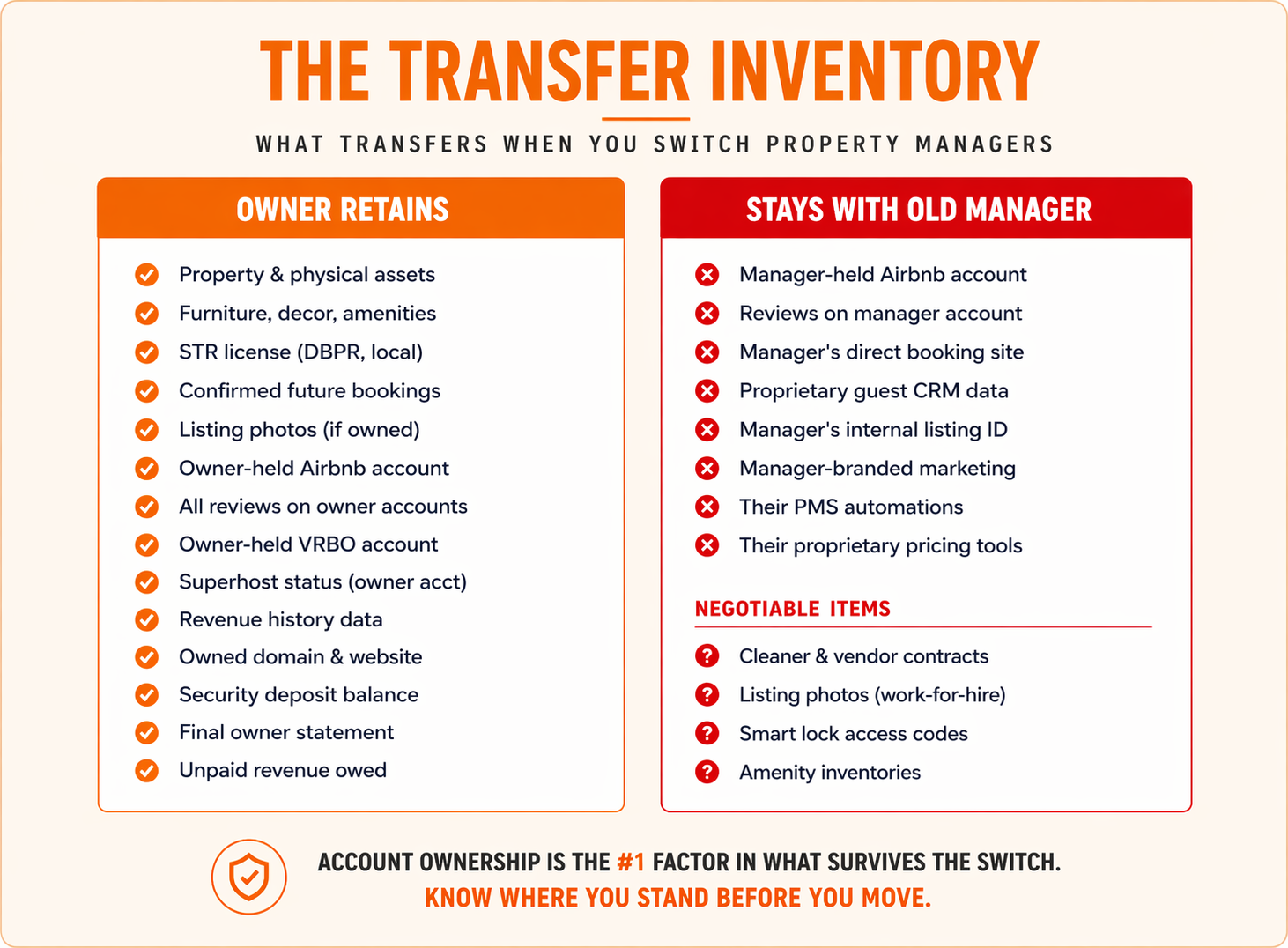
The single most important factor determining what survives the switch is who owns the listing accounts. Owners who kept Airbnb and VRBO accounts in their own name lose nothing when they switch property managers. Owners who let the manager create accounts in the manager’s name face a harder road. We’ll cover both scenarios.
The 5 situations where switching property managers makes immediate sense
Not every frustration justifies a switch. But these five situations almost always do. If any of these apply, the math for switching is usually a slam dunk.
1. Your bookings are declining year-over-year in a stable or growing market
Orlando’s vacation rental market is expanding, not shrinking. If your property’s revenue is going down while the market is going up, your manager is the bottleneck. According to industry performance data, owners who switch to higher-performing management companies typically see a 10 to 25 percent increase in net income within the first year.
2. Your manager won’t share dynamic pricing data or strategy
A good manager should walk you through exactly how your nightly rates are set, which events trigger price spikes, and how minimum stays flex with demand. If you ask and the answer is vague, they’re probably running flat seasonal pricing and losing you money every week.
3. You’re getting guest complaints about response time or property condition
Guest complaints about the manager leak directly into your reviews. Every “the manager took 8 hours to respond” line in a review hurts your listing ranking. Orlando’s competitive market means these reviews cost you dozens of future bookings.
4. Owner statements don’t match your listing data
If your monthly statement shows $4,200 in gross bookings but you can count $5,800 of confirmed stays on the calendar, something is wrong. Either the manager’s accounting is sloppy (bad) or they’re keeping revenue that belongs to you (worse). Either way, time to switch property managers.
5. Your contract is ending and renewal terms got worse
Some managers use the renewal moment to quietly raise their fees, add new charges, or extend lockup periods. A renewal is the perfect window to evaluate alternatives, since your exit cost is zero.
We’ve covered the broader warning signs in our 10 red flags guide. Worth reading if you’re still on the fence about whether to move.
The 5-phase transition playbook to switch property managers with zero disruption
Here’s the exact 60-day timeline we use when we onboard an Orlando owner who wants to switch property managers. The whole thing is engineered around one non-negotiable principle: no guest experiences a disruption, no booking is lost, and no review is compromised.
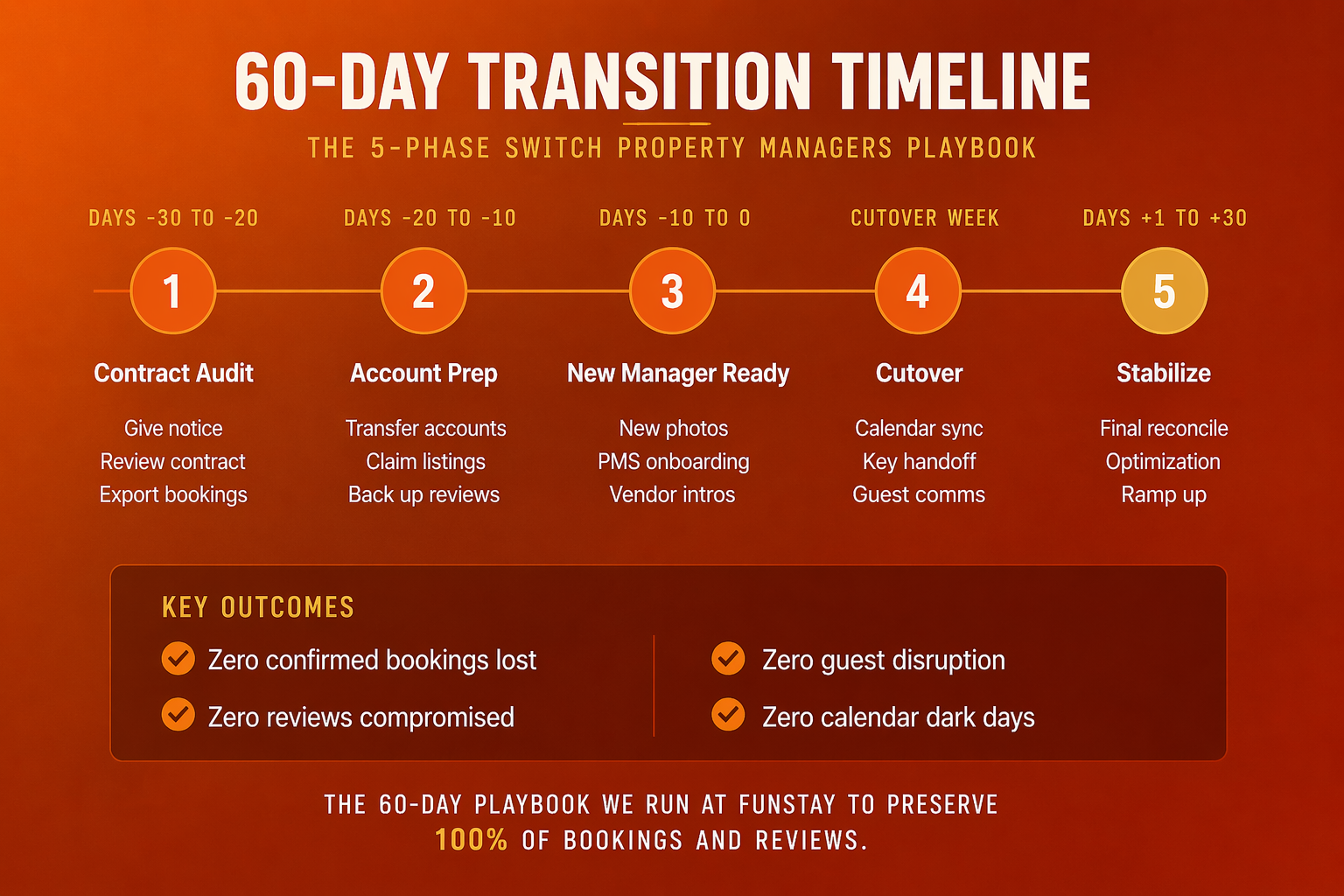
Phase 1: Contract audit (Days −30 to −20)
Before you say a word to your current manager, pull out your management agreement and read it carefully. You’re looking for three specific things:
- Notice period. Usually 30 to 60 days. Some contracts require written notice delivered specific ways (email, certified mail). Miss the method and you could owe another month of fees.
- Early termination clauses. Some contracts let you exit immediately for performance failures. If your manager has dropped the ball, this may apply.
- Booking honorability clause. Check whether the outgoing manager is required to honor bookings already on the calendar. Most contracts include this.
Once you understand your exit rights, send formal notice. Don’t be emotional about it. A simple, factual email naming your termination date is enough. You don’t owe anyone an explanation when you switch property managers.
Phase 2: Account preparation (Days −20 to −10)
This is the most critical phase and where most owners go wrong. If your listing accounts are in the manager’s name instead of yours, you need to address this now.
If accounts are already in your name (ideal):
- Change passwords immediately after giving notice
- Update payout banking to your own account
- Screenshot every review as a backup
- Export your booking history and guest data
- Download all photos from your listing
If accounts are in the manager’s name (harder):
- Request in writing that all listings be transferred to your name
- If they refuse, Airbnb’s policy allows host transfer requests with proper documentation
- Create a backup profile in your name and prepare to relaunch if transfer fails
- Screenshot every review before the transition so you can reference them publicly
The sooner you identify which scenario applies, the more options you have. Owners who discover mid-transition that their manager owns the account face the hardest road.
Phase 3: New manager ready-state (Days −10 to Day 0)
Your incoming management team should be using this window to prepare everything for a seamless takeover. At FunStay, we use this phase to:
- Conduct a property walk-through and inventory check
- Take fresh professional listing photos
- Rewrite the listing description for improved ranking
- Import all confirmed bookings into our property management system
- Set up cleaner schedules aligned with the booking calendar
- Establish vendor relationships (pool, handyman, pest control)
- Configure dynamic pricing and minimum-stay rules
- Prepare guest communication templates branded to your property
A manager who can’t list these steps back to you in detail isn’t ready to take over your property. If they’re vague about the transition process, they’ll be vague about management too.
Phase 4: Cutover week (Days 0 to +7)
Cutover is the narrow window where the outgoing and incoming managers officially change places. Everything hinges on sequencing. Here’s what needs to happen, usually within 48-72 hours:
- Calendar synchronization: all confirmed bookings imported to new PMS
- Payment methods updated on all booking platforms
- Smart lock codes reprogrammed (if applicable)
- Physical key handoff with the new team
- Cleaning service transition (new cleaner intro completed)
- Guest notifications sent for any guests arriving in the next 30 days
- Backup access to the property documented
At FunStay, we handle all cutover coordination ourselves so the owner doesn’t have to. Our full-service property management team runs the 48-hour cutover checklist like a military operation. The owner signs once and we handle the rest.
Phase 5: Stabilize and optimize (Days +1 to +30)
The first 30 days under new management set the tone. This is where you should expect:
- A full final reconciliation with the previous manager (outstanding revenue owed, security deposits, etc.)
- Fresh photography and listing optimization deployed
- Dynamic pricing fully calibrated based on first-week data
- First owner statement from the new manager
- A kickoff call to review performance expectations and reporting cadence
Properly-executed transitions ramp to full performance by day 30. By day 60, most owners see meaningfully better results than they were getting before.
What actually transfers when you switch property managers: the complete checklist
Here’s the detailed transfer inventory we walk through with every owner during onboarding. Not every item applies to every property, but using this checklist prevents gaps.
Protecting your Airbnb reviews during a property manager switch
Of all the fears that keep owners from making the move, losing Airbnb reviews tops the list. It’s the single most common question we hear: “Will I lose my reviews if I switch property managers?”
The honest answer depends entirely on whose Airbnb account hosts your listing. Let’s break it down clearly.
Scenario A: Your Airbnb account hosts your listing
If the listing lives on your Airbnb account and the manager simply had co-host access, you keep 100 percent of your reviews when they’re removed as a co-host. Nothing changes from the guest’s perspective. The listing URL stays the same, the review count stays the same, and your Superhost status is preserved (if earned).
This is the best-case scenario and the arrangement we recommend every FunStay owner set up from day one. It’s also why our onboarding includes setting up or verifying owner-held accounts.
Scenario B: The manager’s account hosts your listing
This is where it gets complicated. If the listing lives on the manager’s Airbnb account, the reviews technically belong to that account. Three paths forward:
Path 1: Request a listing transfer. Airbnb allows property listings to be transferred between hosts with proper documentation. Success rates vary, and the manager must cooperate. If they do, you keep the reviews. If they don’t, you need another path.
Path 2: Launch a new listing with review screenshots referenced. You start a fresh listing on your own account and reference prior reviews in the description (“Previously managed property, 4.9-star rating from 127 reviews, references available”). Not ideal, but works.
Path 3: Run dual listings temporarily. During the transition, some owners keep the old listing active (under the manager) while building up the new one. Expensive and only works for a limited window, but preserves continuity during ramp-up.
For owners we onboard who fall into Scenario B, we generally recommend Path 1 first and fall back to Path 2 if the manager refuses cooperation. Either way, we protect the owner from the worst-case outcome.
100%
of confirmed future bookings transfer cleanly to a new manager when the handover is sequenced correctly, regardless of which Airbnb account hosts the listing.
Red flags to watch for in any new property management company
Before you switch property managers, make sure the incoming company is actually better than the one you’re leaving. Here are the specific red flags that should make you pause before signing.
- They want long-term lockups (12+ months). Good managers earn your business every month. Long contracts protect them, not you.
- They won’t share specific performance data. Any reputable manager will show you revenue, occupancy, and ADR numbers from their current portfolio in your community.
- They don’t handle the transition for you. If they’re dumping logistics on you, they’ll dump everything else on you too.
- Their management fee seems too low. If they’re undercutting the market by 30+ percent, they’re skimping somewhere (cleaning quality, response time, marketing budget).
- No performance guarantees or exit options. Great managers put their money where their mouth is. No guarantee means no accountability.
- No Orlando-specific track record. Managing beach rentals in Gulf Coast is not the same as managing Disney-area vacation homes. Market specialization matters.
- They’re vague about who actually handles your property. Is it a local team with boots on the ground, or a call center in another state?
Review our commission vs flat-fee guide to understand which fee structure actually makes sense for your property before you commit.
The cost of waiting too long to switch property managers
We see this pattern constantly: an owner knows their current manager is underperforming, but they delay the decision for 6 to 12 months because the transition feels risky. They end up losing far more to the underperformance than they ever would have to a clean switch.
Here’s the math on waiting. Say your current manager is producing $52,000 in annual revenue on a property that should realistically produce $68,000 under better management. That’s a $16,000 annual performance gap.
Every month you delay switching is roughly $1,333 in lost revenue. Six months of delay equals $8,000 gone. Twelve months equals $16,000. The transition itself is 60 days, handled correctly, with zero booking loss. So the real cost of “playing it safe” with a bad manager is significantly higher than the perceived risk of switching.
Our blog on how property management impacts profitability breaks down the revenue math in more detail if you want to run your own numbers.
The owners who benefit most from switching are the ones who stop framing it as “risky change” and start framing it as “correcting a revenue leak.” Because that’s what it actually is.
Mike Chen, Co-founder FunStay Homes
How FunStay handles property manager transitions differently
We’ve onboarded owners from nearly every major Orlando property management company. What we do differently during the transition is the same thing we do differently during normal operations: we own the details so you don’t have to.
When an Orlando owner decides to switch property managers and comes to us, here’s what we handle end-to-end:
- Full review of your existing management contract with exit-option analysis
- Drafting and delivering your termination notice to the outgoing manager
- Account transfer coordination with Airbnb, VRBO, and Booking.com support
- Review preservation strategy customized to your account setup
- Fresh professional photography and listing optimization
- Importing all confirmed bookings into our PMS with guest notifications
- Vendor transitions (cleaners, handymen, pool service)
- Smart lock and access code reconfiguration
- Final financial reconciliation with the outgoing manager
- Performance baseline establishment in the first 30 days
The entire transition runs on a 60-day timeline that we manage, not you. Learn more about why FunStay is different or look at our full-service management offering.
The bottom line on switching property managers in 2026
If you know you need to switch property managers, the question isn’t whether to do it. The question is whether you have the right transition plan to preserve everything that matters. With a 60-day sequenced handover, confirmed bookings transfer cleanly, reviews are preserved (when account structure allows), and guest experience isn’t disrupted.
The owners who struggle with transitions are almost always the ones who try to DIY the process without an experienced new manager guiding them. The owners who succeed hand the transition off to a team that has run the playbook dozens of times before.
You’ve spent years building your Orlando vacation rental into a performing business. Don’t let the fear of a bad transition keep you stuck with a manager who’s costing you five figures a year. Do it right, do it once, and move on.
Frequently asked questions about switching property managers
Will I lose my Airbnb reviews if I switch property managers?
It depends on whose account hosts the listing. If your Airbnb account hosts the listing and the manager is a co-host, you keep 100 percent of your reviews when they’re removed. If the manager’s account hosts the listing, reviews technically belong to their account, though transfers are sometimes possible. Always check account ownership before you switch property managers, and if you have flexibility, establish owner-held accounts from day one.
How long does a property manager transition take?
A properly-sequenced transition takes about 60 days from notice to full stabilization. That includes 30 days of contract notice, 20 days of preparation and account work, 7 days of cutover, and 30 days of post-cutover optimization. Confirmed bookings are preserved throughout, and there’s no “dark period” where your calendar goes offline. Faster transitions are possible (30-day sprints) but riskier.
What happens to my confirmed bookings when I switch managers?
Every confirmed future booking transfers to the new manager. Most management contracts require the outgoing manager to honor existing reservations through their end date. The incoming manager imports the booking calendar, takes over guest communication, coordinates cleanings and check-ins, and ensures a seamless guest experience. From the guest’s perspective, nothing changes.
Can my current property manager block the switch?
No. Your management agreement can require notice periods and specific exit procedures, but it cannot prevent you from ending the relationship. Some managers make the process painful by dragging their feet on account transfers or final reconciliation. A good incoming manager knows how to work around obstructive outgoing behavior. The key is documentation, clear deadlines, and escalation paths if needed.
How much does it cost to switch property managers?
Transition costs vary by incoming manager. At FunStay, transition is included in our onboarding. Other managers charge $250-$1,500 in onboarding fees that typically cover photography, listing setup, PMS onboarding, and dedicated transition management. Compare this to typical performance gains of 10-25 percent on net income, and the transition pays for itself within the first few months.
Should I switch property managers during peak season or shoulder season?
Shoulder season (spring and fall) is typically easier, but don’t delay an obvious switch just to wait for a perfect window. In Orlando, there’s always revenue at stake, and delayed switches cost more than badly-timed ones. A well-executed transition preserves bookings regardless of season. If your calendar is busy, the handover just requires tighter coordination.