
Reunion Resort spans 2,300 acres in Kissimmee, FL, six miles from Walt Disney World. It has three signature golf courses designed by Arnold Palmer, Tom Watson, and Jack Nicklaus, and is the only destination in the world with courses by all three. Properties range from $175K condos to $8M+ estates across more than 20 neighborhoods, and the income gap between them is just as wide.
Below is what each property tier actually earns, what it costs to operate, and what owners keep after expenses.
Revenue by Property Type
Rental income depends on property size, location within the resort, and management quality. The figures below are from professionally managed Reunion Resort properties.
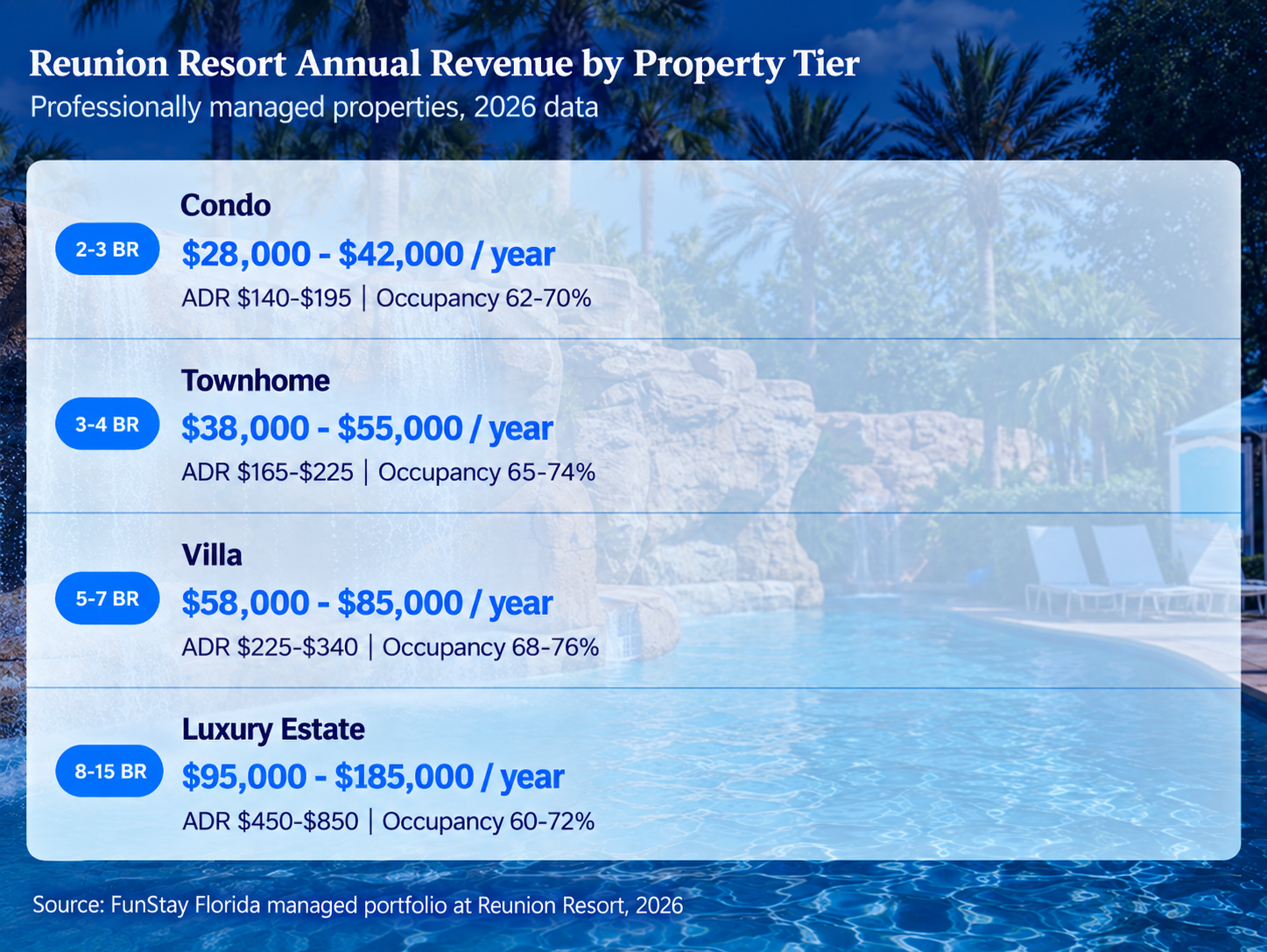
For context, the 34747 zip code (Reunion’s zip) has roughly 7,176 active short-term rental listings with a median annual revenue of $45,155. Reunion villas ($58K-$85K) outperform that median by 28% to 88%. Luxury estates beat it by more than double. Condos fall below it, which is expected for smaller units in a market where private pools and space drive the rate premium.
Revenue across the broader Kissimmee market has also been climbing. Year-over-year data through mid-2026 shows a 39.8% increase in per-listing revenue, with ADR up 24.6% and occupancy gaining 8.8%.
One seven-bedroom villa in FunStay’s managed portfolio went from $62,400 to $94,800 in annual revenue after switching to professional management. That is a 52% increase, driven by occupancy rising from 58% to 72% and ADR climbing from $295 to $361.
The highest-performing neighborhood is Bears Den, a gated enclave of custom estates on Reunion’s western side. Five-bedroom Bears Den villas gross $85,000 to $110,000 per year. Eight-bedroom estates reach $150,000 to $200,000 or more. A five-bedroom Bears Den villa averages $400 to $550 per night versus $225 to $340 for a standard Reunion villa of similar size.
What Drives the Rate Premium
Reunion consistently commands higher nightly rates than surrounding communities. Four factors drive that gap.
- Three golf courses by three legends. Palmer, Watson, and Nicklaus courses are the resort’s signature draw. Golf groups spend $3,000 to $8,000 per reservation and help fill shoulder months when family travel slows.
- Disney proximity. The main gate is six miles away. ChampionsGate sits 14 miles out. For families booking week-long stays, that gap matters.
- Amenity density. A five-acre water park with a waterslide, kids’ splash zone, and 1,000-foot lazy river, eight community pools, rooftop dining at Eleven, a spa, pickleball courts, mini golf, and scheduled shuttle service to Walt Disney World.
- Brand recognition. Reunion holds TripAdvisor’s Travelers’ Choice award for 2026 and hosts the Under Armour Junior Golf World Championship through 2028.
A five-bedroom home at Reunion averages $225 to $340 per night versus $215 to $275 at ChampionsGate and $200 to $280 at Solara Resort.
Revenue by Season
Short-term rental revenue in the Disney corridor swings sharply by month. Owners who budget only on annual averages get caught off guard.
Peak season (mid-December through mid-April) delivers the highest rates and strongest occupancy. Snowbird tenants lock in 14- to 28-night stays at slightly lower nightly rates but produce near-full monthly occupancy.
Summer (June through early August) is the second peak, driven by family travel.
September and early October are the weakest months. Fixed costs do not pause: Club dues, HOA, CDD, and insurance all continue against minimal revenue. Owners should budget for net-negative months during this stretch.
Reunion properties have two buffers other communities lack. Golf groups fill fall gaps at premium rates. And dynamic pricing across multiple booking platforms helps capture demand that static single-platform listings miss. Average booking lead time in the Kissimmee market runs about 65 days, so rate adjustments need to start two to three months before slow periods.
The Full Cost Stack
Reunion Resort carries one of the heaviest cost stacks in Central Florida. Multiple overlapping fees hit the same property, and several are mandatory for vacation rental investors.
| Expense | Typical Range | Notes |
|---|---|---|
| HOA | $395-$1,000+/mo | Varies by neighborhood |
| CDD Assessment | $1,500-$4,000+/yr | On property tax bill, not HOA invoice |
| Club Initiation | $15,000 one-time | 60-day window after closing; miss it, permanently forfeited |
| Club Membership | $500-$925/mo | Gold ($500) or Platinum ($925) |
| STR Tax | 13.5% of gross | 6% state + 1.5% surtax + 6% TDT |
| Insurance | $5,000-$10,000+/yr | STR-specific policy required |
| Property Management | 20-25% of gross | Full-service management |
| Pool & Lawn | $3,000-$4,200/yr | Beyond HOA common areas |
| Repairs & Supplies | $3,000-$5,000/yr | Guest wear, restocking |
CDD amounts vary by parcel size and district. Reunion East properties carry 57% of shared costs; Reunion West carries 43%.
Taxes take 13.5% off every rental dollar. Airbnb collects the state portion automatically but does not collect the 6% tourist development tax (TDT) in Osceola County. Owners or their property manager must remit TDT directly to the county tax collector by the 20th of each month.
Every short-term rental at Reunion also requires a DBPR vacation rental license and an Osceola County business tax receipt before accepting bookings.
Full neighborhood-by-neighborhood fee breakdowns are covered in our Reunion Resort HOA and CDD guide.
Club membership is not optional for STR investors.
Without an active membership, rental guests cannot access the water park, pools, or golf courses. Properties listed without amenity access compete at a significant disadvantage and earn materially less. The $15,000 initiation fee has a strict 60-day window after closing. If the owner misses that deadline, membership is permanently forfeited for that property.
Net Income: A Worked Example
Annual revenue looks strong until the cost stack hits. Here is what a real scenario looks like for a five-bedroom pool home in the Homestead neighborhood, purchased at roughly $600,000.
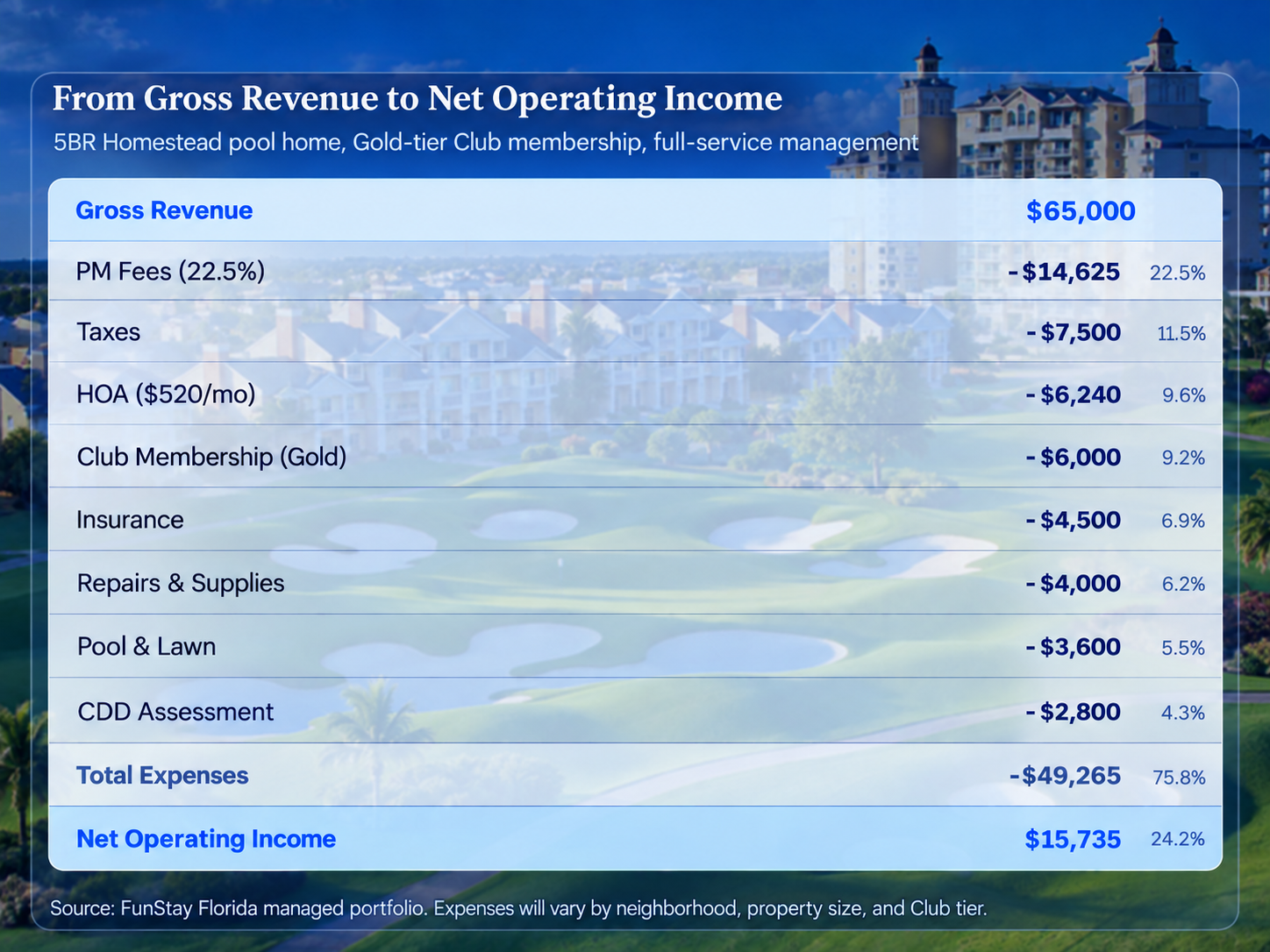
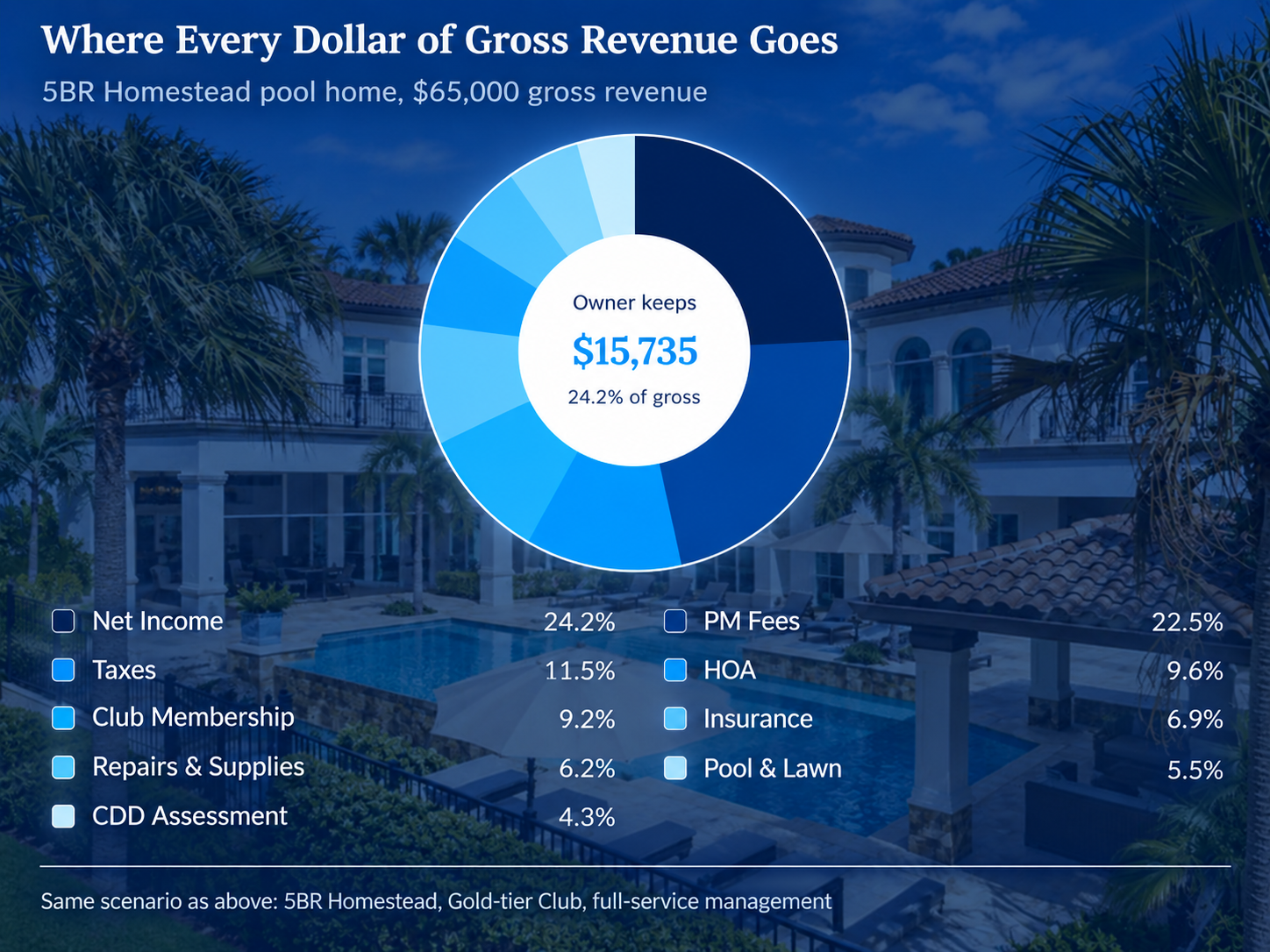
Cap rate on a $600,000 purchase: 2.6%. Year one is tighter. Add the $15,000 Club initiation and first-year net drops to $735.
This assumes Gold-tier Club membership at $500 per month. Platinum membership ($925 per month) cuts another $5,100 from NOI but gives guests discounted golf rounds, which can improve reviews and drive repeat bookings.
A 2.6% cap rate means Reunion is not a pure cash-flow investment at current prices. Investors here are typically betting on two things: property appreciation and rental income covering carrying costs while the asset grows. Reunion home values have historically held or appreciated, even as broader 34747 medians have dipped in recent data.
For comparison, a five-bedroom home at ChampionsGate purchased at $450,000 with similar gross revenue but lower total expenses (no club membership, lower HOA) would produce roughly $23,000 to $27,000 in NOI. That is a 5.1% to 6.0% cap rate. Lower entry cost and simpler fee structure make the management math significantly more straightforward.
Across Reunion, operating expenses typically consume 65% to 80% of gross revenue. Condos trend toward the higher end of that range because fixed costs weigh more against lower revenue. Luxury estates trend lower because higher gross absorbs fixed costs more efficiently.
Reunion vs Nearby Resorts
Reunion is not the only STR community near Disney. Here is how the numbers compare for five-bedroom properties under professional management.
| Reunion Resort | ChampionsGate | Solara Resort | |
|---|---|---|---|
| Best For | Golfers, luxury seekers | Families, cash flow | Families, mid-range |
| Entry Price (5BR) | $550K-$800K | $400K-$550K | $450K-$650K |
| Nightly Rate | $225-$340 | $215-$275 | $200-$280 |
| Occupancy | 68-76% | 74-80% | 65-75% |
| Annual Revenue | $58K-$85K | $58K-$78K | $47K-$77K |
| HOA | $395-$1,000+/mo | $343-$800/mo | ~$663/mo |
| Club Membership | $500-$925/mo (required) | None | None |
| Disney Distance | ~6 mi | ~14 mi | ~8 mi |
ChampionsGate and Solara deliver stronger gross yield (revenue divided by purchase price) because of lower entry costs and no club membership. Reunion delivers higher absolute revenue and stronger long-term appreciation, but thinner cash-flow margins.
The deciding factor is investor profile. Cash-flow-first buyers tend to do better at ChampionsGate. Investors who can absorb thinner near-term yield for higher property appreciation typically choose Reunion.
At the luxury end (eight bedrooms and up), Reunion has no direct equivalent at either resort. Bears Den estates regularly command $450 to $1,100 per night. Nothing within 15 miles of Disney competes at that price point.
Which Neighborhood Fits Your Budget
Entry Level ($175K to $400K)
Condos and townhomes in Seven Eagles, Heritage Crossing, Centre Court Ridge, Reunion Grande, The Terraces, Spectrum+, Carriage Pointe, and The Crescent (new construction). Expected gross revenue: $28,000 to $55,000.
These are the lowest entry points at Reunion. HOA fees eat a larger share of revenue at this price point. Best suited for investors who want a Reunion Resort address and guest amenity access without a $500K+ commitment.
Mid-Range ($450K to $800K)
Single-family homes in Homestead, Patriot’s Landing, and Liberty Bluff, plus townhomes in Eagle Trace. Expected gross revenue: $55,000 to $85,000.
This is the volume segment. The five-bedroom Homestead example above is typical. These neighborhoods attract multi-generational family bookings and offer the strongest balance of income to costs. Most Reunion STR investors buy in this tier.
Premium ($1M to $8M+)
Custom estates in Bears Den, Legends Corner, Masters Landing, Fairway Ridge, Heritage Preserve, Eagle Estates, and the new Whitemarsh Cove development (nine-bedroom villas from $2.1M). Expected gross revenue: $85,000 to $200,000+.
Bears Den is the most in-demand luxury STR neighborhood at Reunion. Whitemarsh Cove is still in development. This tier draws golf groups, corporate retreats, and multi-family vacations willing to pay $700 to $1,200+ per night.
Risk Factors Every Buyer Should Know
- CDD bond default. Reunion East’s CDD Series 2002 and 2005 bonds have been in default since November 2022 due to insufficient funds for scheduled debt service. This could lead to special assessments for East-side property owners. Review the latest CDD financial statements before closing on any Reunion East property.
- Club membership lock-in. Owners have exactly 60 days after closing to pay the $15,000 Club initiation. There is no extension and no second chance. Factor this deadline into your closing timeline.
- New supply. Reunion’s owner, Kingwood International Resorts, has announced expansion plans that could add significant new rental inventory and a hotel. Additional supply may dilute per-unit revenue over time.
- Insurance costs. Florida’s short-term rental insurance market remains volatile. Premiums have increased 30% to 50% in parts of Central Florida over recent years. Budget $5,000 to $10,000+ annually and expect year-over-year increases.
- Seasonal cash flow gaps. September and October frequently produce net losses when fixed costs continue against minimal revenue. Owners should maintain reserves for at least two to three negative months per year.
- Amenity access rules. The resort sets specific requirements for how bookings qualify for guest amenity access. Verify your property management company’s arrangements with Reunion before listing.