
Here’s a question I get at least twice a week from vacation rental owners in Orlando: “Should I sell my place furnished or strip it and list it empty?”
The short answer is that a furnished vacation rental with solid income documentation can sell for significantly more than the same property listed unfurnished. But the longer answer involves tax traps, buyer expectations, and a hard look at the condition of your furniture.
I’ve sold furnished Orlando vacation rental properties where the turnkey premium added six figures to the sale price. I’ve also seen sellers lose money because their tired furniture made buyers discount the property instead of paying more for it.
This is the guide I wish every owner had before listing.
The Turnkey Premium: What It Actually Looks Like
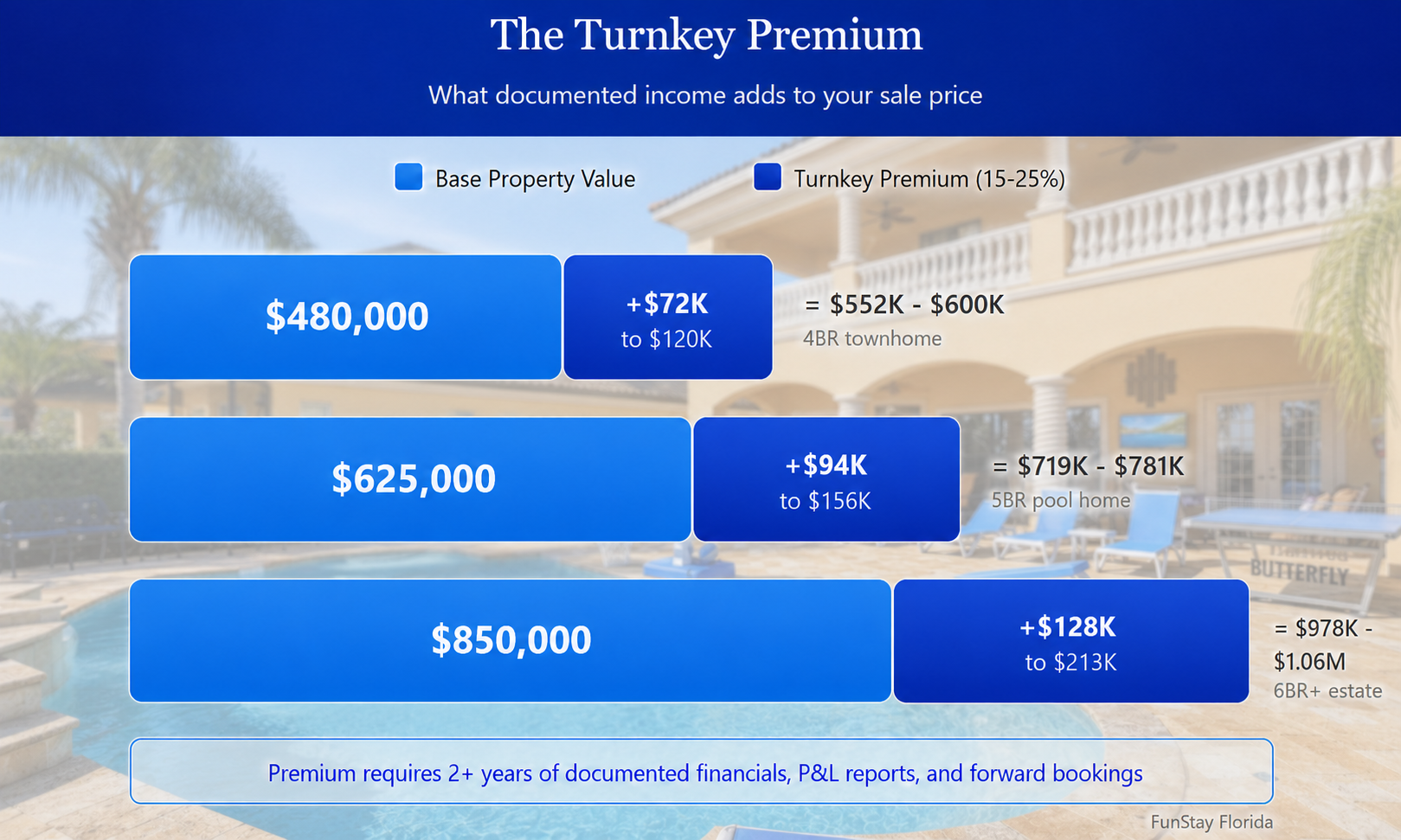
Furnished vacation rentals with documented income history sell for an estimated 15-25% more than comparable unfurnished properties. That range comes up consistently across real estate brokerages, property management companies, and investor forums. It’s not a guaranteed number, but it’s the ballpark I’ve seen play out in Orlando transactions.
On paper, the math looks like this:
$72-120K
Premium on a $480K property
$94-156K
Premium on a $625K property
$128-213K
Premium on an $850K property
But here’s the part most people miss. That premium isn’t really for the furniture. A houseful of vacation rental furniture is worth maybe $10,000-$22,000 at salvage. The premium is for the income stream, the forward bookings, the operational systems, and the fact that the buyer can start collecting rent on day one.
The documentation is everything.
Without at least two years of platform-pulled financial statements, monthly P&L reports showing seasonal trends, and a forward booking calendar, the turnkey premium drops to zero. Buyers don’t pay extra for furniture. They pay extra for a proven business.
What qualifies as “documentation” in a turnkey sale? At a minimum: 24 months of income reports pulled directly from Airbnb, Vrbo, or your property management portal. Monthly profit and loss statements with seasonal breakdowns. A current booking calendar showing confirmed forward reservations. Occupancy rates and average daily rates by month. An itemized operating expense ledger. Vendor contracts, property management agreements, and cleaning schedules.
If you can’t produce those documents, you don’t have a turnkey sale. You have a furnished house. And the market prices those very differently.
When Furniture Hurts Your Sale Price
Not all furniture adds value. If yours is more than five or six years old with visible wear, it’s actually pulling your sale price down.
Here’s why. Buyers walk through a vacation rental with tired furniture, and they don’t see what you paid for it. They see the cost to replace it. A full refurnish in Orlando runs $25,000 to $45,000 depending on the size and quality level. Buyers subtract that number from what they’re willing to pay, and that discount is usually steeper than what the furniture is actually worth.
The five-year rule of thumb:
If your furniture is under five years old, in good condition, and designed for the vacation rental aesthetic (durable fabrics, neutral tones, guest-friendly layout), it adds value. If it’s past that threshold with stains, tears, or dated styling, it’s working against you.
There’s another scenario where selling furnished backfires. Some Orlando resort communities have seen their buyer demographics shift over time. Communities that used to attract mostly STR investors are now drawing second-home buyers, retirees, or people looking for a hybrid personal-use and rental property.
Those buyers don’t care about your turnkey setup. They want to decorate with their own taste. Your furniture becomes something they have to haul out, and they’ll negotiate accordingly.
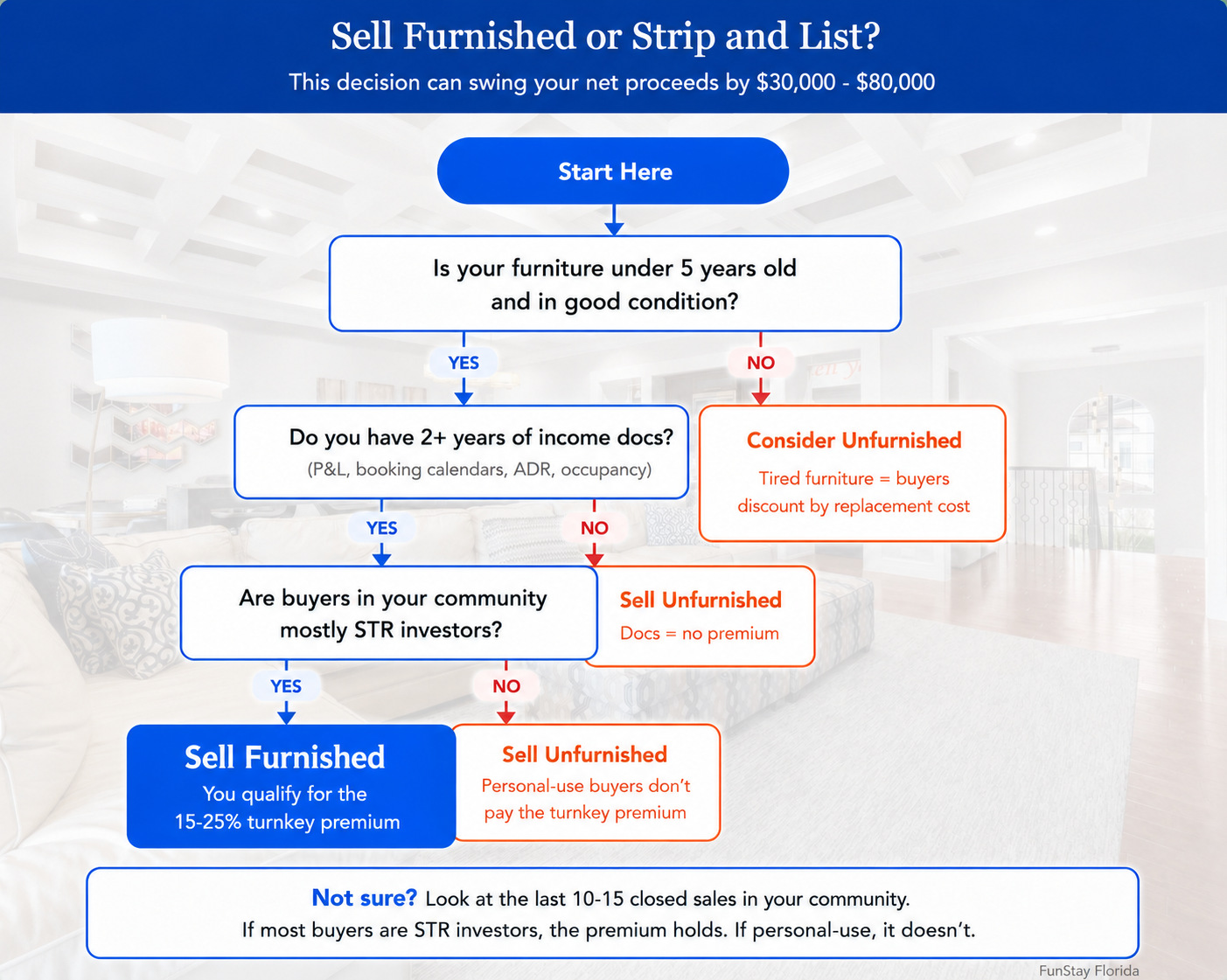
Before listing furnished, look at the last 10-15 sales in your community. If most buyers are still STR investors, the turnkey premium holds. If the buyer pool has shifted toward personal-use buyers, you may be better off selling unfurnished.
Three Tax Traps Most Sellers Don’t See Coming
This is where furnished vacation rental sales get complicated. Three tax issues catch sellers off guard at closing, and all three are specific to furnished properties.
Trap 1: Section 1245 Depreciation Recapture
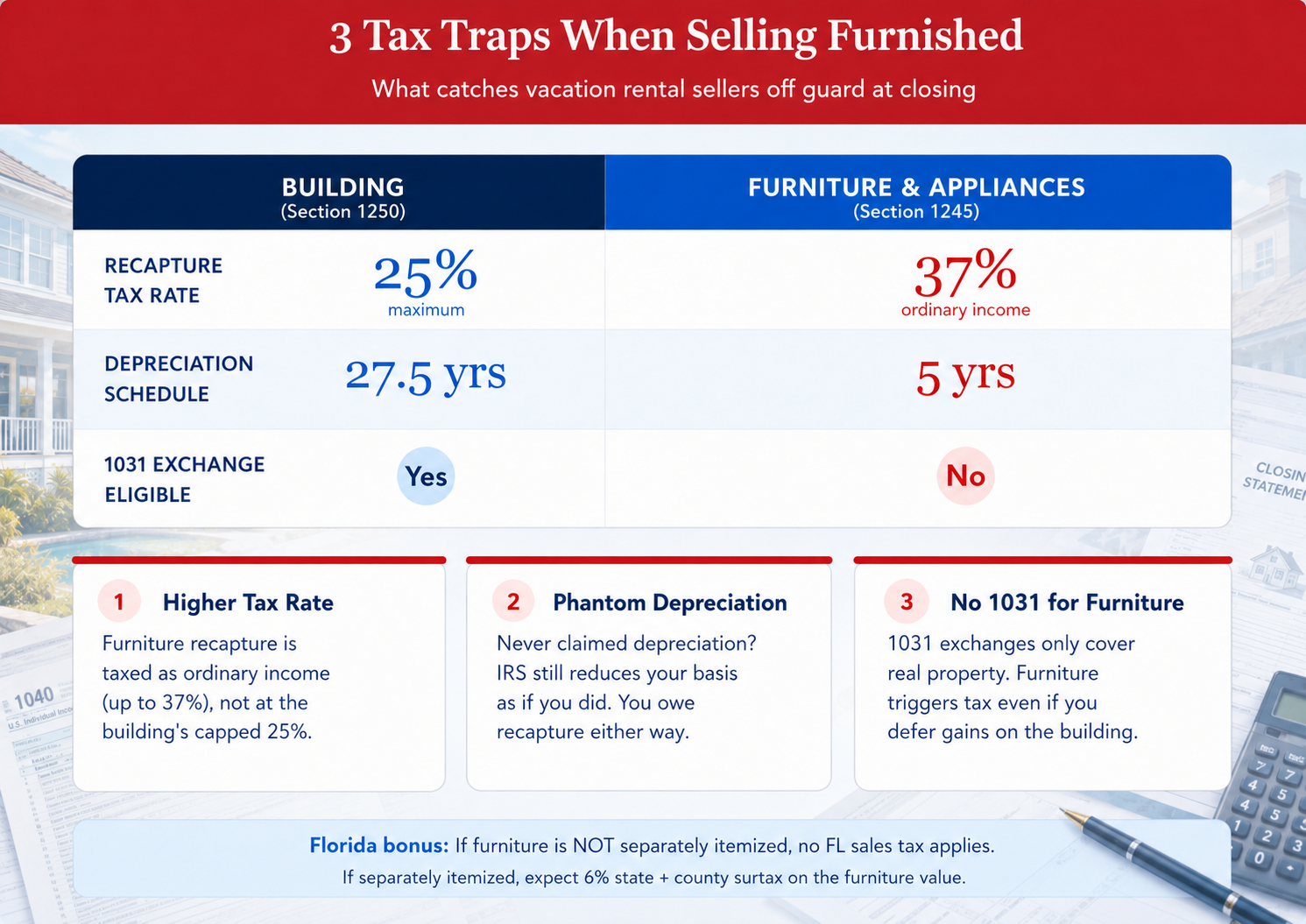
When you sell a vacation rental, the IRS splits the transaction into two buckets. The building itself is Section 1250 property, and depreciation recapture on that portion is capped at a maximum 25% tax rate.
But the furniture, appliances, and equipment? That’s Section 1245 property. And all the depreciation you claimed on those items is recaptured as ordinary income, taxed at your marginal rate up to 37%.
Under IRS Publication 527, furniture and appliances used in residential rental property are classified as 5-year MACRS property. If you’ve owned your vacation rental for five or more years, you may have fully depreciated the furniture. At sale, every dollar of that depreciation gets recaptured at ordinary income rates.
The “phantom depreciation” trap:
Even if you never claimed depreciation deductions on your furniture, the IRS reduces your cost basis as if you did. This is the “allowed or allowable” rule. You owe depreciation recapture whether you took the deductions or not. Owners who skipped depreciation “to keep things simple” still get hit at closing.
Trap 2: Florida Sales Tax on Separately Itemized Furniture
Under Florida Department of Revenue guidance, if you separately itemize your furniture with a specific dollar value in the closing documents, that triggers Florida sales tax on the furniture portion. That’s 6% state sales tax plus your county’s discretionary surtax.
If the furniture is NOT separately itemized and is treated as incidental to the real estate transaction, no sales tax applies. The entire sale is treated as one non-taxable real estate transfer. (This is separate from the vacation rental licensing and tax obligations you already deal with as an STR operator.)
This is a structuring decision, not a compliance loophole. Work with a Florida real estate attorney to handle it correctly.
Trap 3: Furniture Doesn’t Qualify for 1031 Exchange
If you’re planning a 1031 like-kind exchange to defer taxes on your sale, know this: 1031 exchanges apply only to real property. The furniture, appliances, and personal property in your vacation rental do not qualify.
That means even if you successfully defer capital gains on the real property portion, the furniture triggers depreciation recapture tax regardless. Your CPA needs to plan for this before you close.
| Tax Category | Property Type | Tax Rate at Sale | 1031 Eligible? |
|---|---|---|---|
| Building (Section 1250) | Real property | Max 25% on depreciation recapture | Yes |
| Furniture & appliances (Section 1245) | Personal property | Ordinary income up to 37% | No |
| Land | Real property | Capital gains rates | Yes |
| Capital gain above cost basis | Any | 0%, 15%, or 20% (+ 3.8% NIIT) | Real property only |
One bright spot for buyers.
The One Big Beautiful Bill Act, signed into law on July 4, 2025, permanently restored 100% bonus depreciation for qualifying property placed in service after January 19, 2025. That means your buyer can fully expense the furniture value in Year 1. It’s a real selling point when marketing a turnkey property to investors.
Not Sure What Your Furnished Property Is Worth?
I run the numbers on your specific property: turnkey premium potential, tax implications, and whether selling furnished or unfurnished nets you more. It’s free.
What Orlando Vacation Rental Buyers Want in a Turnkey Package
Investor buyers looking at furnished Orlando vacation rentals have a checklist. If your property doesn’t hit these basics, they’ll either pass or negotiate the turnkey premium away.
The non-negotiables
Smart locks and keyless entry. This is standard for vacation rentals now. Buyers expect it because guests expect it.
A fully stocked kitchen. Cookware, dishes, utensils, small appliances (coffee maker, toaster, blender). A well-equipped kitchen is one of the biggest advantages vacation homes have over hotels, and buyers know it drives better reviews.
TVs in every bedroom and the main living area. Smart TVs with streaming access. The main living room should have at least a 65-inch screen.
Performance-fabric furniture. Leather, microfiber, or treated fabrics that handle spills and heavy guest rotation. Cotton or linen upholstery is a red flag for experienced STR buyers.
Outdoor furniture and a grill. For pool homes in Orlando’s resort communities, the outdoor living space is a major booking driver. Buyers want patio dining sets, loungers, and a functional grill or outdoor kitchen.
The documentation package
Beyond the physical furnishings, here’s what buyer due diligence looks like on a turnkey sale:
24 months of platform-pulled income reports. Monthly P&L with seasonal breakdowns. Forward booking calendar with confirmed reservations. Average daily rate and occupancy by month. Itemized operating expenses. Property management agreement, vendor contracts, and cleaning schedules. Login credentials for listing channels and property management software.
If you’re using a property manager like FunStay Florida, most of this is already organized through your monthly reporting. If you’re self-managing, start pulling these reports now. It takes time to compile, and having clean numbers is what separates a turnkey sale from a regular furnished listing. Need help understanding what your property actually earns? Here’s how to calculate ROI on a vacation home.
What doesn’t transfer
One thing buyers need to understand: Airbnb and Vrbo listings do not transfer to a new owner. The buyer will need to create a new account and build a new listing from scratch. Your review history, search ranking, and Superhost status stay with your account.
This is exactly why the financial documentation matters more than the listing itself. A buyer can rebuild a listing in a week. They can’t fake two years of income data.
How to Prepare a Furnished Vacation Rental for Sale
If you’ve decided to sell furnished, here’s how to maximize the turnkey premium. This isn’t about staging a regular house for sale. Vacation rental prep is different.
Start 4-6 months before listing
A turnkey vacation rental sale takes preparation. Use those months to compile your financial documentation, address any deferred maintenance, and get the property into showing condition while it’s still earning revenue.
Do a room-by-room inventory
Photograph every item. Record the item name, category, quantity, condition, and estimated replacement value. Use a spreadsheet template (Lodgify, Hostfully, and others offer free versions). This inventory becomes part of your sale documentation and can be used for the bill of sale if furniture is included.
Replace high-impact items
You don’t need to refurnish the whole place. Focus on what photographs well and what guests (and buyers) touch: mattresses, throw pillows, bed linens, bath towels, and any upholstery with visible wear. A $3,000-$5,000 refresh on these items can preserve tens of thousands in perceived value.
Deep clean to hospitality standards
This is not a regular house cleaning. Hire a professional team for a hospitality-level deep clean. Inside the oven and refrigerator. Behind appliances. All vents and baseboards. Every high-touch surface. Buyers notice details that guests overlook, and a spotless property signals a well-maintained investment.
Get professional photos
Professional listing photos can generate significantly more views and inquiries than DIY shots. For a property you’re selling, this is even more important because the MLS photos need to make investors see immediate income potential. Shoot on a clear day, during the golden hour (one hour after sunrise or two to three hours before sunset). Aim for 20-30 images covering every room, outdoor spaces, and amenities.
The Decision
Should You Sell Furnished or Strip and List?
This decision can swing your net proceeds by $30,000 to $80,000, depending on your property and market. Here’s the framework I walk sellers through.
Sell Furnished When:
- Furniture is under 5 years old and in good condition
- You have 2+ years of documented income history
- Your buyer pool is primarily STR investors
- You have forward bookings that transfer value to the buyer
- Your property is in a resort community where turnkey is the norm
Sell Unfurnished When:
- Furniture is 6+ years old with visible wear or dated styling
- Your community’s buyer pool has shifted to personal-use buyers
- You can liquidate furniture separately for decent value (estate sale, Facebook Marketplace, STR furniture resellers)
- You lack income documentation to justify the turnkey premium
- Refurnishing would cost more than the premium it would generate
If you’re somewhere in between, that’s where a market-specific analysis helps. The right call depends on recent comps in your community, your buyer pool, the condition of your specific furnishings, and the tax implications of your sale structure. I’ve seen the same property in the same community go either direction depending on timing and who the likely buyer is.
Whether you’re leaning toward selling turnkey or stripping the property, the biggest mistake is guessing. Look at the last 10-15 closed sales in your community. Talk to a realtor who understands the Orlando vacation rental market specifically, not just residential resales. The math is different for investment properties.
Let’s Run the Numbers on Your Property
Furnished or unfurnished? I’ll analyze your specific situation: furniture condition, buyer pool, income documentation, and tax exposure. Then I’ll tell you which path nets you more.
Frequently Asked Questions