
Eight steps every out-of-state investor should complete before buying Airbnb investment property Orlando, Kissimmee, or Davenport.

An out-of-state investor called me last fall about a 5-bedroom he’d just closed on near ChampionsGate. Beautiful home. Good price. One problem: his HOA had amended its CC&Rs six months earlier to ban rentals under 30 days. He found out after closing. That’s a $380,000 house that can’t do what he bought it to do.
He’s not the only one. I’ve managed over 100 vacation rentals across Orlando, Kissimmee, and Davenport, and I’ve seen every version of this mistake from investors buying Airbnb investment property Orlando, Kissimmee, and Davenport. Zoning surprises. Unlicensed operations. Insurance gaps that don’t show up until a hurricane season claim. Tax bills from agencies they didn’t know existed.
This is the vacation rental due diligence checklist Florida investors need before writing a check. Eight steps, each one based on real problems I’ve seen with real properties. If you’re figuring out how to buy a vacation rental in Florida without getting burned, start here.
8
Steps before you close
3
Counties with different rules
$230
DBPR license (first year)
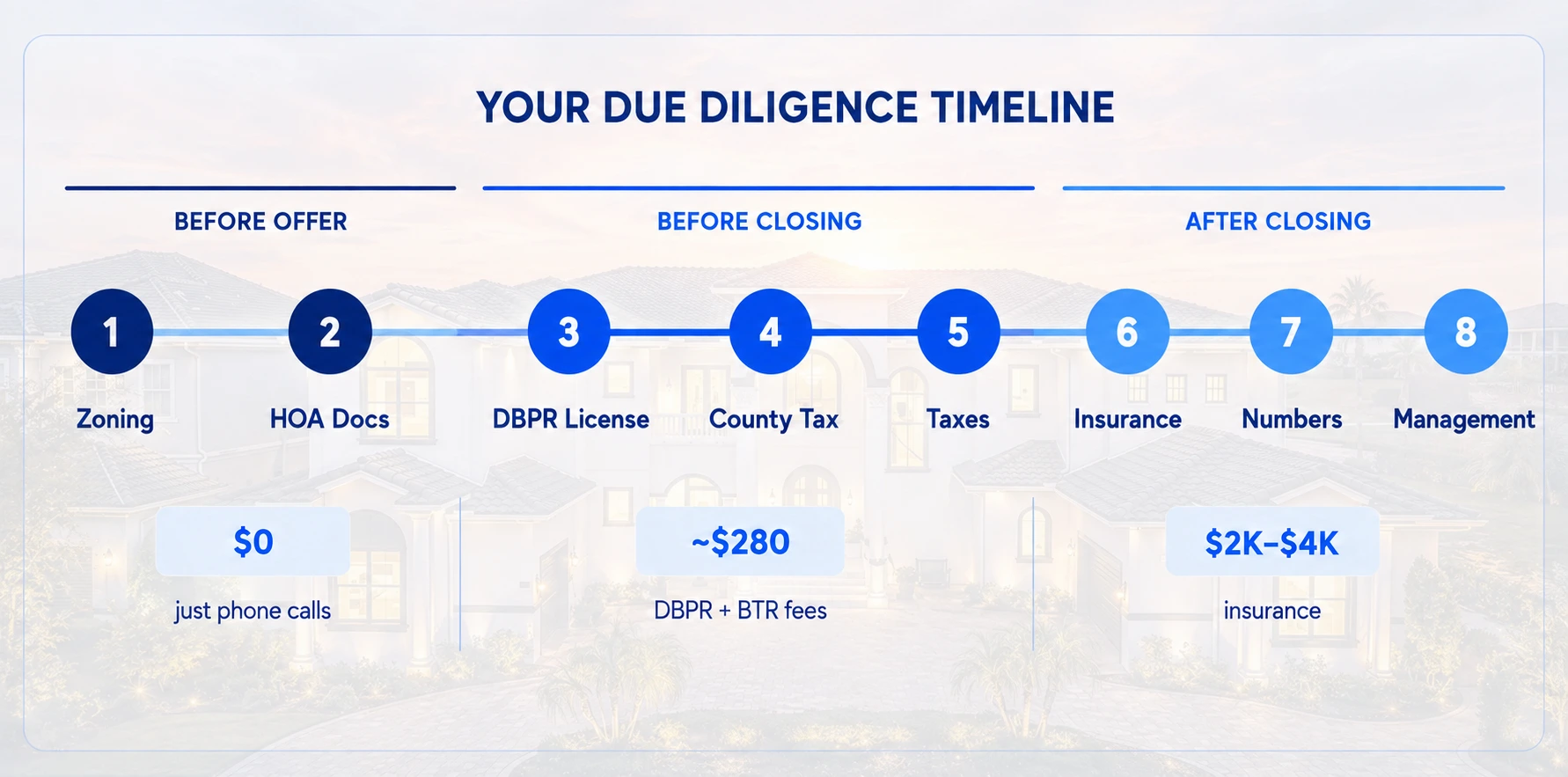
1. Verify Zoning Before You Make an Offer
Florida has a statewide preemption law (F.S. 509.032(7)(b)) that prevents local governments from banning vacation rentals outright. But there’s a catch. Any ordinance passed before June 1, 2011 still stands.
That grandfather clause is why short-term rental investment Central Florida looks completely different depending on the county. Orange County can enforce 30-night minimums on whole-house rentals because their ordinance predates the cutoff. If your property sits in unincorporated Orange County and wasn’t operating as a short-term rental before 2011, you’re limited to monthly stays. That’s not a vacation rental. That’s a furnished monthly rental with a cleaning fee.
How to verify a property is zoned for short-term rental in Orlando and the surrounding area: pull the property record from your county property appraiser.
Osceola County: osceolapafl.org
Orange County: ocpafl.org
Polk County: polkpa.org
Check the zoning designation and review the Orlando vacation rental zoning rules for your specific area. Look for overlay districts or conditional use requirements. Then call the county zoning office directly. A ten-minute phone call can save you from buying a property that can’t legally rent short-term.
| Orlando Vacation Rental Zoning Rules | Osceola County | Orange County | Polk County |
|---|---|---|---|
| Minimum stay | None | 30 nights (unless pre-2011) | None |
| Nightly rentals allowed | Yes | Grandfathered only | Yes |
| Annual cap on rental days | No cap | N/A (30-night minimum) | No cap |
| Permissiveness | Most permissive | Strict | Very permissive |
| Key cities | Kissimmee, Celebration | Orlando, Winter Park | Davenport, Haines City |
⚠ City of Orlando.
The City of Orlando has effectively banned whole-house short-term rentals within city limits. Room-only rentals have a separate conditional use permit process, but whole-house nightly rentals are off the table. Don’t confuse “Orange County” with “City of Orlando.” They’re different jurisdictions with different rules.
For the full breakdown of Florida’s short-term rental laws and how they apply county by county, we’ve written a separate deep dive.
FSF Insight:
The first item on any vacation rental due diligence checklist Florida investors use should be zoning. Verify it before you make an offer, not after. I’ve seen three deals in the last year where the buyer assumed they could do short-term rentals because the listing agent said so. The listing agent was wrong. Pull the zoning yourself.
2. Read the HOA Documents Cover to Cover
This is where most investors get burned. Florida’s preemption law protects you from local government restrictions, but it does not protect you from your HOA.
Can an HOA ban short-term rentals in Florida? Yes. Under F.S. 720.306(1)(h), any homeowners association can amend its governing documents to restrict or prohibit rentals of six months or less. They can do it with a majority vote of the membership, even if those restrictions didn’t exist when you bought the property.
Vacation rental HOA restrictions Florida investors face have increased in recent years. Several communities near ChampionsGate and along the US-192 corridor added 30-day minimum stay requirements since 2023. The state preemption law does not apply to private HOA covenants.
What to look for in the HOA documents
CC&Rs (Covenants, Conditions & Restrictions): Any language about rental minimums, guest registration, maximum occupancy, or “transient rental” bans
Meeting minutes (last two years): HOAs don’t always update CC&Rs immediately. A vote to restrict rentals can appear in meeting minutes months before the formal amendment
Special assessments: A $15,000 clubhouse renovation assessment in year one wrecks your returns
CDD fees: Most resort communities in Osceola County have Community Development District fees on top of HOA dues. CDD fees run $1,000 to $3,500 per year and cover roads, drainage, and shared amenities
HOA dues in Central Florida resort communities typically run $250 to $800 per month. Add the CDD assessment on top. These are fixed costs that hit your bottom line whether the property is booked or not.
⚠ Vacation rental HOA restrictions Florida buyers overlook are the single biggest risk for out-of-state investors.
A property can have perfect zoning, full county approval, and a DBPR license, and still be blocked from short-term rentals by three sentences in the CC&Rs. Read every page.
Buying Airbnb Investment Property Orlando?
Our Airbnb property management Orlando team manages 100+ vacation rentals across Central Florida. Before you close, let us review your property’s zoning, HOA, and revenue potential.
Step 3 of 8
3. Get Your Florida DBPR Vacation Rental License
Every vacation rental in Florida needs a license from the Department of Business and ProGet a Free Property Reviewfessional Regulation. Do I need a license to Airbnb in Florida? Yes. You need a Florida vacation rental license DBPR calls “Vacation Rental – Dwelling.” It covers any whole house or condo unit rented for periods under 30 days.
Apply online at myfloridalicense.com
First-year fee: $230
Annual renewal: $180
Renewal date: April 1 for properties in DBPR District 4 (Orlando, Kissimmee, Davenport)
Processing time: 2 to 4 weeks
A fire marshal inspection is required before your Florida DBPR vacation rental license is issued. The inspector checks smoke detectors, fire extinguishers, carbon monoxide detectors, pool barriers, and exit signage. Most properties pass on the first visit if you’ve installed the basics ahead of time.
⚠ Operating without a license is a second-degree misdemeanor.
That’s up to 60 days in jail and a $500 fine per violation. DBPR actively enforces this through Airbnb listing audits and neighbor complaints. Getting your Florida vacation rental license DBPR requires is not optional, and it’s not something you do after your first booking.
4. Register with Your County
On top of your state license, each county requires its own business tax receipt (BTR). The process is straightforward, but missing this step means you’re operating illegally at the county level even with a valid DBPR license.
| Requirement | Osceola County | Orange County | Polk County |
|---|---|---|---|
| BTR fee | ~$50/year | ~$50/year | ~$30/year |
| Where to register | Osceola County Tax Collector | Orange County Tax Collector | Polk County Tax Collector |
| TDT registration | Required (separate from BTR) | Required | Required |
| Osceola County STR regulations | Most permissive, no minimum stay | 30-night minimum (if not grandfathered) | No minimum stay |
Osceola County STR regulations are the most straightforward in Central Florida. Register, pay the fee, get your tourist development tax account, and you’re legal. The best areas to buy Airbnb Orlando properties are in Osceola and Polk counties, where the zoning is clear and the permitting is fast. Orange County adds complexity with its conditional use permit process for properties that weren’t operating before June 2011.
5. Understand Your Tax Obligations
What taxes do Airbnb owners pay in Kissimmee? More than most investors budget for, and from more agencies than they expect. Vacation rental tax rates Orlando and the surrounding counties vary, but the structure is the same everywhere: three separate taxes on every booking.
| Tax Layer | Osceola (Kissimmee) | Orange (Orlando) | Polk (Davenport) |
|---|---|---|---|
| State sales tax | 6% | 6% | 6% |
| County surtax | 1.5% | 0.5% | 1% |
| Tourist development tax | 6% | 6% | 5% |
| Total guest tax | 13.5% | 12.5% | 12% |
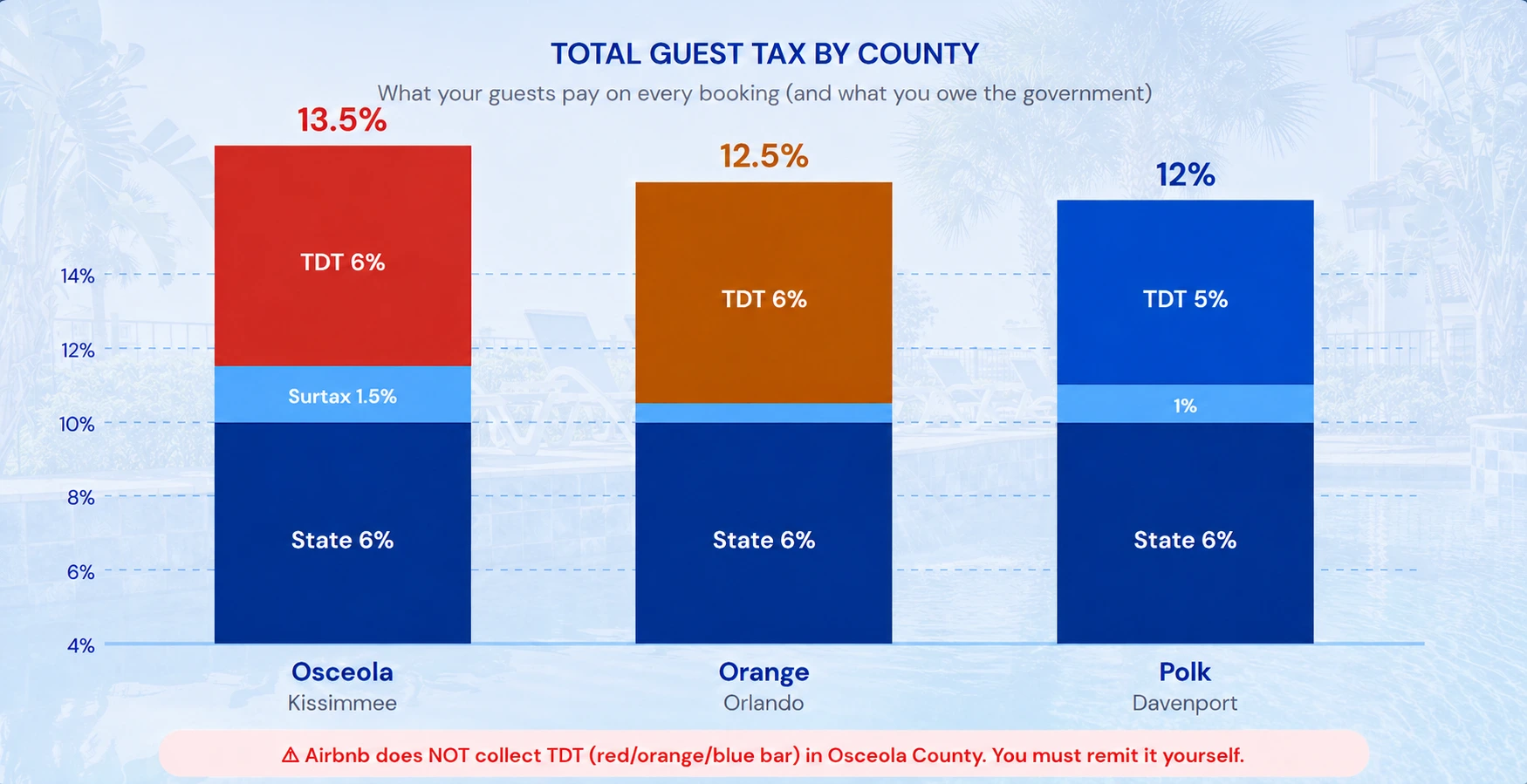
⚠ The Osceola County gap.
Airbnb collects state sales tax and county surtax automatically. But Airbnb does NOT collect the 6% tourist development tax in Osceola County. If your property is in Kissimmee, you must register with the Osceola County Tax Collector and remit 6% TDT yourself every month. This is the single most common tax mistake I see new owners make.
For the full breakdown of filing deadlines, deduction strategies, and what happens if you miss a payment, read our complete guide to Florida vacation rental taxes for Central Florida hosts.
6. Get the Right Insurance
Do I need insurance for a vacation rental in Florida? Yes. And not just any policy.
Standard homeowner’s insurance (HO-3) does not cover properties used as short-term rentals. If you file a claim and your insurer discovers the property was being rented to guests, they can deny the entire claim. I’ve seen it happen twice in the last 18 months.
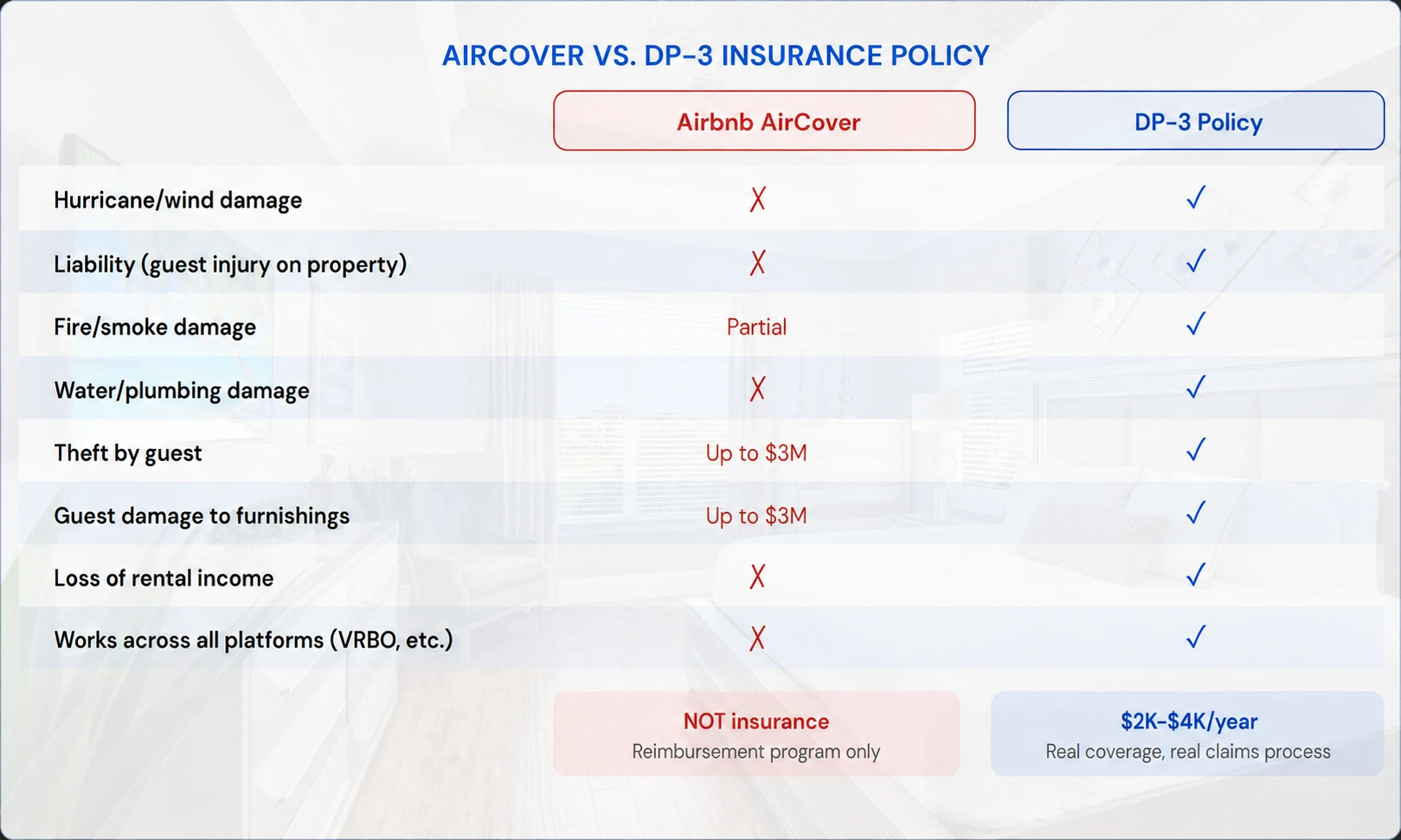
What you need is a DP-3 policy (Dwelling Property 3). This is the commercial equivalent designed for non-owner-occupied rental properties. Budget $2,000 to $4,000 per year for a 4-5 bedroom vacation home in Central Florida.
Key insurance facts for short-term rental investment Central Florida
Citizens Property Insurance (Florida’s insurer of last resort) stopped covering short-term rental properties as of January 2025. If your current policy is through Citizens, you need to find a private carrier.
AirCover is NOT insurance. It’s a limited damage reimbursement program with exclusions, caps, and a claims process that can take months. It does not replace a real insurance policy.
Hurricane deductibles in Florida are percentage-based (2%, 5%, or 10% of the dwelling coverage), not a flat dollar amount. On a $400,000 home with a 5% deductible, you cover the first $20,000 out of pocket before insurance pays anything.
FSF Insight:
Insurance is the line item most investors underestimate. A standard homeowner’s policy runs $1,200 to $2,000. A proper DP-3 policy for a vacation rental runs $2,000 to $4,000. That’s a real cost difference. But it’s the difference between having coverage when a guest floods the kitchen and having a denied claim and a $15,000 repair bill.
7. Run the Real Numbers
BNBCalc and AirDNA give you revenue projections. Those numbers are useful as a starting point. But if you’re working through a proper vacation rental due diligence checklist Florida property buyers need, you need to model the expenses side too. Most investors I talk to underestimate operating costs by 20-30%.
Monthly operating costs: 4-bedroom vacation rental in Kissimmee
| Expense | Monthly Range |
|---|---|
| HOA dues | $300 – $600 |
| CDD assessment | $100 – $300 |
| Insurance (DP-3) | $200 – $350 |
| Utilities (electric, water, internet, streaming) | $400 – $600 |
| Property management (15-20% of gross) | Varies |
| Lawn care and pool service | $200 – $350 |
| Pest control | $50 – $75 |
| Supplies and consumables | $100 – $200 |
| Maintenance reserve (1-2% of value/year) | $250 – $500 |
| Fixed monthly costs (before PM and cleaning) | $1,600 – $2,975 |
Then add the non-monthly costs: furnishing ($15,000 to $35,000 to get a 4-5 bedroom guest-ready), annual DBPR renewal ($180), county BTR renewal, and property taxes. Cleaning runs $180 to $300 per turnover and is typically passed to the guest, but you’re covering it during vacancies and for mid-stay cleans.
A property that projects $60,000 per year in gross rental revenue can easily cost $35,000 to $45,000 per year to operate. Anyone buying Airbnb investment property Orlando should model the full expense side. Without it, you’re buying based on hope.
For real performance data on what properties actually earn in specific communities, see our analysis of Orlando vacation rental income and whether your property is earning enough.
8. Choose Your Management Strategy
You have three options: self-manage, hire a co-host, or hire a full-service property manager. Whichever path you pick, you’re also deciding how to handle Airbnb vs VRBO management Orlando investors deal with daily. Listing on multiple platforms increases bookings but doubles the operational complexity.
Self-managing from out of state is possible but hard. You need a local team for cleaning, maintenance, and guest lockouts, and you need to be available for emergencies around the clock. If you’re managing from New Jersey, a 2 AM pool pump failure is your problem at 2 AM.
A co-host handles day-to-day operations while you keep your listing. Fees typically run 10-15% of revenue. Lower cost, but you’re still the one making pricing decisions and handling escalations.
For a deeper look at what that division of labor actually involves, see our comparison of local versus national vacation rental management in Orlando.
Full-service Airbnb property management Orlando companies charge 15-25% of revenue but cover everything: listing optimization, dynamic pricing, guest communication, cleaning coordination, maintenance dispatch, and compliance. The best property managers also handle your DBPR renewals, tax filing, and insurance coordination.
FSF Insight:
When you’re buying Airbnb investment property Orlando from out of state, the management question isn’t “can I save money by self-managing?” It’s “what will my vacancy rate look like if I can’t respond to a guest issue within 30 minutes?” We manage over 100 properties across Central Florida, and the owners who try to self-manage from 1,000 miles away almost always switch to professional management within the first year. The 15-20% fee pays for itself in higher occupancy and fewer refunds.
Ready to Complete Your Due Diligence?
We’ve helped hundreds of out-of-state investors complete every step of the vacation rental due diligence checklist Florida requires. Zoning verification, HOA review, licensing, tax setup, insurance guidance, and full property management. One team handles all eight steps.
Frequently Asked Questions
What do I need to know before buying a vacation rental in Florida?
Verify zoning (especially the June 2011 grandfather clause in Orange County), read HOA documents for rental restrictions under F.S. 720.306(1)(h), get your DBPR license ($230 first year), register with your county, understand your total tax burden (12-13.5% depending on county), secure a DP-3 insurance policy, and build a realistic expense model. Osceola County is the most permissive for short-term rental investment Central Florida offers. Orange County enforces 30-night minimums for non-grandfathered properties.
How do I verify a property is zoned for short-term rental in Orlando?
Check the zoning designation through your county property appraiser: osceolapafl.org (Osceola), ocpafl.org (Orange), or polkpa.org (Polk). For Orange County properties, confirm whether the property was operating as a vacation rental before June 1, 2011. Properties within Orlando city limits face an effective ban on whole-house nightly rentals. Always call the county zoning office directly before making an offer.
What taxes do Airbnb owners pay in Kissimmee?
Total guest taxes in Kissimmee (Osceola County) are 13.5%: 6% state sales tax, 1.5% county surtax, and 6% tourist development tax. Airbnb collects the state tax and surtax automatically, but does NOT collect the 6% TDT in Osceola County. You must register with the Osceola County Tax Collector and remit TDT monthly yourself.
Do I need insurance for a vacation rental in Florida?
Yes. Standard homeowner’s insurance (HO-3) does not cover short-term rental activity. You need a DP-3 policy designed for rental properties. Budget $2,000 to $4,000 per year for a 4-5 bedroom home. Citizens Property Insurance stopped covering STR properties in January 2025. Airbnb’s AirCover is not a substitute for a real insurance policy.
Can an HOA ban short-term rentals in Florida?
Yes. Under F.S. 720.306(1)(h), any HOA can vote to restrict or ban rentals under six months with a majority vote. Florida’s state preemption law prevents local governments from banning vacation rentals, but vacation rental HOA restrictions Florida investors encounter are a separate legal category. The preemption does not apply to private HOA covenants. Always review CC&Rs and recent meeting minutes before closing.
