
“How much do Airbnbs actually make in Florida?” I get asked this at least three times a week. Usually from someone staring at a Zillow listing in Kissimmee, trying to figure out if the numbers work.
I manage over 100 vacation rental properties across Orlando, Kissimmee, and Davenport. I see real revenue numbers every month, not projections. This breakdown covers the average Airbnb income in Florida for 19 cities, sourced from AirDNA, Airbtics, and AirROI data published between February and August 2026.
Every number below has a source. Where platforms disagree (and they often do), I note both figures and explain why.
Florida Statewide Averages: The Baseline
Before comparing individual cities, here’s where the state sits overall.
| Metric | Value | Source |
| Average Annual Revenue | $63,441 | Airbtics (Jan-Dec 2025) |
| Average Daily Rate (ADR) | $262 | Airbtics |
| Average Occupancy Rate | 64.27% | Airbtics |
| YoY Revenue Growth | +24.77% | Airbtics |
| YoY Supply Growth | +20.49% | Airbtics |
Revenue is growing faster than supply across the state. That’s a healthy signal for current and prospective owners. But it doesn’t mean every market is performing equally, and the statewide average Airbnb income in Florida masks some important local realities.
Airbnb Revenue by City: 19 Florida Markets Compared
This is the table everyone asks for. Nineteen Florida markets, sorted by annual revenue, with standardized data from a single source for apples-to-apples comparison.
| City | ADR | Occup. | Annual Rev. | Listings |
| Key West | $416 | 72% | $111,575 | 1,171 |
| Destin | $305 | 67% | $75,918 | 3,066 |
| Fort Myers Beach | $304 | 61% | $68,931 | 822 |
| Cocoa Beach | $248 | 70% | $64,644 | 902 |
| Panama City Beach | $260 | 60% | $58,305 | 4,202 |
| Clearwater Beach | $221 | 68% | $56,193 | 1,615 |
| St. Augustine | $227 | 64% | $55,057 | 1,132 |
| Fort Lauderdale | $213 | 68% | $54,547 | 4,224 |
| Sarasota | $218 | 65% | $52,621 | 1,105 |
| Kissimmee | $201 | 69% | $52,062 | 1,822 |
| Miami | $199 | 69% | $51,798 | 7,236 |
| Jacksonville | $220 | 62% | $51,436 | 8,793 |
| Cape Coral | $236 | 57% | $50,345 | 3,990 |
| Tampa | $158 | 65% | $38,886 | 3,000 |
| Orlando | $147 | 67% | $37,533 | 1,315 |
| St. Petersburg | $143 | 66% | $35,340 | 1,164 |
| Gainesville | $168 | 54% | $34,253 | 1,657 |
| Davenport* | $255 | 55% | $27,500 | 12,152 |
| Naples* | $323 | 56% | $24,900 | 6,845 |
A few things jump out from this data.
Beach markets dominate the top half. Key West, Destin, Fort Myers Beach, Cocoa Beach, Panama City Beach, and Clearwater Beach all land in the top six. But Kissimmee, a non-beach market 20 minutes from Disney World, holds its own at $52,062 with 69% occupancy, the second-highest occupancy rate on the entire list.
The most profitable Airbnb locations in Florida aren’t always the ones with the highest nightly rates. Cocoa Beach earns $64,644 on a $248 ADR because it maintains 70% occupancy. Naples charges $323 per night but only hits 56% occupancy, landing at $24,900 in annual revenue. High ADR with low occupancy is a losing combination.
How much do Airbnbs make in Florida depends heavily on which city you’re in. The gap between the top market (Key West at $111,575) and the bottom (Naples at $24,900) is 4.5x. Choosing the right market matters more than almost any other investment decision, especially when narrowing down the best areas to buy an Airbnb near Disney World.
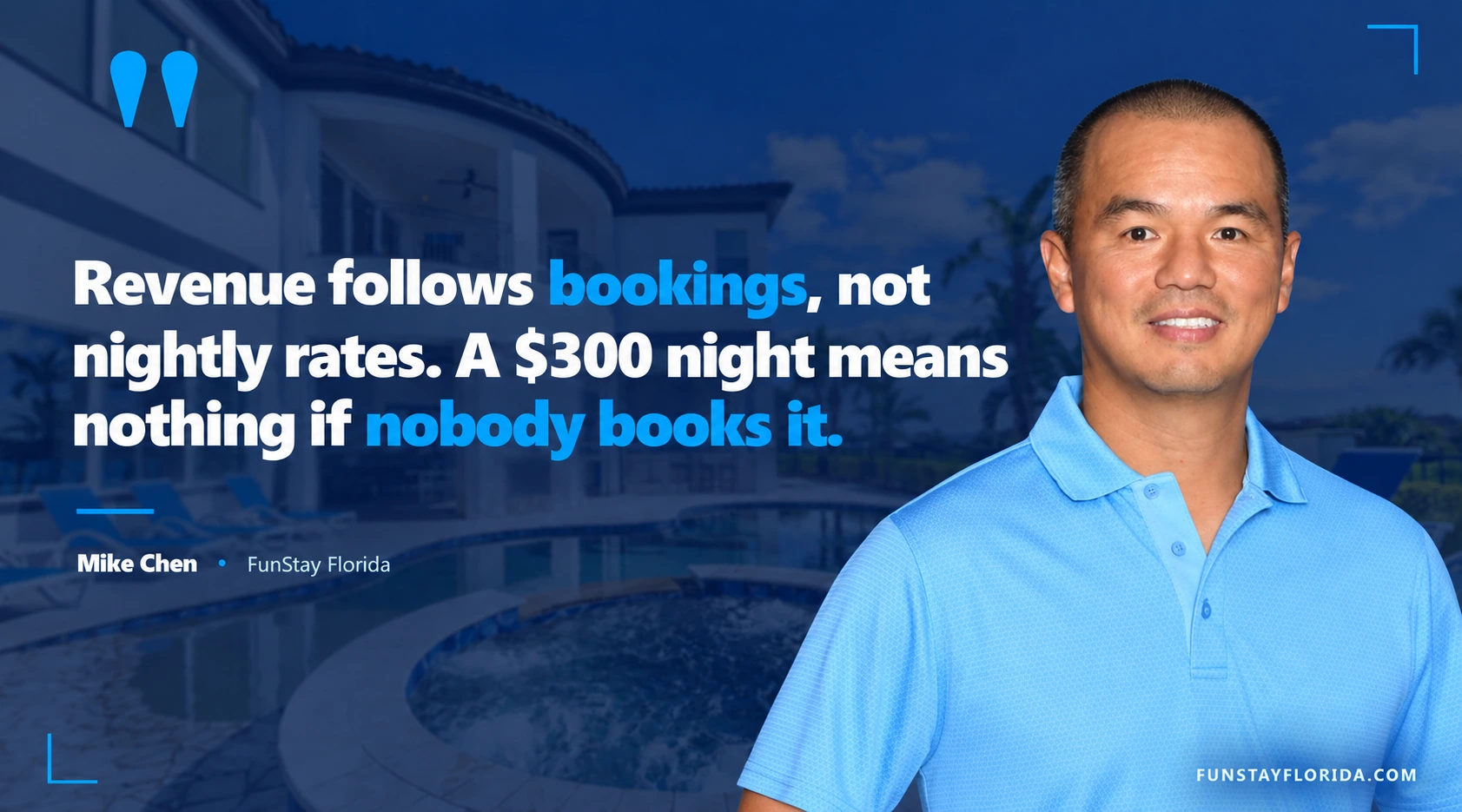
The takeaway from this table: the most profitable Airbnb locations in Florida share two traits. High occupancy rates (65%+) and limited listing supply. Revenue follows bookings, not nightly rates. Florida’s 6 most profitable cities for Airbnb investment prove the point.
The 5 Highest-Earning Florida Airbnb Markets
1. Key West: $111,575/year
Highest ADR in the state at $416 (Airbtics) to $695 (AirROI). Limited supply, with just 1,171 tracked listings, keeps rates high. Revenue grew 10.8% year over year. The catch: median home prices exceed $1M, which compresses your yield. High revenue doesn’t always mean high return on investment.
2. Destin: $75,918/year
Peak summer months (June-July) generate $9,583 per month with $507 nightly rates. But Destin revenue dropped 14.3% year over year, the biggest decline on this list. The Panhandle is heavily seasonal, and supply is catching up to demand. If you buy here, budget for thin winter months.
3. Fort Myers Beach: $68,931/year
Strong ADR at $304 with 61% occupancy. Only 822 tracked listings, so competition is relatively low. Revenue growth was slightly negative (-5.6% YoY) as new listings came online after Hurricane Ian rebuilding, but the market fundamentals remain solid.
4. Cocoa Beach: $64,644/year
Space Coast proximity and Kennedy Space Center tourism drive steady demand. 70% occupancy is the highest on this entire list. With only 902 tracked listings, Cocoa Beach is still an under-the-radar market. Worth watching.
5. Panama City Beach: $58,305/year
Revenue growth of 46.8% year over year, the fastest in the state. But this is the most seasonal market on the list: July averages $8,373 per month while January drops to $1,379. Panama City Beach also has strict STR regulations. Do your due diligence on local rules before buying.
Central Florida Deep Dive: Orlando vs. Kissimmee vs. Davenport
This is where I spend my days, so I’ll go deeper here than any data dashboard can.
Most investors looking at the best short-term rental markets in Florida near Disney are choosing between these three cities. They’re all within 30 minutes of the parks, but they perform very differently. The Davenport vs Kissimmee for Airbnb gap alone shows how much location matters at the neighborhood level.
| Metric | Orlando | Kissimmee | Davenport |
| ADR | $147 – $244 | $201 – $290 | $255 – $291 |
| Occupancy | 53% – 67% | 45% – 69% | 41% – 55% |
| Annual Revenue | $24,700 – $37,533 | $35,205 – $61,951 | $27,500 – $31,874 |
| Active Listings | 1,315 – 15,067 | 1,822 – 10,688 | 3,909 – 12,152 |
| STR Regulation | RESTRICTED | LENIENT | LENIENT |
| Avg Property Size | 2-3 BR (mixed) | 5+ BR (80% have 3+) | 5+ BR (93% have 3+) |
| Rev. Growth YoY | +8.9% to +29.3% | +3.5% to +32.3% | +2.2% to +10.1% |
Ranges reflect different data sources: Airbtics, AirDNA, AirROI. See research document for full source attribution.
Orlando
Orlando averages $24,700 to $37,533 in annual revenue depending on the data source. But here’s the critical detail most articles miss: short-term rentals under 30 nights are banned in most of unincorporated Orange County and most City of Orlando residential zones. The “Orlando” listings on AirDNA are mostly resort community properties in Kissimmee and Davenport that use “Orlando” in their listing titles for searchability. If you’re buying specifically within Orlando city limits, your STR options are extremely limited.
Kissimmee
Kissimmee is the real hub for vacation rental income in florida near the theme parks. Annual revenue ranges from $35,205 (AirROI) to $61,951 (GuestFavorites), with the variation driven largely by property size. 80% of Kissimmee listings have 3 or more bedrooms. The average guest capacity is 7 people. This is a big-home, big-family market. Kissimmee Airbnb profitability runs strong because of lenient STR regulations, year-round Disney demand, and resort communities built specifically for vacation rentals.
Davenport
Davenport runs similarly to Kissimmee, with $27,500 to $31,874 in annual revenue for the average listing. But the performance tiers tell a more interesting story. The top 10% of Davenport properties earn $92,628+ per year. The bottom 25% earn under $19,476. That’s nearly a 5x gap between well-managed resort properties and neglected standalone homes.
93% of Davenport listings have 3 or more bedrooms, and 51% have 5 or more. This is the most concentrated large-home market in Central Florida. If you’re buying a 5-7 bedroom home in a resort community like ChampionsGate, Solterra, or Windsor Island, your revenue potential is meaningfully higher than the city average suggests.
Revenue by Bedroom Count: Where the Real Money Is
City-level averages are misleading if you don’t account for property size. A 1-bedroom condo and a 7-bedroom resort home are completely different businesses operating in the same zip code.
| Bedrooms | Orlando Revenue | Kissimmee Rev. | Notes |
| 1 BR | $3,738/year | $7,287/year | Barely covers expenses |
| 2 BR | $3,964/year | – | Similar to 1 BR returns |
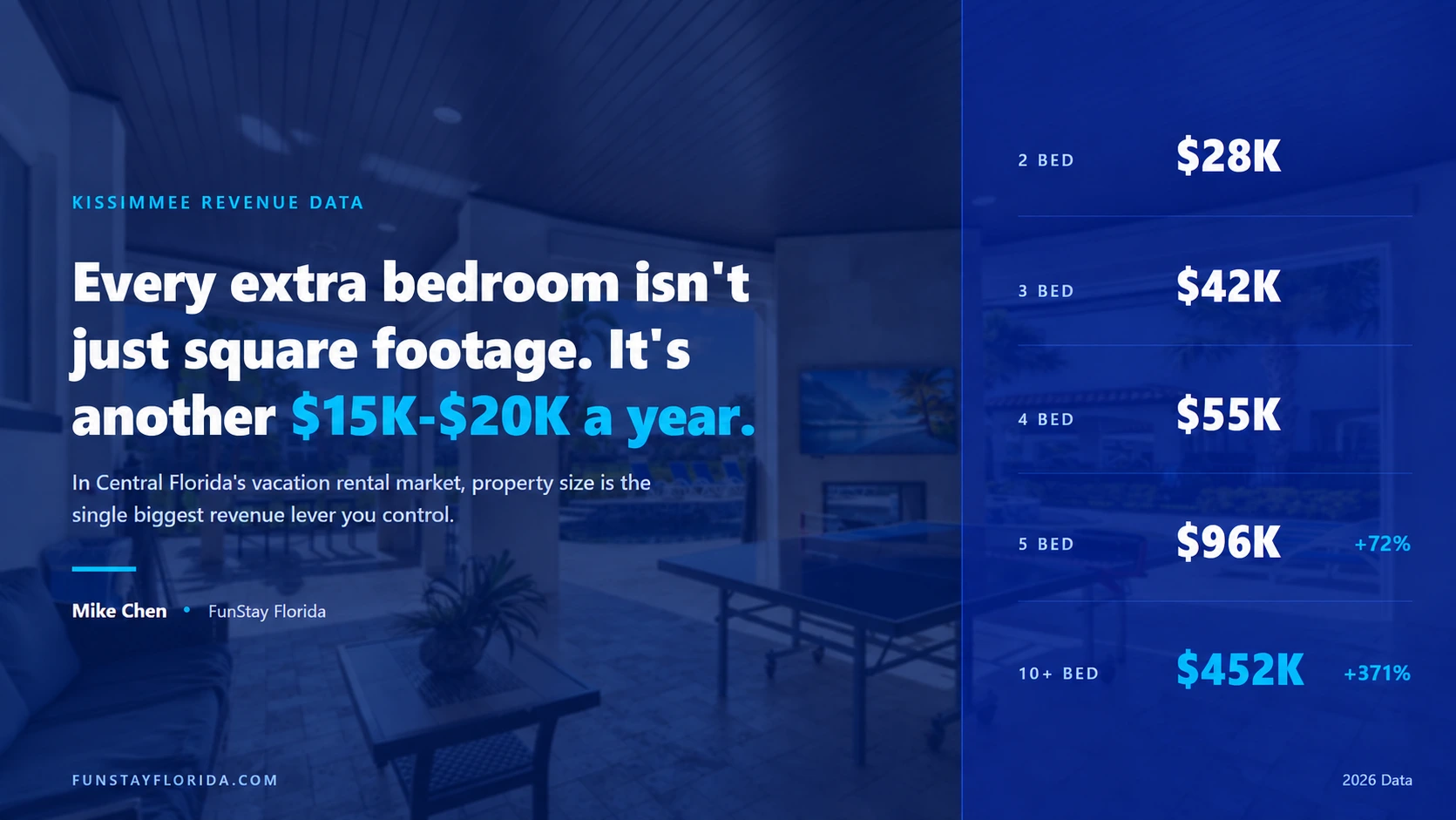
| 3 BR | $14,798/year | $18,604/year | 3.7x jump from 2 BR |
| 4 BR | $24,861/year | – | Sweet spot for smaller families |
| 5 BR | $27,748/year | $31,153 – $44,429 | 1,101 listings in Orlando |
| 6+ BR | $36,093/year | – | Top 10% of 5BR: $62,243 |
| 8 BR | – | $61,076/year | $467 ADR |
| 10 BR | – | $70,262/year | $584 ADR, 45% occupancy |
Orlando data: TheShortTermShop, 2026. Kissimmee data: AirROI, trailing 12 months.
The jump from 2 bedrooms to 3 bedrooms is where the math starts working. Orlando revenue nearly quadruples from $3,964 to $14,798. From 3 to 5 bedrooms, revenue roughly doubles again.
And the top performers blow past these averages. The highest-grossing Kissimmee listing (10 bedrooms) earned $452,170 in the trailing twelve months. A 20-bedroom Davenport resort property earned $398,011. Those are outliers, but they show what’s possible with premium amenities in the right resort communities.
If you’re evaluating a purchase, the bedroom count matters more than the city average. A 5-bedroom Kissimmee home will significantly outperform the $52,062 city average. A 2-bedroom condo in the same zip code will underperform badly. This is exactly why the most profitable Airbnb locations in Florida tend to be markets dominated by large resort homes, not studio apartments.
Seasonal Patterns: When Florida Airbnbs Earn the Most
Florida isn’t one market. It’s three seasonal patterns in one state, and understanding which pattern applies to your property is critical for cash flow planning.
| Region | Peak Rev/Mo | Low Rev/Mo | Peak Months | Ratio |
| Central FL (Kissimmee) | $5,505 | $3,074 | Mar, Apr, Dec | 1.8x |
| Central FL (Davenport) | $5,383 | $2,798 | Mar, Apr, Feb | 1.9x |
| Central FL (Orlando) | $4,409 | $2,602 | Mar, Dec, Apr | 1.7x |
| South FL (Miami) | $6,778 | $3,344 | Feb, Mar, Dec | 2.0x |
| South FL (Miami Beach) | $7,242 | $3,502 | Mar, Feb, Apr | 2.1x |
| Panhandle (Destin) | $9,583 | <$2,000 | Jun, May, Jul | 5x+ |
| Panhandle (PCB) | $8,373 | $1,379 | Jul peak | 6.1x |
Source: AirROI, rolling 12-month windows. Monthly figures are peak/low season averages.
Central Florida peaks in March (spring break) and bottoms in September (back to school, hurricane season). The revenue swing is roughly 1.7x to 1.9x between peak and trough. That’s manageable for cash flow planning, and the Orlando Airbnb peak season vs off season swing still matters when setting your reserve fund.
South Florida peaks during snowbird season (February-March) with higher absolute revenue but a similar 2x swing.
The Panhandle is where seasonality becomes a real business risk. Panama City Beach swings 6.1x between its July peak ($8,373) and January low ($1,379). If you need consistent monthly cash flow, Panhandle markets will test your reserves.
If you want predictable monthly revenue from your vacation rental income in Florida, Central Florida’s year-round Disney demand is hard to beat. The parks don’t close in September. Demand softens but doesn’t disappear.
Which Markets Are Growing (and Which Are Slowing Down)
Not every Florida market is heading in the same direction.
| City | Rev. Growth YoY | Supply Growth YoY | Signal |
| Panama City Beach | +46.8% | +19.6% | Revenue > supply = healthy |
| Kissimmee | +32.3% | +27.9% | Revenue > supply = healthy |
| Cocoa Beach | +32.0% | +19.7% | Revenue > supply = healthy |
| Orlando | +29.3% | +20.3% | Revenue > supply = healthy |
| Sarasota | +27.3% | N/A | Strong growth |
| Cape Coral | +18.1% | +15.4% | Balanced |
| Fort Lauderdale | +17.2% | +17.2% | Balanced |
| Miami | +16.2% | +26.2% | Supply > revenue = watch |
| Key West | +14.7% | +20.2% | Supply > revenue = watch |
| Davenport | +10.1% | +44.0% | Supply >> revenue = caution |
| Destin | -14.3% | N/A | Declining |
The signal to watch is the ratio between revenue growth and supply growth. When revenue grows faster than supply, existing owners benefit. When supply grows faster, per-listing revenue compresses.
Kissimmee is in a strong position: revenue grew 32.3% while supply grew 27.9%. Demand is outpacing new inventory. Panama City Beach is even more dramatic at 46.8% revenue growth. Both rank among the most profitable airbnb locations in florida for 2026 based on these growth dynamics.
Davenport is the cautionary signal. Supply grew 44% but revenue only grew 10.1%. That means more properties are splitting the same demand. If you’re buying in Davenport, property quality and management will matter more than ever to compete.
Destin is the outright warning. Revenue declined 14.3% year over year while ADR held steady. That means fewer bookings at the same price, which points to demand shifting elsewhere or oversupply finally biting.
What These Numbers Don’t Tell You
Every data point in this article is gross revenue. That’s what comes in before expenses go out.
The real cost to run a short-term rental in Orlando includes property management (15-25% of revenue), cleaning fees ($150-$350 per turnover), utilities ($200-$500/month), insurance ($3,000-$6,000/year), property taxes, HOA fees ($200-$500/month in resort communities), maintenance, supplies, platform fees (3-15%), and your mortgage.
A rough benchmark: net income typically runs 35-50% of gross revenue for a well-managed property. So that $52,062 Kissimmee average translates to roughly $18,200 to $26,000 in actual take-home income before mortgage payments.
If you’re evaluating a purchase, the gross revenue number is just the starting point. How to calculate ROI on a vacation home requires modeling the full expense stack against the purchase price, not just looking at top-line revenue.
Why Airbnb Data Varies Between Sources
If you’ve looked up Airbnb data for a Florida city before, you’ve probably noticed different platforms report different numbers. Orlando’s annual revenue shows as $24,700 on AirDNA, $29,472 on AirROI, and $37,533 on Airbtics. Same city, three different answers.
Geographic boundaries are the biggest factor. AirDNA covers the broader Orlando metro area (15,067 listings). Airbtics tracks tighter city limits (1,315 listings). AirROI falls in between at 4,520. When the geographic boundary changes, the average shifts because you’re including (or excluding) resort communities, condos, and downtown apartments.
Platform coverage matters too. AirDNA aggregates Airbnb, Vrbo, and Booking.com. Airbtics tracks primarily Airbnb-only. If you search “airbnb occupancy rate florida” across different tools, you’ll see numbers ranging from 45% to 70% for the same city because of these methodology differences.
For the comparison table in this article, I used Airbtics as the primary source because it’s the most comprehensive single-source dataset covering all 19 target cities with consistent methodology. But if you’re making an investment decision, cross-reference multiple sources for your specific target market.
Bottom Line
The average Airbnb income in Florida varies dramatically by city, property size, and management quality. Statewide averages ($63,441) are a useful benchmark, but they won’t tell you what a specific property will earn. Your actual vacation rental income in Florida depends on your market, your bedroom count, your management, and your pricing strategy.
The markets with the strongest fundamentals right now are Kissimmee (year-round Disney demand, lenient regulations, 32.3% revenue growth), Cocoa Beach (70% occupancy, limited supply), and Panama City Beach (46.8% revenue growth, though highly seasonal).
We manage over 100 vacation rental properties across Kissimmee, Davenport, and Orlando. If you’re looking at a specific property and want to know what it could actually earn based on comparable performance data from the same community, reach out. We run those projections from real numbers, not estimates.