
International investors purchased more than 78,100 US residential properties in the 12 months ending March 2025. That is a 44% increase over the prior year and the first year-over-year gain since 2017, according to the 2025 NAR International Transactions Report. Florida captured 21% of those purchases, extending its streak as the top destination for foreign buyers to over 15 consecutive years.
Mike Chen, founder of FunStay Florida and a licensed property manager who works directly with international owners across our Orlando, Kissimmee, and Davenport portfolio, built this international investor Orlando vacation rental guide from real transaction data and operational experience managing properties for buyers based outside the United States.
Most guides for international investors stop at the closing table. They cover how to buy but say nothing about what happens after you own the property. Running a short-term rental 6,000 miles away requires a level of operational coordination that catches many first-time foreign investors off guard. This guide covers both sides: the legal and financial framework for purchasing, and the day-to-day reality of STR investing in Orlando as an absentee owner.
QUICK ANSWER
Foreign citizens can buy Orlando vacation rental property with no residency restrictions. You will need an ITIN for tax filing (7 to 11 weeks to process), a 25% to 40% down payment for foreign national financing, and professional property management to handle the day-to-day operations. When you eventually sell, FIRPTA requires 15% of the sale price to be withheld for the IRS.
Why International Investors Choose Orlando Vacation Rentals
Orlando is not just a tourist destination. It is the most visited metro area in the United States, drawing over 76 million visitors in 2025 alone. That visitor volume creates a vacation rental market with demand characteristics that few other US cities can match: year-round occupancy driven by theme parks, conventions, and Florida’s winter tourism season.
The Orlando-Kissimmee-Sanford metro is one of Florida’s top markets for international buyers, second only to the Miami-Fort Lauderdale metro. Unlike Miami, where foreign buyers skew toward luxury condos and long-term appreciation plays, Orlando attracts investors focused on rental yield.
The international investor Orlando vacation rental market is concentrated in resort communities surrounding Disney, Universal, and Epic Universe, where STR yields consistently outperform most US markets.
21%
of all US foreign real estate purchases happen in Florida
78,100
US homes purchased by international buyers (2024-2025)
$494K
Recent Airbnb pool lawsuit settlement
Florida also offers structural advantages that matter to international investors. The state has no personal income tax, which means rental profits are only subject to federal taxation. Property prices remain competitive compared to global gateway cities; the cost per square meter in Orlando is a fraction of what buyers pay in London, Hong Kong, Singapore, or Sao Paulo.
The legal framework is straightforward: there are no restrictions on foreign ownership of US real estate. International buyers do need to understand local STR regulations that govern where and how vacation rentals can operate, but resort communities in Kissimmee, Davenport, and Osceola County are specifically zoned for short-term rental use.
From our portfolio: We currently manage properties for owners based in multiple countries. The most common concern we hear from international investors is not about buying the property. It is about what happens after closing: how to handle guest turnover, maintenance emergencies, tax compliance, and vendor coordination from a different time zone.
ITIN: Your Tax Identification Number
An Individual Taxpayer Identification Number (ITIN) is a nine-digit number issued by the IRS to individuals who need a US taxpayer ID but are not eligible for a Social Security Number. Every international investor Orlando vacation rental buyer needs an ITIN for tax filing on rental income, mortgage applications, and real estate transactions.
How to Apply for an ITIN
The standard ITIN application involves filing IRS Form W-7 with supporting documentation. Processing takes 7 to 11 weeks through the standard channel.
International real estate buyers have a faster pathway: when Form W-7 is submitted alongside Form 8288-B (Application for Withholding Certificate for Dispositions by Foreign Persons), the IRS ITIN unit processes the application within approximately 10 business days per IRS procedural guidelines.
| ITIN Application Method | Processing Time | Best For |
|---|---|---|
| Standard (Form W-7 by mail) | 7 – 11 weeks | Early-stage planning, no urgency |
| IRS Taxpayer Assistance Center (in person) | 7 – 11 weeks | Applicants visiting the US |
| Certified Acceptance Agent (CAA) | 7 – 11 weeks | Applicants who cannot mail original documents |
| Expedited with Form 8288-B | ~10 business days | Active real estate transactions |
Timing tip: Apply for your ITIN before you start shopping for properties. Mortgage lenders and title companies will need it, and the 7- to 11-week standard processing time can delay your closing if you wait until a property is under contract.
LLC Structuring for Foreign-Owned Vacation Rentals
Most international investors hold Orlando vacation rental property through a Florida LLC rather than in their personal name. The LLC structure addresses three concerns that are especially relevant for foreign owners: liability protection, probate avoidance, and estate tax planning.
Why an LLC Matters for Foreign Investors
Liability Protection
Vacation rentals carry inherent risk from guest injuries, property damage, and slip-and-fall incidents. An LLC separates the investment property from the owner’s personal assets, limiting exposure to the value of the property itself.
Probate Avoidance
When a foreign national dies owning US real property in their personal name, the estate must go through Florida probate, a court-supervised process that can take months and cost thousands in legal fees. An LLC avoids this because the owner holds membership interests, not direct title to the real estate.
Estate Tax Planning
Non-resident aliens face US estate tax on US-situated assets exceeding $60,000 in value, with rates up to 40%. Compare that to the $15 million exemption for US citizens. Proper entity structuring can help mitigate this exposure, though the specifics depend on the investor’s home country and any applicable tax treaties.
Critical:
Florida LLC setup for international investors should be handled by a US attorney experienced in foreign real estate transactions. Incorrect structuring can trigger Florida corporate income tax, create unintended ECI exposure, or eliminate the liability protections you set out to gain. Do not use a generic online LLC filing service for an international ownership structure.
| Ownership Structure | Liability Protection | Probate Avoidance | Estimated Setup Cost |
|---|---|---|---|
| Personal name | None | No | $0 |
| Single-member FL LLC | Yes | Yes | $500 – $2,000 |
| LLC owned by foreign corp | Yes | Yes | $3,000 – $8,000 |
| US blocker corporation | Yes | Yes | $5,000 – $15,000 |
Financing Options for International Buyers
Nearly half (47%) of international buyers in the US paid all cash in 2025, compared to 28% among all buyers. High mortgage rates and the complexity of cross-border lending drove that number up.
All-cash purchases are not the only option. The US mortgage market offers specialized loan products designed specifically for foreign nationals who lack US credit history and may not have US-based income.
Foreign National Mortgage Programs
Foreign national loans are non-QM (non-qualified mortgage) products that evaluate the property’s value and the borrower’s global creditworthiness rather than relying on a US credit score. Down payment requirements for investment properties typically range from 25% to 40%, with most lenders settling around 30% for vacation rental purchases in resort communities.
DSCR Loans: The Most Common Choice
DSCR (Debt Service Coverage Ratio) loans have become the preferred financing tool for international vacation rental investors. These loans qualify the borrower based on the property’s projected rental income rather than personal income documentation.
If the property’s expected rental income covers the mortgage payment at a ratio of 1.0 or higher (meaning revenue equals or exceeds the debt service), the loan can be approved. No US credit score is required for foreign nationals.
| Financing Detail | Foreign National Loan | DSCR Loan |
|---|---|---|
| Down payment | 25% – 40% | 25% – 35% |
| US credit score required | No | No (for foreign nationals) |
| Income verification | Foreign income docs or bank statements | Based on property rental income |
| Key documents | Passport, foreign credit report, bank reference | Passport, rental projections, bank statements |
| Typical loan term | 30 years fixed or ARM | 30 years fixed or ARM |
| Best for | Buyers with strong foreign income | Investment-focused buyers |
Understanding the full picture of management costs and operating expenses is essential before committing to a financing structure. The mortgage payment is only one line item in a vacation rental budget that includes property taxes, insurance, HOA fees, maintenance, and management.
FIRPTA: The Exit Tax Every Foreign Seller Faces
FIRPTA (Foreign Investment in Real Property Tax Act) is the federal law that governs what happens when a foreign person sells US real estate. Under current IRS rules, the buyer is required to withhold 15% of the gross sale price and remit it directly to the IRS at closing.
This 15% is not an additional tax. It is a prepayment toward the seller’s US capital gains tax liability. If the seller’s actual tax owed on the gain is less than 15% of the sale price, the difference is refunded when the seller files their US tax return. If the tax owed is more, the seller pays the balance.
FIRPTA Withholding Rates
| Sale Scenario | Withholding Rate |
|---|---|
| Standard foreign seller disposition | 15% of gross sale price |
| Buyer will use as primary residence, sale price $1M or less | 10% of gross sale price |
| Buyer will use as primary residence, sale price $300K or less | 0% (exempt) |
| Withholding certificate approved (Form 8288-B) | Reduced to estimated tax liability |
Planning ahead:
For a $450,000 Orlando vacation rental sale, the standard FIRPTA withholding is $67,500 held at closing. If your actual capital gains tax is $3,000, you would file for a $37,500 refund. Alternatively, filing Form 8288-B before closing can reduce the withholding to the estimated tax amount, but processing takes 90 days and requires planning.
Managing Your Orlando Vacation Rental from Abroad
This is where most international investor guides end, and where the real challenge begins. Buying the property is a one-time transaction. Managing it as a vacation rental is a daily operation that runs 365 days a year with no off-season in Orlando.
The operational demands of a short-term rental are fundamentally different from a long-term rental. Vacation rental guests expect hotel-level service: fast response times, spotless properties, working amenities, and immediate resolution of any issues.
Delivering that standard from another country, often in a different time zone, is where international owners face their steepest learning curve.
The Core Operational Challenges
Guest communication. Airbnb and Vrbo guests expect response times measured in minutes, not hours. A guest arriving at 11 PM to find a lockbox issue or an AC not working needs immediate help.
Time zone differences of 5 to 12 hours mean that the owner’s 3 AM is the guest’s check-in time. That gap alone makes self-managing from abroad impractical.
Turnover coordination. Back-to-back bookings during peak season mean the cleaning crew, pool service, and property inspection all need to happen in a 4- to 6-hour window between checkout and check-in.
One missed cleaning or one broken appliance that nobody catches can generate a 1-star review. It takes months of 5-star reviews to recover from that.
Maintenance emergencies. A burst pipe, a failed water heater, or a pest issue requires someone with established vendor relationships who can dispatch a licensed contractor within hours, not days.
International owners who try to coordinate repairs over WhatsApp from overseas consistently report longer resolution times, higher costs, and lower guest satisfaction.
Regulatory compliance. Florida requires a DBPR vacation rental license, proper licensing requirements and tax registration, plus collection of state sales tax (6%) and county tourist development tax (6% in both Osceola and Orange counties).
HOA rules in resort communities add another layer of compliance. Missing any of these creates fines and legal exposure.
Dynamic pricing. Orlando’s rental market swings dramatically with theme park events, school holidays, convention schedules, and seasonal demand patterns. Properties that do not adjust nightly rates daily leave significant revenue on the table.
Effective dynamic pricing requires local market knowledge that international owners simply do not have access to from abroad.
From our portfolio:
International owners who switch from self-management to our full-service management program typically see review scores improve within the first 60 days. The difference is not about effort. It is about proximity. A local team that can inspect the property between every turnover, respond to maintenance calls within the hour, and adjust pricing through professional rate optimization based on real-time market conditions will outperform remote self-management every time.
Annual Tax Obligations for Foreign Owners
International owners of Orlando vacation rentals have two ongoing federal tax obligations: income tax on rental profits and annual tax return filing.
The ECI Election: Critical for Rental Income
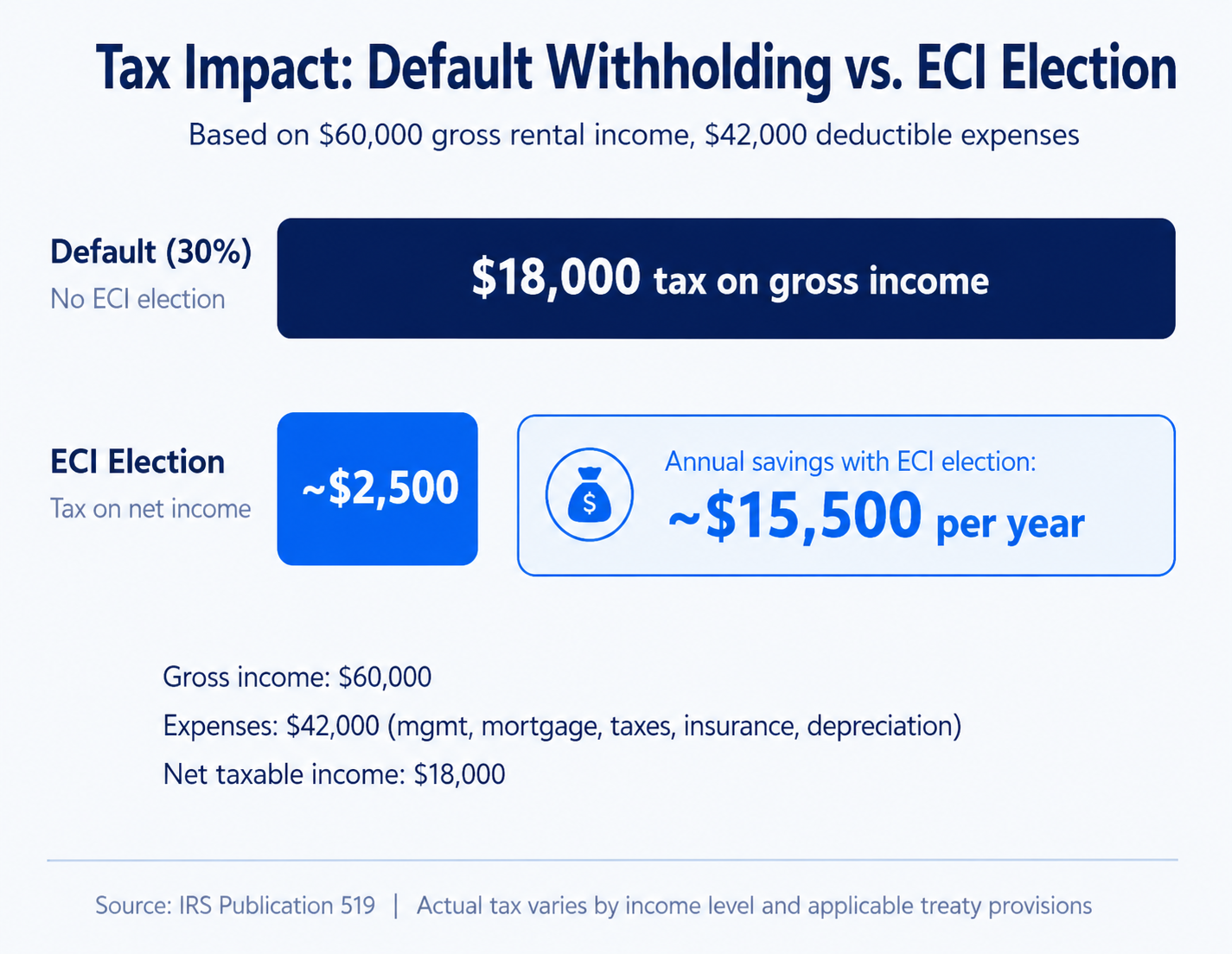
By default, the IRS withholds 30% of gross rental income from non-resident property owners. That rate applies to the total rent collected, not the profit after expenses.
For a property generating $60,000 in annual rental revenue, the default withholding would be $18,000. It does not matter whether the property was profitable after expenses.
The ECI (Effectively Connected Income) election changes this calculation entirely. By electing to treat rental income as ECI under IRC Section 871(d), foreign owners pay tax on net income after deducting mortgage interest, property management fees, repairs, depreciation, insurance, utilities, and all other legitimate business expenses.
Most vacation rental properties show significantly lower taxable income under the ECI election because operating expenses consume 50% to 70% of gross revenue.
Example:
A property generating $60,000 in gross rental income with $42,000 in deductible expenses (management, mortgage interest, taxes, insurance, depreciation) would have $18,000 in taxable income under ECI. The federal tax on $18,000 at graduated rates is approximately $2,000 to $3,000, compared to $18,000 under the default 30% gross withholding. The ECI election is not optional for any international investor Orlando vacation rental owner. It is essential. (Source: IRS Publication 519)
Annual Filing Requirements
Foreign owners must file IRS Form 1040-NR (U.S. Nonresident Alien Income Tax Return) annually, reporting all US-source rental income and claiming allowable deductions.
International tax preparation for vacation rental owners typically costs $500 to $2,000 per year, depending on the complexity of the ownership structure and whether treaty benefits apply.
CPA selection matters:
Work with a CPA who has specific experience with non-resident real estate taxation. General-practice accountants frequently miss deductions and treaty provisions that reduce the tax bill. The right CPA pays for themselves many times over.
Investing from Abroad? We Manage the Operations.
Our team handles guest communication, maintenance, pricing, tax compliance, and vendor coordination for international owners across Orlando, Kissimmee, and Davenport.
What Successful International Investors Get Right
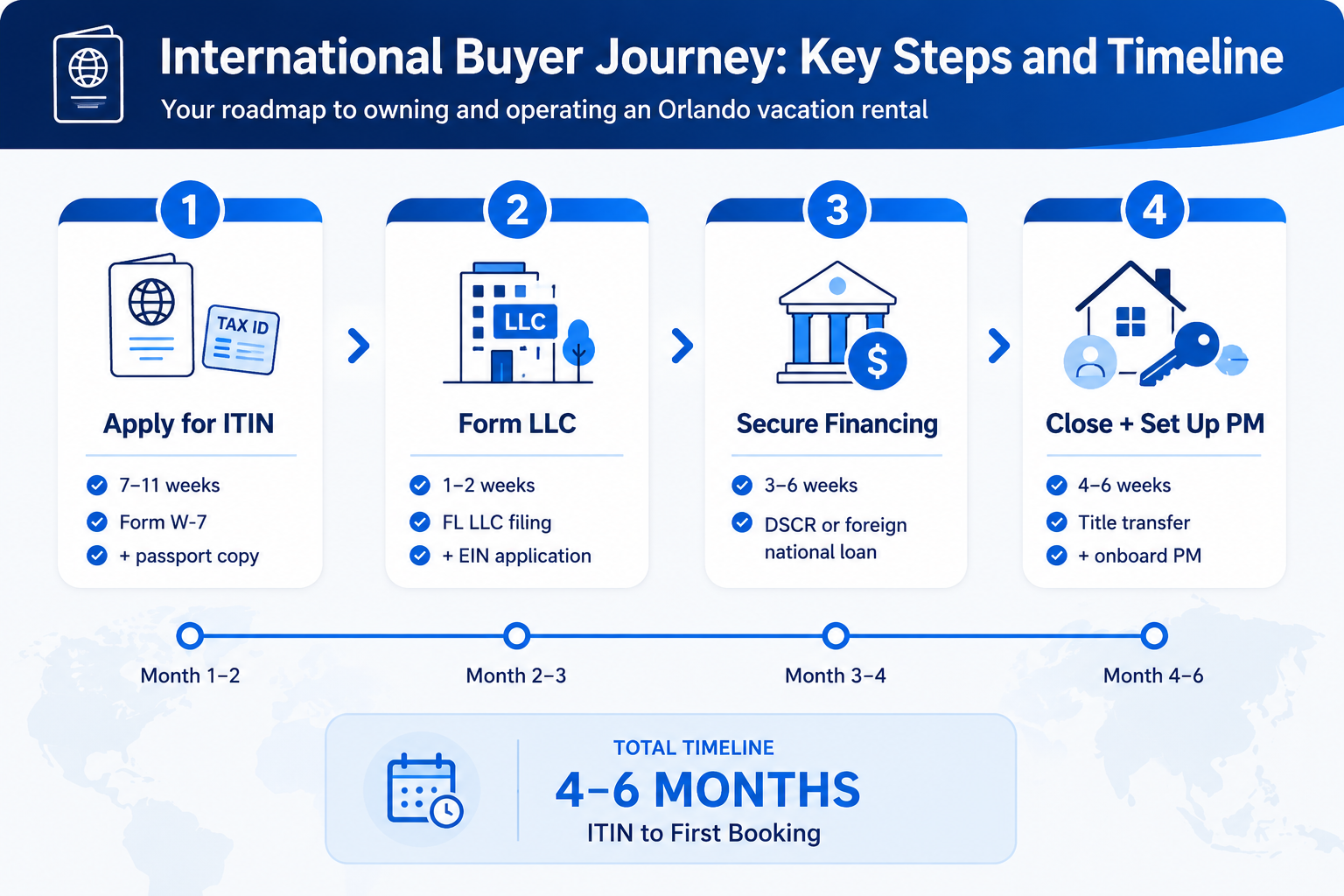
The international investor Orlando vacation rental market is mature, accessible, and well-supported by legal and financial infrastructure that specifically accommodates foreign buyers. The path from ITIN application to first guest booking takes 4 to 6 months with proper planning, and the ROI calculations work for investors who budget accurately and understand the operational requirements before they buy.
The biggest mistake we see international investors make is underestimating the management side of the equation. Buying the property is the easy part. Running it profitably from thousands of miles away requires local knowledge, vendor relationships, regulatory expertise, and round-the-clock availability that no owner can replicate from another country.
The 15% to 25% management fee is not a cost to be avoided. It is the line item that protects the other 75% to 85% of your revenue.
For international investors evaluating Orlando’s vacation rental market, the fundamentals remain strong: 76 million annual visitors, year-round demand, no state income tax, competitive property prices by global standards, and state rental laws that welcome foreign capital.
The investors who succeed are the ones who treat this as a business from day one, set up the legal and tax structure correctly, and partner with a property management team that has the local infrastructure to execute. Choosing the right service partner is the single biggest factor in long-term profitability.
Frequently Asked Questions
Can a foreign citizen buy a vacation rental in Orlando?
Foreign citizens can purchase vacation rental property in Orlando and anywhere in Florida without citizenship or residency restrictions. There are no legal barriers to foreign ownership of real estate in the United States. International buyers will need an ITIN (Individual Taxpayer Identification Number) for tax filing, and financing typically requires a 25% to 40% down payment through foreign national mortgage programs. Florida has been the top US destination for international real estate buyers for over 15 consecutive years according to the National Association of Realtors.
What is FIRPTA and how does it affect Orlando vacation rental sellers?
FIRPTA (Foreign Investment in Real Property Tax Act) requires the buyer to withhold 15% of the gross sale price when a foreign person sells US real property and remit it to the IRS. This is not an additional tax but a prepayment toward the seller’s US capital gains tax liability. If the actual tax owed is less than 15%, the seller can file for a refund. The withholding rate drops to 10% for properties sold at $1 million or less when the buyer intends to use it as a primary residence.
How much down payment do international buyers need for an Orlando vacation rental?
International buyers purchasing an Orlando vacation rental as an investment property typically need a 25% to 40% down payment through foreign national mortgage programs. The exact percentage depends on the lender, property type, and the borrower’s financial profile. DSCR (Debt Service Coverage Ratio) loans are popular among international investors because they qualify based on the property’s projected rental income rather than the buyer’s personal income or US credit history.
Can I manage my Orlando Airbnb from another country?
Managing an Orlando vacation rental from another country is possible but extremely difficult without professional support. Vacation rentals require 24/7 guest communication, same-day maintenance response, weekly cleaning coordination, dynamic pricing adjustments, and compliance with Florida’s DBPR licensing and tax collection requirements. Time zone differences, lack of local vendor relationships, and the high turnover nature of short-term rentals make remote self-management impractical for most international owners.
What is an ITIN and how do I get one for buying Florida property?
An ITIN (Individual Taxpayer Identification Number) is a tax processing number issued by the IRS to individuals who need a US taxpayer identification number but are not eligible for a Social Security Number. International investors need an ITIN to file US tax returns on rental income, apply for financing, and complete real estate transactions. Standard ITIN processing takes 7 to 11 weeks, but expedited processing through Form 8288-B takes approximately 10 business days.
Should I buy my Orlando vacation rental under an LLC?
Most international investors benefit from holding Orlando vacation rental property through a Florida LLC. An LLC provides personal liability protection, avoids Florida probate (which can be lengthy and expensive for foreign estates), and may offer estate tax planning advantages. Florida has no state income tax, and a properly structured single-member LLC is treated as a disregarded entity for federal tax purposes. International buyers should work with a US attorney experienced in foreign real estate transactions to determine the best ownership structure.
What taxes do foreign owners pay on Orlando rental income?
Foreign owners of Orlando vacation rentals face a default 30% withholding on gross rental income unless they make the ECI (Effectively Connected Income) election. The ECI election allows foreign owners to pay tax on net income after deducting expenses like mortgage interest, property management fees, repairs, depreciation, insurance, and utilities. Most vacation rental properties show significantly lower taxable income under the ECI election. Foreign owners must file an annual Form 1040-NR with the IRS.
How much does it cost to run a vacation rental in Orlando as a foreign investor?
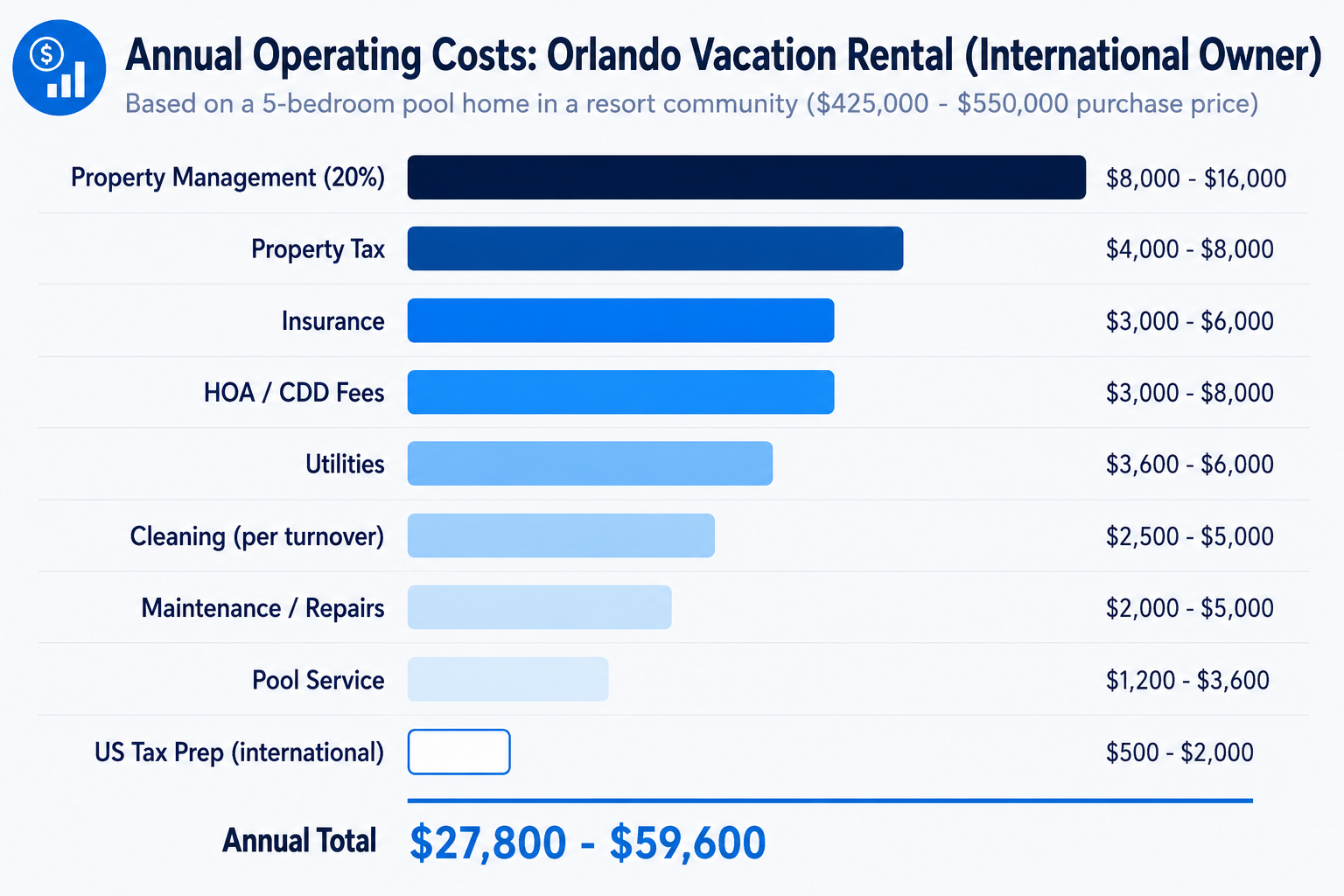
Annual operating costs for an Orlando vacation rental typically range from $27,800 to $59,600 depending on the property size and service level. Major cost categories include property management (15% to 25% of gross revenue), property taxes ($4,000 to $8,000), insurance ($3,000 to $6,000), HOA and CDD fees ($3,000 to $8,000), utilities ($3,600 to $6,000), maintenance and repairs ($2,000 to $5,000), and pool service ($1,200 to $3,600). International investors face additional costs for US tax preparation ($500 to $2,000 annually) and international wire transfer fees.
Do I need a US bank account to buy property in Orlando?
A US bank account is strongly recommended for purchasing and operating an Orlando vacation rental, though it is not legally required for the purchase itself. A US account simplifies receiving rental income, paying vendors and property taxes, and managing operating expenses. Some international banks with US branches can help foreign nationals open accounts, and certain US banks accept foreign nationals with a valid passport and ITIN. Wire transfer fees from international accounts typically run $25 to $50 per transaction.
Why do international owners need a property manager for their Orlando vacation rental?
International owners need professional property management because Orlando vacation rentals require hands-on, time-sensitive operations that cannot be handled remotely. Guests expect same-day maintenance response, properties need inspection between every turnover, ranking factors on Airbnb reward fast response times, and Florida law requires DBPR licensing and proper tax collection. Professional managers also handle vendor coordination, insurance claims, HOA compliance, and emergency response, all of which require local presence and established vendor relationships.