
Real fee data, performance benchmarks, and what actually works in Central Florida’s vacation rental market.
If you own a vacation rental in Orlando, Kissimmee, or Davenport, you have heard these two terms thrown around: co-hosting vs property management. They sound similar. They are not. Choosing the wrong model can cost you thousands of dollars a year in lost revenue, or worse, put your property at legal risk. Whether you are comparing an Airbnb co-host vs. a property manager for the first time or rethinking your current setup, the right answer depends on your situation, not a one-size-fits-all recommendation.
With over 15,800 active short-term rental listings across these three markets and Orlando welcoming a record 76.7 million visitors in 2025, the demand is there. The question is whether your management setup is capturing it. Here is what each model actually looks like, what it costs, and how to decide which one fits.
What Is Co-Hosting? (And How Does It Differ from Property Management?)
A co-host handles specific tasks you assign. Maybe that is guest messaging, pricing adjustments, or coordinating check-ins. You keep your Airbnb listing. You stay in control. The co-host fills gaps where you need help.
A property manager takes over everything. Licensing, cleaning, maintenance, marketing, dynamic pricing, guest communication, tax remittance, and revenue optimization across multiple booking platforms (Airbnb, VRBO, Booking.com, Expedia, Google Vacation Rentals). You own the property. They run the business.
Airbnb launched its Co-Host Network in October 2024, creating a marketplace of 15,000+ vetted co-hosts managing over 100,000 listings across 12 countries. To qualify, co-hosts need a 4.8+ star rating, under 3% cancellation rate, and 10+ completed stays in the past year. 73% are Superhosts.
If you are exploring Airbnb co-hosting in Orlando or nearby markets, the Network is a decent starting point, but it has limitations we will get into below.
The Real Cost Breakdown
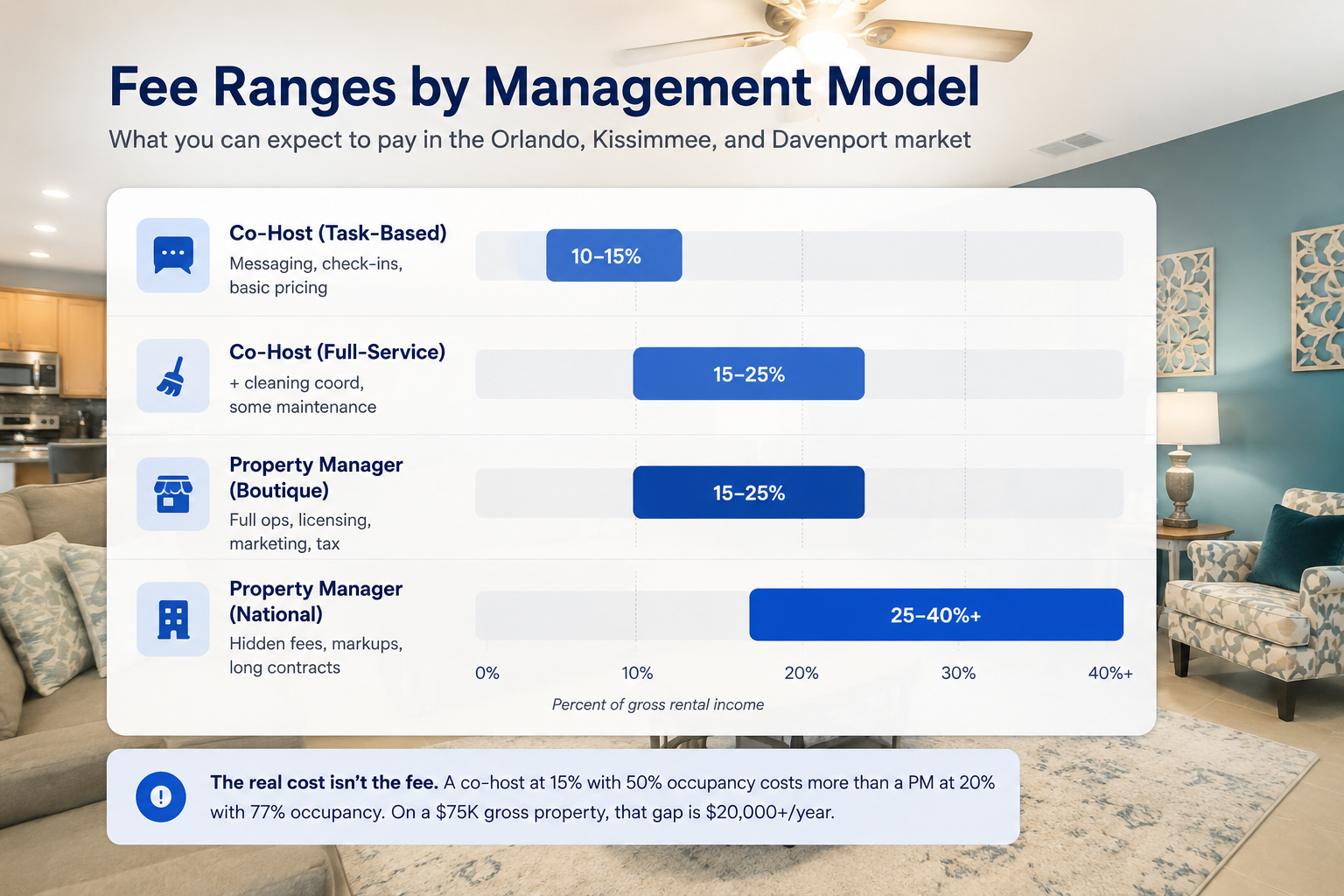
Fee ranges vary widely depending on the commission vs flat-fee model, and most online comparisons miss the hidden costs. Here is what co-hosting vs property management actually costs in the Orlando, Kissimmee, and Davenport markets:
| Management Model | Fee Range | What Is Included |
|---|---|---|
| Co-host (task-based) | 10 – 15% | Guest messaging, check-in coordination, basic pricing |
| Co-host (full-service) | 15 – 25% | Messaging, pricing, cleaning coordination, and some maintenance |
| Property manager (boutique) | 15 – 25% | Full operations, licensing, marketing, maintenance, and tax compliance |
| Property manager (national) | 25 – 40%+ | Full service but often with hidden fees, markups, and long contracts |
But fees only tell part of the story. A co-host charging 15% who cannot get your occupancy above 50% costs you more than a property manager charging 20% who keeps you at 77%. On a property earning $75,000 gross, that occupancy gap is worth $20,000+ per year in lost revenue.
How Each Model Performs in Orlando, Kissimmee, and Davenport
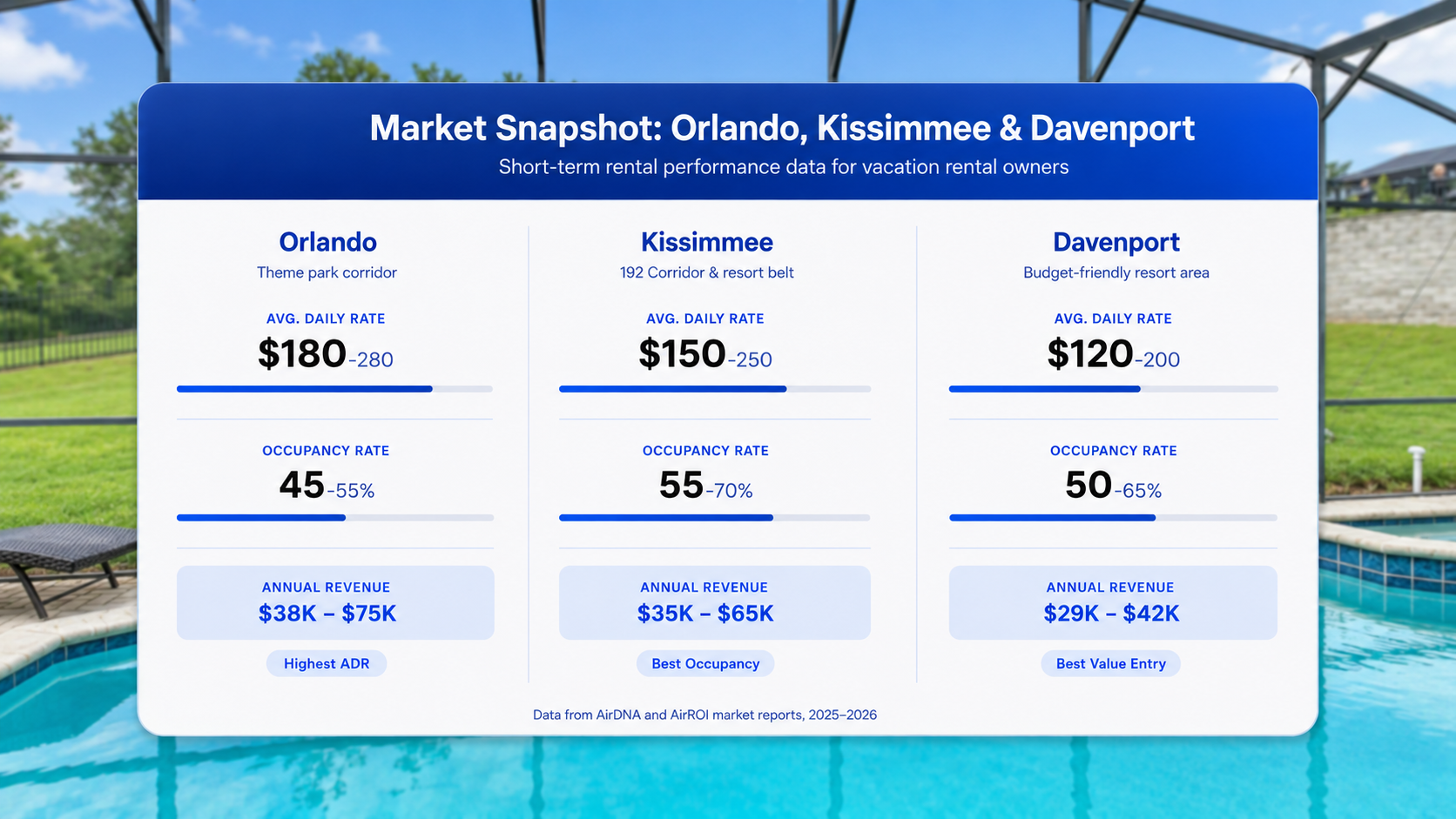
When it comes to co-hosting vs full management in Orlando, the performance gap shows up fast in the data. Central Florida’s vacation rental market is competitive, and the numbers look different depending on which area you are in:
| Metric | Orlando | Kissimmee | Davenport |
|---|---|---|---|
| Average Daily Rate | $227 – 241 | $245 – 276 | $251 – 278 |
| Occupancy Rate | 45 – 55% | 46 – 56% | 41 – 56% |
| Avg Annual Revenue | $31K – 38K | $37K – 38K | $29K – 42K |
| Top Properties Earn | $60K – 80K+ | $65K – 85K+ | $80K+ |
Those “top property” numbers are not random. They come from listings with professional management, optimized pricing, strong photography, and multi-platform distribution. Professionally managed properties in Orlando, Kissimmee, and Davenport earn up to 40% more than market averages.
Epic Universe drew an estimated 10 million visitors in its first year and was named one of Time’s World’s Greatest Places for 2026. That surge in demand is hitting all three markets, and the gap between well-managed and under-managed properties is only getting wider.
Licensing and Legal: The Part Most Owners Miss
This is where the co-hosting vs property management decision gets serious. Florida requires a DBPR vacation rental license for every short-term rental operating under 30 days. There is no specific co-host license in Florida law. That creates a gray area.
Most co-hosts leave the licensing, tax registration, and compliance burden on you. A full property manager handles it. That includes your DBPR license, Osceola County tourist development tax (6% on top of Florida’s 6% sales tax), liability coverage, and HOA compliance.
If your property is in a resort community (Solara, Storey Lake, Windsor at Westside, ChampionsGate, Reunion), your HOA likely has specific rules about minimum stays, noise, and management requirements. A local Airbnb management company in Davenport or Kissimmee that works in 17+ resort communities already knows those rules. A co-host from Airbnb’s marketplace probably does not.
When Co-Hosting Works (and When It Stops Working)
Co-hosting makes sense when you live in Orlando, Kissimmee, or Davenport, own one property, want to stay involved in decisions, and just need help with guest communication or pricing. It is a good starting point for hands-on owners who have the time.
It stops working when:
- You live out of state and cannot handle emergencies (a burst pipe at 2am does not wait for a text back)
- You own multiple properties and the admin is eating your weekends
- Your occupancy has plateaued below 55% and you are not sure why
- You are not listed on VRBO, Booking.com, or Google Vacation Rentals because your co-host only manages Airbnb
- Guest reviews are slipping below 4.7 stars and your Superhost status is at risk
If two or more of those sound familiar, the co-hosting vs property management question has answered itself. That is not a knock on co-hosting. It just means your Kissimmee vacation rental or Davenport vacation rental needs more than what that model was designed to deliver.
When Full Property Management Is the Clear Choice
Out-of-state owners, multi-property portfolios, and resort community properties almost always do better with full vacation rental property management in Orlando, Kissimmee, and Davenport. The math is simple: a professional Airbnb management team with 24/7 guest support, damage protection (up to $50K per incident through Truvi), multi-platform distribution, and dynamic pricing that gets reviewed weekly will consistently outperform a part-time co-host.
At FunStay Florida, we manage 100+ vacation rentals across all three markets at a 15 to 25% flat fee. No hidden charges. No long-term contracts. Our portfolio maintains a 4.81-star average guest rating and 77% occupancy. We also run FunStay Homes for direct bookings, so your property earns from every channel, not just Airbnb.
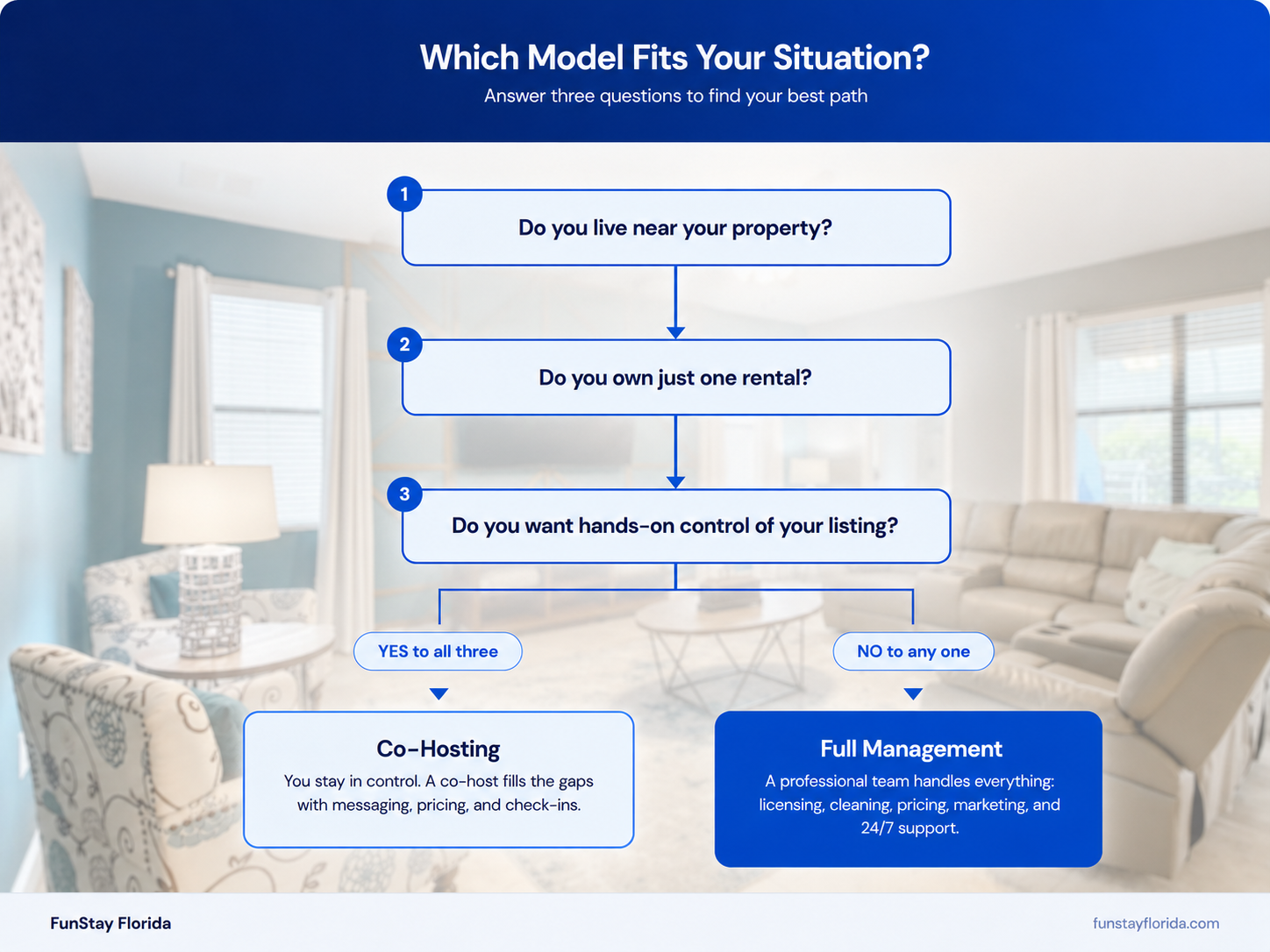
Not sure which model fits?
Get a free rental income estimate for your Orlando, Kissimmee, or Davenport property. We will show you what your home could earn with professional management.
FAQ: Co-Hosting vs Property Management