
$230
Year-One Cost (Single Unit)
$180
Annual Renewal
1-2 Days
Approval Time
An owner in ChampionsGate called us last year after Osceola County fined him $500. He had his Airbnb listed, guests booked, reviews coming in. No DBPR vacation rental license. No county STR permit. No business tax receipt. He thought the Airbnb account was the license.
He is not an outlier. I have managed over 100 vacation rentals in the Orlando and Kissimmee corridor, and the most common question from new owners is still: what licenses do I actually need? The answer starts with the Florida DBPR vacation rental license, but it does not end there.
This is the step-by-step guide I wish existed when I filed my first application. Every fee, every deadline, every mistake I have seen owners make, and how to avoid them. The DBPR license is one layer of a larger regulatory stack covered in our guide to Florida’s short-term rental laws and what every owner needs to know in 2025.
What Is a DBPR Vacation Rental License?
A DBPR vacation rental license is a state permit from the Florida Department of Business and Professional Regulation. Florida Statute 509.241 (leg.state.fl.us) requires it before you can legally operate a short-term rental.
You need a Florida DBPR vacation rental license if your property is rented to guests more than three times per calendar year for stays under 30 days, or if you advertise it as available for short-term stays. List it on Airbnb or VRBO, and it books regularly? You need this license.
One thing most guides miss: Kissimmee defines “short-term” differently than the state. Under Kissimmee’s municipal code, any rental of six months or less counts as a short-term rental. That is wider than the state’s 30-day threshold and catches more properties than owners expect.
Who is exempt: Properties rented three or fewer times per year for short stays. Rooms inside an owner-occupied home (not the whole unit). Long-term rentals of 30 days or more. Timeshare projects have their own license type.
If you are unsure, apply. Operating without a DBPR short-term rental license is an expensive mistake.
Dwelling vs. Condo, Single vs. Group vs. Collective
DBPR issues two types of Florida vacation rental licenses: Dwelling and Condominium. You cannot combine them on the same application.
| License Type | Use It When |
|---|---|
| Vacation Rental Dwelling Single | One single-family home, townhouse, duplex, triplex, or quadruplex you own and rent |
| Vacation Rental Dwelling Group | Multiple dwellings at one address, licensed to a licensed agent |
| Vacation Rental Dwelling Collective | Up to 75 dwellings across separate locations in one district, licensed agent required |
| Vacation Rental Condominium Single | One condo or co-op unit you own and rent |
| Vacation Rental Condominium Group | Multiple condo units in the same building, licensed agent required |
| Vacation Rental Condominium Collective | Up to 75 condo units across locations in one district, licensed agent required |
Most of our owners need Vacation Rental Dwelling Single. One home, one license, filed under the owner’s name or LLC.
A “licensed agent” does not mean a real estate agent. It means someone the owner has authorized, through a rental agreement or contract, to hold the property out for rent. Only a licensed agent can hold a Group or Collective license. Individual owners hold Single licenses.
How to Apply for a DBPR Vacation Rental License in Florida
The Florida vacation rental license application is online at myfloridalicense.com. That is the only official portal. Third-party filing services charge markups to submit the same forms you can file yourself in 20 minutes.
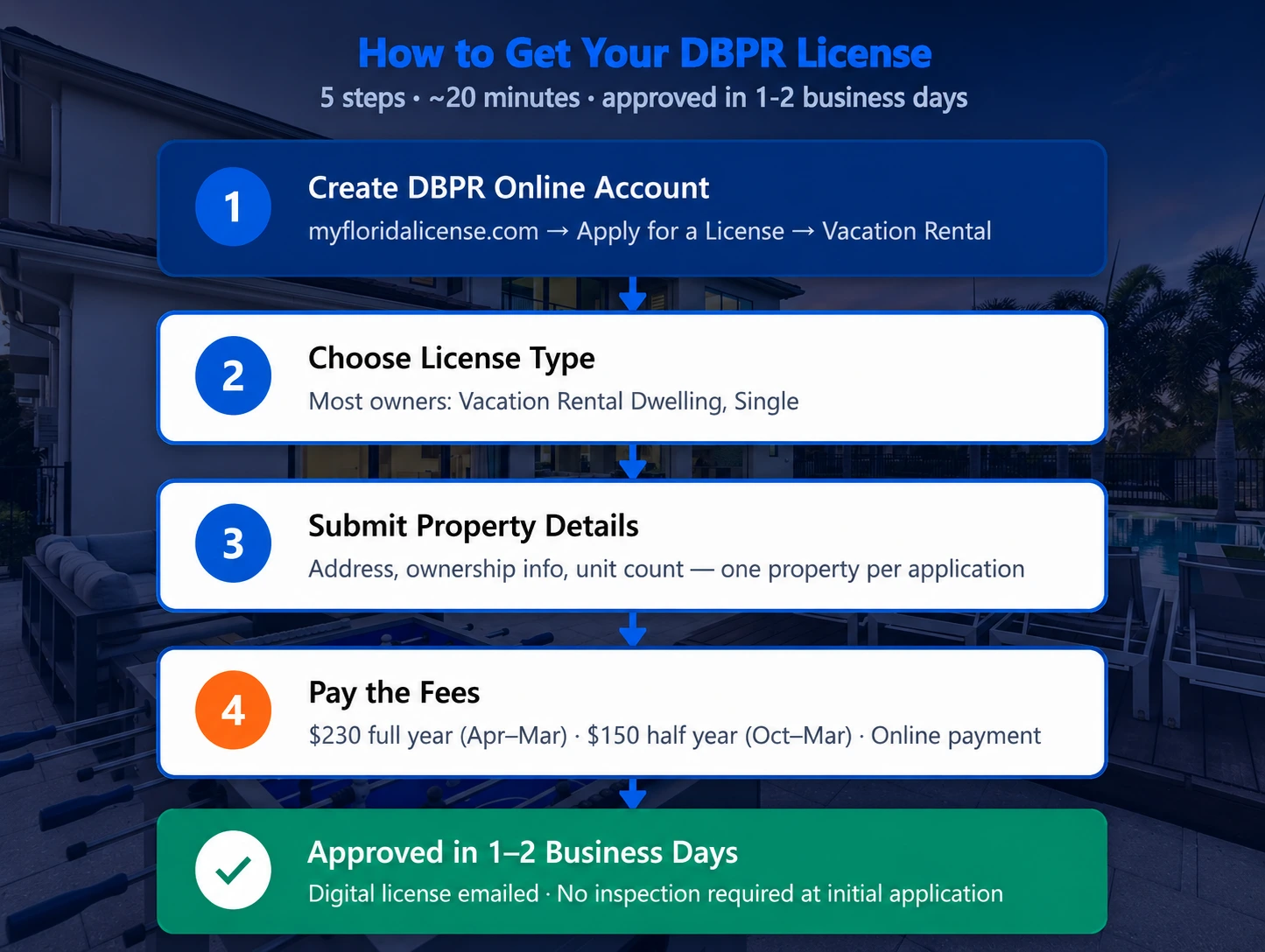
1. Create a DBPR Online Services account.
Submit your application at myfloridalicense.com (the DBPR portal) under “Apply for a License” and select “Vacation Rental.” Decide before you file whether the license should be in your personal name, an LLC, or a trust. This affects taxes and liability, and it is hard to change later.
2. Choose your license type.
For most owners: Vacation Rental Dwelling, Single. The application walks you through property type questions to confirm.
3. Submit property details.
Enter the property address, ownership information, and unit count. Each rental address must be entered individually through your DBPR Online Services account.
4. Pay the fees.
A single-unit DBPR vacation rental license costs $230 for a full year or $150 for a half year. Pay online through the portal.
5. Wait for approval.
How long does it take to get a Florida vacation rental license? Online applications process in one to two business days. The digital license arrives by email immediately after approval.
No inspection is required at initial application. DBPR conducts random and complaint-based inspections after licensing. Some competitor guides claim an inspector will contact you before approval. That is wrong.
After approval, verify your property appears in DBPR’s searchable Vacation Rental Database. Your license number is what Airbnb and VRBO will ask for. If you want us to handle the filing, our Airbnb licensing assistance in Orlando covers DBPR applications for new owners every month.
What You Need to Maintain After Licensing
Getting the license is step one. Keeping it means staying compliant with DBPR’s ongoing requirements:
Display your license number in all advertising. That includes your Airbnb listing, VRBO profile, your website, social media posts, and any print materials. This is a requirement, not a suggestion.
Working smoke detectors in every sleeping room and hallway. Fire extinguisher accessible to guests.
Dishes sanitized between guests, or post a notice. This is one most owners miss. You can either sanitize all dishes and utensils to commercial standards, or simply post a notice informing guests they are responsible for sanitizing dishes before use. The notice costs nothing. A commercial dish machine costs thousands. We tell every new owner: post the notice.
Clean linens and towels between each guest. Mattress and pillow protectors recommended.
How Much Does a Florida Vacation Rental License Cost?
The DBPR vacation rental license cost breaks down into three components (verified against DBPR’s official fee schedule):
| Fee | Full Year | Half Year |
|---|---|---|
| License fee (single unit) | $170 | $90 |
| Application fee (one-time) | $50 | $50 |
| Hospitality Education Program (HEP) | $10 | $10 |
| Total for one home | $230 | $150 |
Year one costs $230. Every year after that, renewal is $180. The $50 application fee is one-time and does not apply at renewal. No grace period on renewals. Miss it, and you owe a delinquent fee up to $50.
How much does a Florida vacation rental license cost if you time it right? That depends on your DBPR district. Orlando, Kissimmee, and Davenport are all in District 4. The renewal date is April 1. The half-year fee kicks in October 1.
DBPR’s own guide says: “Wait to apply if you don’t plan on operating until after the next renewal date.” If you close on a Kissimmee property in November and will not be booking guests until January, file after October 1 and pay $150 instead of $230. That is $80 saved before you host a single guest.
Licensing is just one line item. For the full operating budget including insurance, utilities, and management fees, see our breakdown of the real cost to run a short-term rental in Orlando.
DBPR Is Layer One. Here Is What Else Orlando and Kissimmee Require.
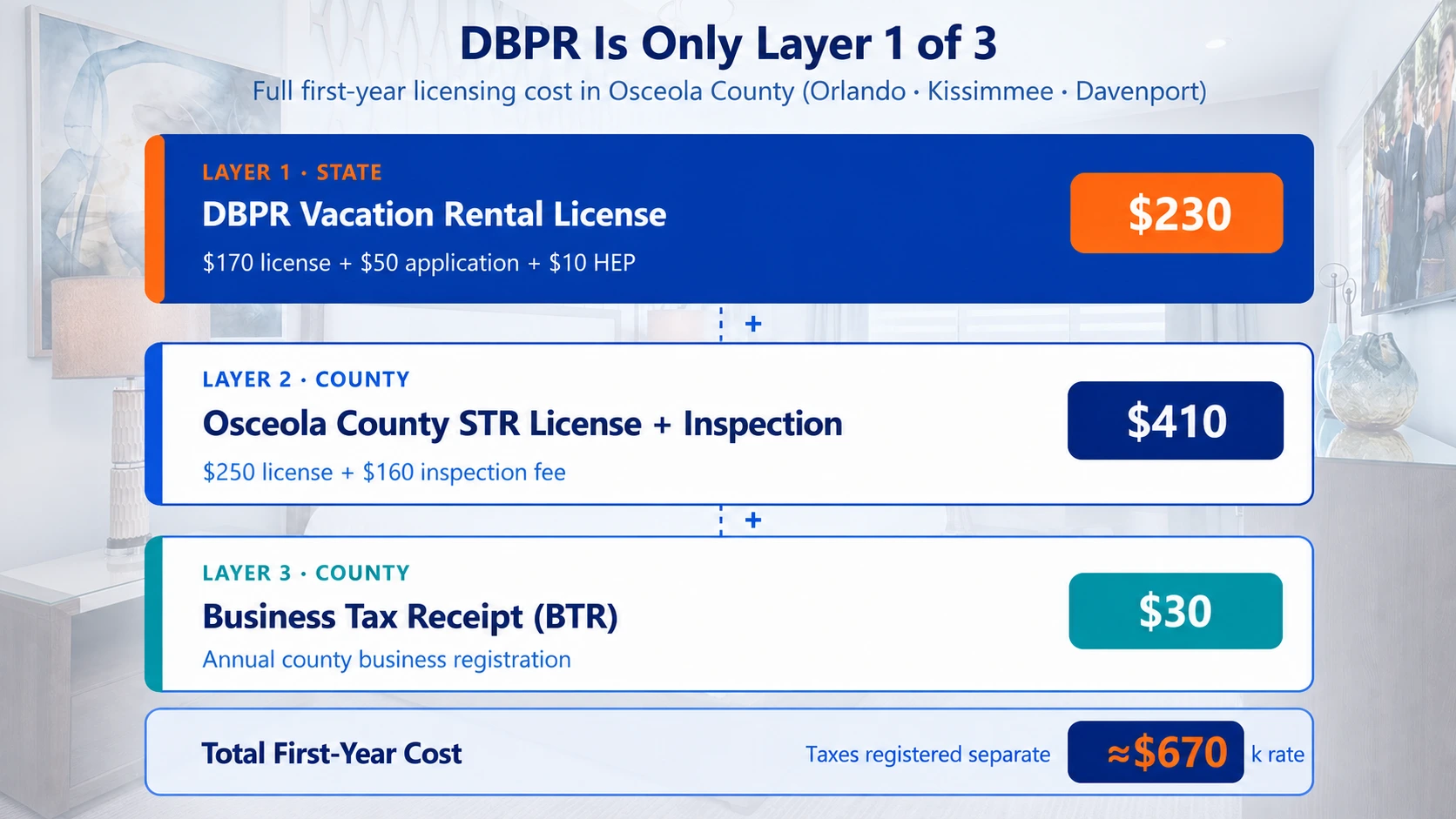
A Florida DBPR vacation rental license covers the state requirement. Osceola County stacks two more layers on top.
| Layer | What | Cost |
|---|---|---|
| 1. State | DBPR vacation rental license | $230 (full year) |
| 2. County | Osceola County STR license + inspection | $250 + $160 = $410 |
| 3. County | Business Tax Receipt (BTR) | $30/year |
Total first-year cost in Osceola County: approximately $670. That covers state and county. Taxes are separate.
You also need to register with the Florida Department of Revenue for sales tax and discretionary surtax, and with the Osceola County Tax Collector for the Tourist Development Tax. The combined guest tax rate in Osceola County runs approximately 13.5%.
One distinction matters here: if your property is in Kissimmee or Davenport, you are in Osceola County. Not the City of Orlando. Orlando city limits have different, stricter rules for whole-home rentals. See our page on Orlando short-term rental laws for Airbnb and VRBO hosts if that applies to you. Most of our owners operate in Osceola County, where short-term rentals are allowed in designated tourist zones. On the tax side, you will owe TDT, sales tax, and surtax. We break down exactly what Florida vacation rental taxes platforms collect versus what you owe out of pocket.
What Happens If You Skip the License
Fines up to $1,000 per day under Florida Statute 509.261. That is the penalty for operating without a vacation rental license in Florida. DBPR enforcement has shifted from purely complaint-based to proactive. They cross-reference Airbnb and VRBO listings against their license database.
Beyond the fine, Airbnb and VRBO now request license numbers for Florida listings. No number, no listing. Standard homeowner insurance policies exclude short-term rental activity. We have seen two claims denied in our network in the past year because the owner’s license had lapsed. Operating without proper licensing gives your insurer a reason to deny any claim.
The DBPR vacation rental license costs less than one weekend booking. Skipping it is the most expensive shortcut you can take.
5 Mistakes We See After Filing 100+ DBPR Applications
1. Filing under a personal name instead of an LLC. Three out of ten new owners we onboard made this mistake. The Florida DBPR vacation rental license ties to a person or entity. Changing it later means a new application and another $50 fee. Decide your ownership structure before you file.
2. Assuming the DBPR license is the only license. It is layer one of three in Osceola County. We see at least two county-level code enforcement fines per quarter from owners who stopped at the DBPR license and never filed for the Osceola County STR permit or BTR.
3. Thinking the seller’s license transfers with the property. A Florida vacation rental license is not transferable. We have helped four owners recover from this assumption in the past year alone. If you buy a property with an active DBPR license, you still need your own. File on closing day.
4. Not registering for tourist development tax separately. Airbnb collects Florida’s 6% state sales tax statewide but does not always collect the county TDT. You owe it regardless. Register with your county tax collector before your first booking.
5. Missing the renewal date. No grace period. Delinquent fee up to $50, and your listing goes non-compliant. Set a calendar reminder 60 days before your District 4 renewal on April 1. Owners in Davenport should also review the Davenport vs Kissimmee comparison with Polk County regulation details, since Polk County adds a separate county layer.
Skip the Paperwork. We Handle It.
We file DBPR applications, Osceola County STR licenses, business tax receipts, and tax registrations for new owners every month. Two phone calls, zero paperwork headaches.
Frequently Asked Questions