
A Kissimmee host called us last year after getting a letter from the Osceola County Tax Collector. She’d been on Airbnb for two years. Assumed the platform handled all her Florida vacation rental taxes. Turns out, Airbnb never collected a dime of her county’s tourist tax. She owed $7,200 in back taxes, plus penalties.
She’s not an outlier. I’ve managed over 100 vacation rentals across Orlando, Kissimmee, and Davenport, and this Airbnb tax situation in Florida is the number one thing new owners get wrong. Not pricing. Not a guest screening. Taxes.
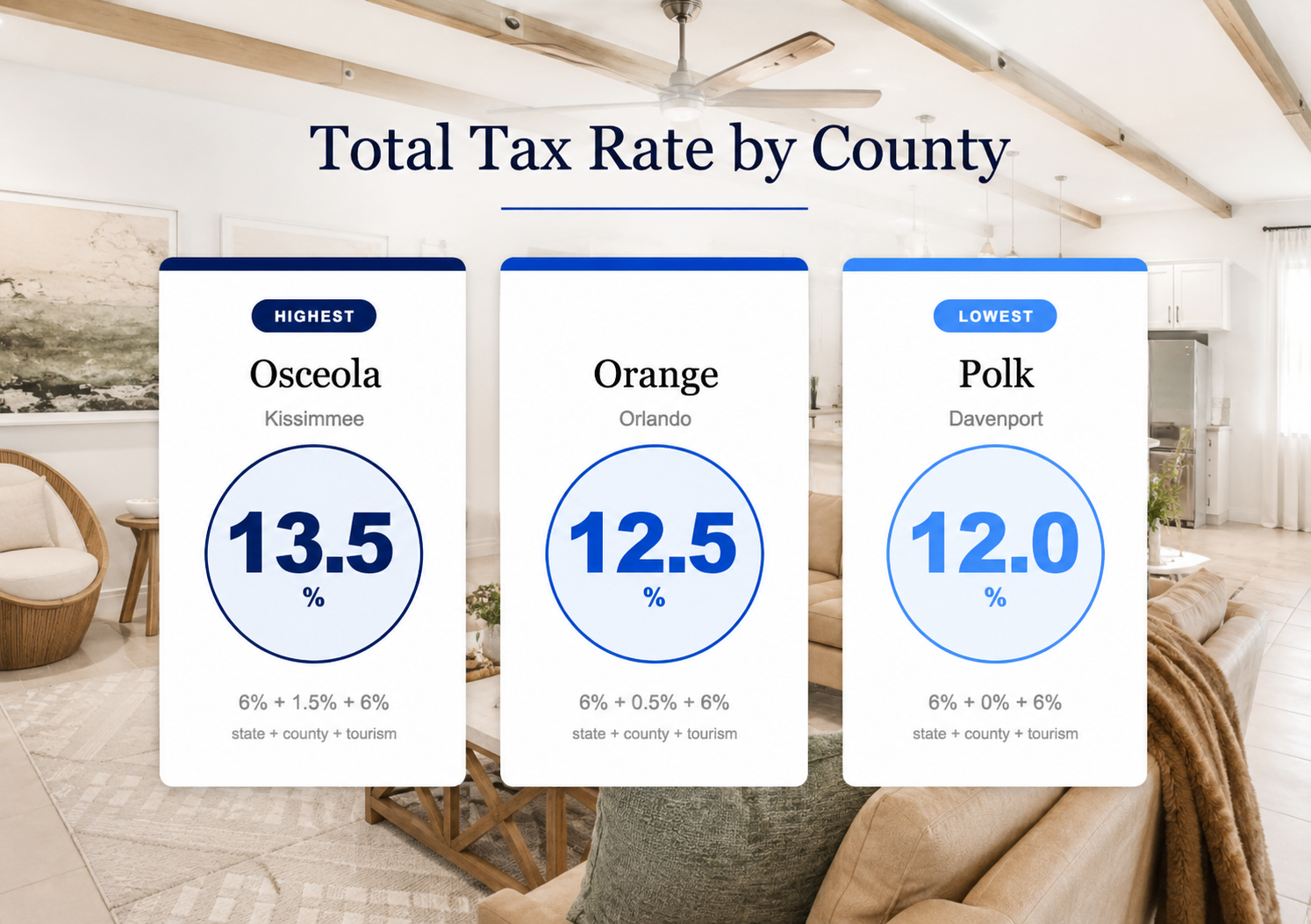
You owe between 12% and 13.5% on every booking, depending on your county. Three separate taxes, two government agencies, and a gap in what platforms collect that nobody warns you about. Here’s the full breakdown so you don’t end up like that Kissimmee host.
13.5%
Total tax in Kissimmee (Osceola County)
12.5%
Total tax in Orlando (Orange County)
12.0%
Total tax in Davenport (Polk County)
The Three Tax Layers Every Florida Host Owes
Most owners think “Florida vacation rental taxes” means one tax at one rate. It’s actually three taxes stacked together, each going to a different place, each with its own filing deadline. Miss one and you won’t know until the penalty notice arrives.
1. State Sales Tax (6%)
Florida charges 6% on every transient rental under six months. That’s Florida Statute 212.03, unchanged for over a decade. You file it with the Florida Department of Revenue on Form DR-15.
Important detail: “total rental charged” means more than the nightly rate. It includes cleaning fees, pet fees, and every mandatory charge. More on that below.
2. County Tourist Development Tax (5-6%)
This is the one I see owners miss constantly. The tourist development tax in Florida goes to your county, not the state. Completely separate registration. Completely separate return. Completely separate deadline.
Osceola County and Orange County both charge 6% TDT, the maximum Florida law allows. Polk County charges 5%. The Polk County vs Osceola County rental regulations differ on more than just the rate.
3. Discretionary Sales Surtax (0.5-1.5%)
The small one. Every county adds a surtax on top of the state’s 6%. Osceola adds 1.5%, Polk adds 1.0%, Orange adds 0.5%. This files together with your state sales tax on the DR-15, so at least it’s not a third account to manage.
Bottom line:
You need TWO separate tax accounts before your first guest checks in. One with the Florida Department of Revenue (sales tax + surtax) and one with your county tax collector (TDT). Miss either and penalties start stacking on day one.
Florida Vacation Rental Tax Rates by County
I get asked about these rates every week. Here’s the full Florida sales tax on vacation rental breakdown for the three counties where we manage properties. All rates current; no changes are scheduled.
| Tax Component | Osceola (Kissimmee) | Orange (Orlando) | Polk (Davenport) |
|---|---|---|---|
| State sales tax | 6.0% | 6.0% | 6.0% |
| Discretionary surtax | 1.5% | 0.5% | 1.0% |
| Tourist development tax | 6.0% | 6.0% | 5.0% |
| Total combined rate | 13.5% | 12.5% | 12.0% |
On a $200/night booking in Kissimmee, that’s $27 in taxes per night. On a property earning $60,000/year, you’re looking at $8,100 in total tax. That’s a real line item, and knowing the full cost to run a short-term rental in Orlando starts with understanding this number.
Quick tip for Davenport owners: parts of ChampionsGate fall in Osceola County (13.5% total) while other Davenport addresses are in Polk (12.0%). That 1.5% difference adds up to $900/year on a $60K property. Your property tax bill shows which county you’re in.
What Airbnb and Vrbo Collect (And What You Still Owe)
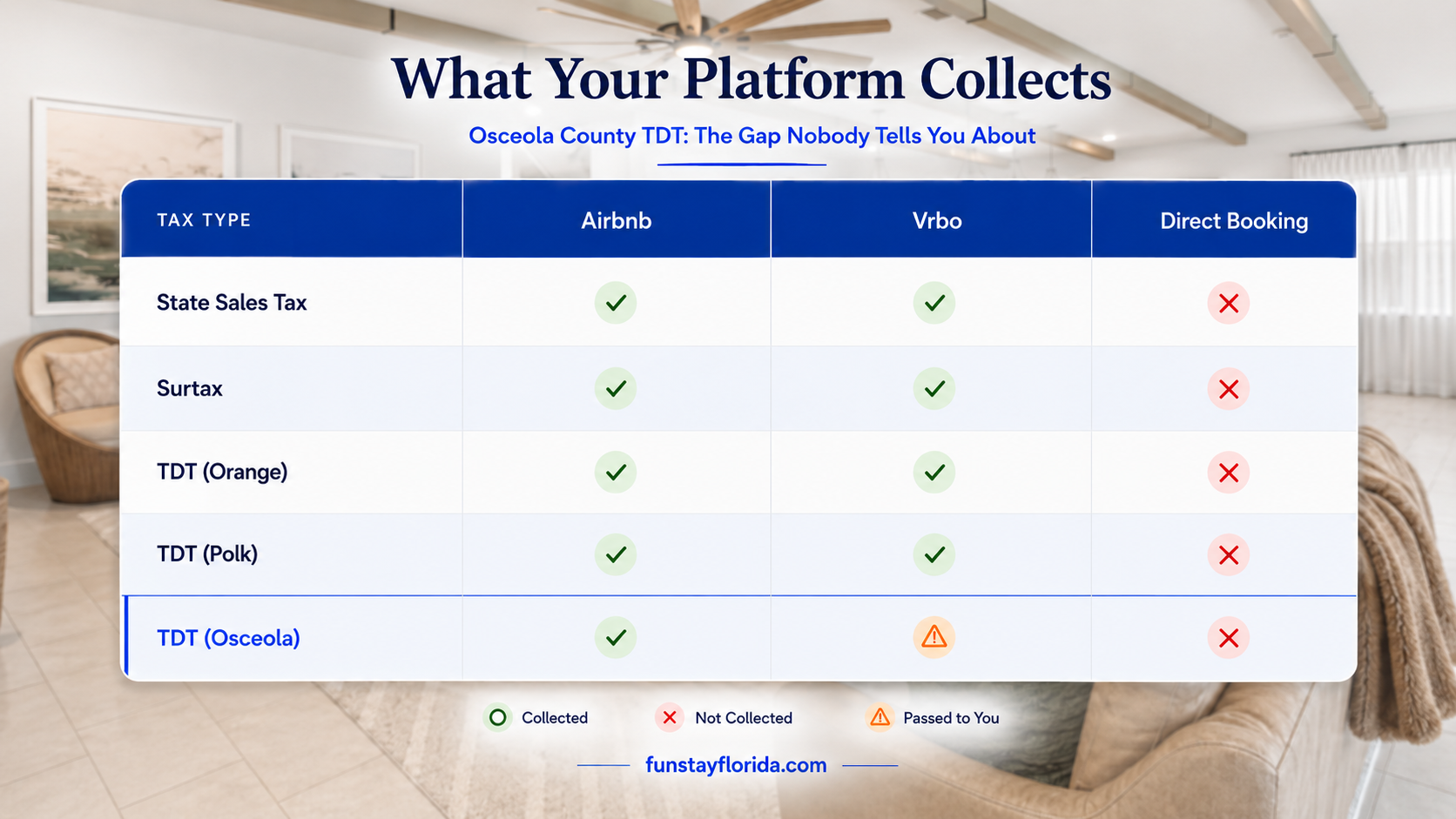
This is where Florida short-term rental tax gets really messy. Every platform handles tax collection differently, and the biggest gap sits right in Osceola County, where most of our owners have properties.
| What They Collect | Airbnb | Vrbo | Direct Bookings |
|---|---|---|---|
| State sales tax (6%) | ✓ Yes | ✓ Yes | ✗ You collect |
| Discretionary surtax | ✓ Yes | ✓ Yes | ✗ You collect |
| TDT: Orange County | ✓ Yes | ✓ Yes | ✗ You collect |
| TDT: Polk County | ✓ Yes | ✗ No | ✗ You collect |
| TDT: Osceola County | ✗ No | ⚠ Collects but passes to you* | ✗ You collect |
*Vrbo collects the Osceola County tourist tax from the guest but passes it to the owner/property manager to remit to the county. You are still responsible for filing.
⚠ The Osceola County trap:
Airbnb does NOT have a collection agreement with Osceola County for tourist development tax. If your property is in Kissimmee, Celebration, or the Osceola side of ChampionsGate, you must register with the Osceola County Tax Collector and remit the 6% TDT yourself. Every single month. Even if 100% of your bookings come through Airbnb.
I can’t stress this enough. This is the single biggest compliance trap for Kissimmee hosts. Every owner we onboard from self-managing, this is the first thing we fix. The Florida DOR sees every Airbnb listing through 1099-K filings. If you have bookings but no Osceola County tourist tax account, you’re already flagged.
When you list across Airbnb, Vrbo, and direct booking channels, tracking which taxes each platform collects becomes a monthly reconciliation headache. That’s one of the biggest reasons owners switch to a full-service property manager who handles this for every booking.
Are Cleaning Fees Taxable on Florida Vacation Rentals?
Yes, and this trips up more hosts than you’d think. Under Florida Administrative Code 12A-1.061, “total rental charged” means every charge that’s required as a condition of the stay. If the guest can’t decline it, the full 12-13.5% applies.
Your cleaning fee? Taxable. Pet fee? Taxable. Resort fees, utility surcharges, mandatory damage insurance? All taxable. Both state sales tax and your county TDT apply to every one of these.
What’s NOT taxable: refundable security deposits (unless you keep them for unpaid rent) and truly optional add-ons the guest can decline. Pool heating for $25/day that guests can skip? Not taxable. A $150 cleaning fee they can’t skip? Taxable on every booking.
Practical example:
Your guest pays $250/night for 5 nights ($1,250) plus a $200 cleaning fee and a $75 pet fee. The taxable amount is $1,525, not $1,250. In Osceola County, that’s $205.88 in total tax. Filing on just the nightly rate would leave $37.13 uncollected, and the state considers that your liability, not the guest’s.
How to Register and File Your Florida Vacation Rental Taxes
This is the part where most owners’ eyes glaze over. But get through this once and you’re set. Here’s the step-by-step for DR-1 Florida sales tax registration and county TDT setup.
Step 1: Register with the Florida Department of Revenue
1. Complete Form DR-1 Online
Go to floridarevenue.com and submit your Florida Business Tax Application. Processing takes 3-5 business days. If you own multiple rental properties, use Form DR-1C for collective registration.
2. Receive Your Certificate of Registration (DR-11)
Once approved, you’ll get Form DR-11 (Certificate of Registration) and Form DR-13 (Annual Resale Certificate). These are non-transferable. If ownership changes, you need a new registration.
3. File Form DR-15 Monthly
Returns are due on the 1st of the month following the reporting period. You’re not considered late until after the 20th. Report transient rental income on Line D with discretionary surtax on Lines 15(a) through 15(d). You must file even if you had zero rentals that month.
Step 2: Register with Your County Tax Collector
This is a completely separate process. Contact your county tax collector directly:
| County | Agency | Filing Due Date |
|---|---|---|
| Osceola (Kissimmee) | Osceola County Tax Collector | By the 20th of following month |
| Orange (Orlando) | Orange County Comptroller | Due 1st, delinquent after 20th |
| Polk (Davenport) | Polk County Tax Collector | Due 1st, delinquent after 20th |
The Collection Allowance (Free Money Most Hosts Miss)
Here’s a small win most hosts don’t know about. File and pay electronically, on time, and Florida gives you 2.5% back on the first $1,200 of tax due. That’s up to $30 per filing period, or $360/year. Not huge, but it’s free money for doing what you should be doing anyway.
Paper filing forfeits the allowance entirely. So does paying late. The FL DOR launched a new eFile system in December 2025 that makes this painless.
Heads up:
If you use direct bookings through your own website, you collect and remit everything yourself. There’s no platform handling any piece of it. That’s another reason direct booking strategies work better with a professional manager tracking the tax side.
Taxes Are Complicated. Your Manager
FunStay Florida handles tax registration, collection, and filing for every property we manage. Two agencies, twelve monthly returns, zero headaches for you.
Tax Deductions That Lower Your Bill
Now for the good news. Florida has no state income tax, which means every vacation rental tax deduction in Florida flows straight to your federal return. No state-level clawback. Here are the write-offs that save our owners the most money.
The Big Deductions
| Deduction | What You Can Write Off | Where It Goes |
|---|---|---|
| Mortgage interest | Fully deductible. No $750K cap (that limit is for personal residences only). | Schedule E |
| Property taxes | Fully deductible. No SALT cap on rental property (the $10K limit is Schedule A only). | Schedule E |
| Depreciation (building) | 27.5-year straight-line on the building value, excluding land. | Schedule E |
| Depreciation (furnishings) | 5-7 year MACRS. 100% bonus depreciation is now permanent under the One Big Beautiful Bill Act (signed July 4, 2025). | Schedule E |
| Property management fees | Fully deductible. Includes PM fees, platform service fees, and co-hosting fees. | Schedule E |
| Short-term rental insurance | Hazard, liability, flood, umbrella, PMI. All fully deductible. | Schedule E |
| Airbnb cleaning service | Turnover cleaning, supplies, linens, toiletries. All deductible. | Schedule E |
| Travel to property | $0.70/mile (2026 standard rate). Out-of-town trips deductible if 50%+ rental purpose. | Schedule E |
The QBI Deduction (20% Off Your Rental Income)
This one is big and most hosts don’t claim it. Section 199A lets you deduct 20% of qualified business income from your vacation rental. Made permanent under the One Big Beautiful Bill Act. The safe harbor requires 250 hours of rental services per year, and your property manager’s hours count toward that total.
Real numbers: if your rental nets $40,000, QBI saves you up to $8,000 in taxable income. That’s $1,760 in actual tax savings for a host in the 22% bracket. Phase-outs start at $201,750 single/$403,500 married filing jointly.
Cost Segregation (Advanced Strategy)
This is the power move for owners with properties worth $250K+. A cost segregation study reclassifies 20-30% of your property into faster depreciation buckets (5, 7, 15 years instead of 27.5). With 100% bonus depreciation now permanent, those reclassified amounts become a Year 1 deduction.
Studies cost $2,500 to $6,000 but typically save $15,000 to $40,000 in the first year. Catch: you’ll recapture at 25% when you sell (unless you 1031 exchange into another property). Talk to your CPA first, but for most Central Florida investors, the math is a no-brainer.
⚠ Homestead warning:
If you rent out your homesteaded primary residence for more than 30 days per calendar year for two consecutive years, you risk losing your homestead exemption entirely. Florida property appraiser offices actively cross-reference short-term rental licenses against homestead rolls. If you’re thinking about renting your primary home, read about blocking your vacation rental for personal use to understand the boundaries.
Penalties for Getting Florida Vacation Rental Taxes Wrong
I don’t say this to scare you, but Florida does not mess around here. I’ve seen owners brush off filing for a few months thinking they’ll catch up later. The penalties escalate faster than most people realize.
Late Filing
Miss your deadline and you owe a 10% flat penalty on the tax due, with a minimum of $50 even on a zero-activity return. You also lose your collection allowance for that period. Interest accrues at 12% per year starting July 2026, calculated daily and non-negotiable.
Criminal Penalties
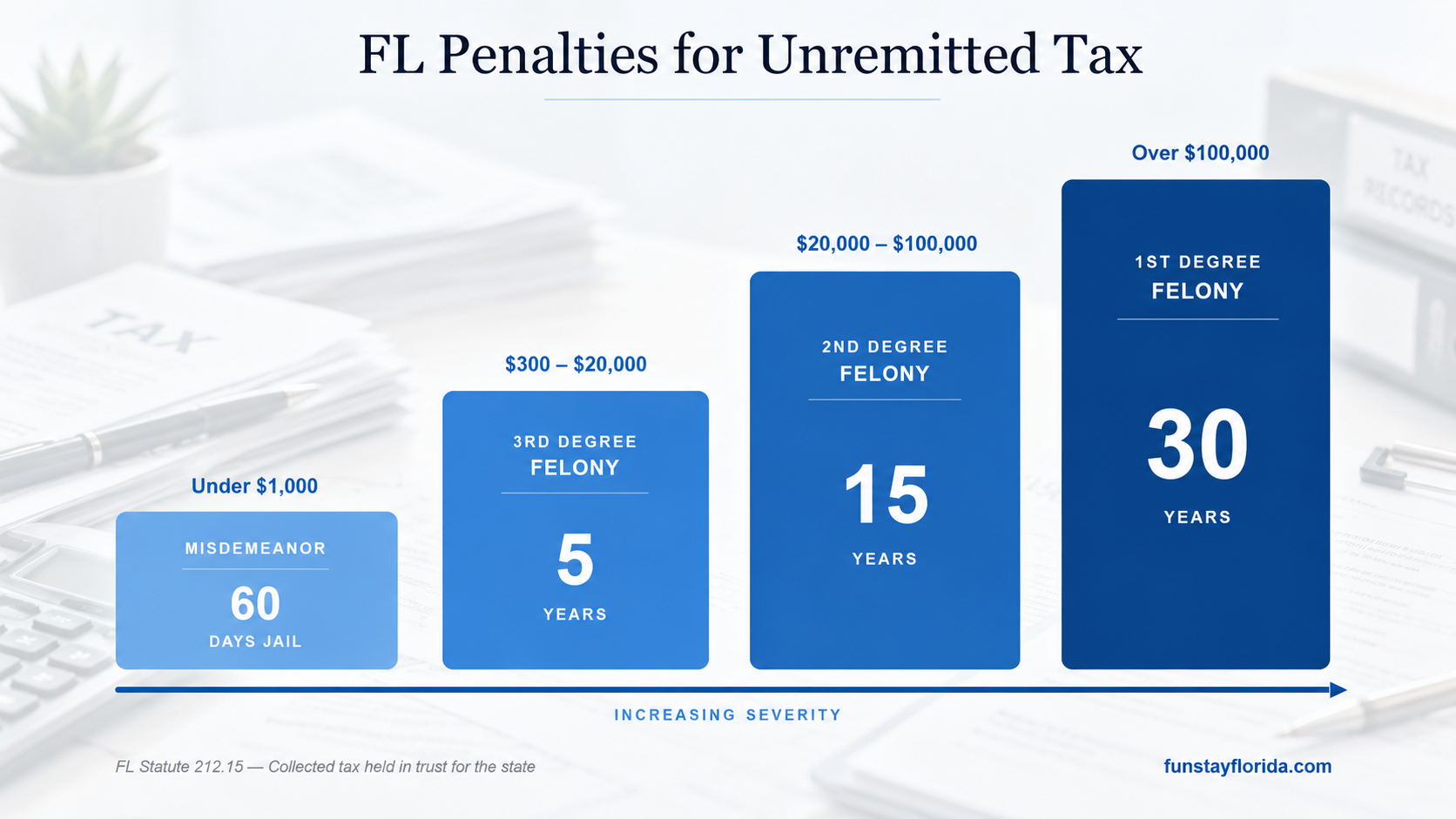
This is the part most tax guides skip over. Under Florida Statute 212.15, sales tax collected from guests is held in trust for the state. If you collect it and don’t send it in, Florida classifies that as theft of state funds. Not a civil matter. Criminal.
| Unremitted Amount | Offense Level | Maximum Penalty |
|---|---|---|
| Under $1,000 | 2nd degree misdemeanor | 60 days jail |
| $300 to $20,000 | 3rd degree felony | 5 years prison |
| $20,000 to $100,000 | 2nd degree felony | 15 years prison |
| Over $100,000 | 1st degree felony | 30 years prison |
These penalties apply to state sales tax. County TDT penalties vary but all include 10% late penalty minimums plus interest. And the statute of limitations for unfiled returns? It never expires. If you never filed, the state can come after you indefinitely.
How They Find You
People ask me how the state even finds non-filers. It’s not hard. The DOR cross-references Airbnb 1099-K filings with their tax registration database. They also match DBPR vacation rental licenses against DOR accounts. If you pulled a license but never registered for tax, you’re already in their system.
Operating a short-term rental in Florida without proper licensing and tax registration isn’t a gray area. It’s a countdown to an audit letter.
Voluntary disclosure option:
If you’ve been renting without filing, contact the FL DOR’s Voluntary Disclosure Program at 850-617-8552 BEFORE they contact you. They generally waive penalties and limit the look-back to three years. Interest is still owed, but it’s far better than waiting for the audit letter.
What This Actually Costs: A Kissimmee Rental Example
Enough theory. Let’s put real numbers to Florida vacation rental taxes using a property that looks like most of the rentals we manage in Kissimmee.
$60K
Annual gross rental income
$8,100
Total annual tax (13.5%)
$360
Collection allowance you keep
Of that $8,100 in total tax, $4,500 is state sales tax and surtax (filed with FL DOR), and $3,600 is Osceola County tourist development tax (filed separately with the county). On Airbnb bookings, the platform handles the $4,500 to the state. You’re responsible for the $3,600 to Osceola County yourself.
If you miss six months of Osceola County TDT filings, that’s $1,800 in uncollected tax, $180 in penalties, plus interest. And that’s before the state starts asking why your 1099-K shows rental income, but you have no county tax account.
This is why understanding the full cost picture matters when you’re calculating your vacation rental ROI. A property that looks profitable on paper can quietly bleed money through missed tax obligations you didn’t even know you had.
Frequently Asked Questions
We Handle Your Taxes So You Don’t Have To
FunStay Florida manages 100+ vacation rentals across Orlando, Kissimmee, and Davenport. We register with both agencies, file every return, collect every tax, and reconcile every platform. You get a monthly report showing exactly what was collected and remitted.