
$0
FL State Income Tax
100%
Bonus Depreciation
$30K+
Cost Seg First-Year Benefit
23.8%
Max Effective Cap Gains
Most Orlando vacation rental owners leave money on the table at tax time. They either overpay on the keep side or undersell on the exit because they never ran the real numbers. This guide covers every Florida vacation rental tax deduction worth claiming, plus the sell-side strategies around capital gains, depreciation recapture, and 1031 exchanges that determine whether holding or selling is the smarter move. If you own a short-term rental in Central Florida, your Airbnb tax write-offs in Florida start here.
The Two Sides of Vacation Rental Taxes in Florida
Florida vacation rental owners deal with two separate tax obligations. The first is collection taxes: the 6% state sales tax and 5-6% county tourist development tax you charge guests and remit to the state and county. We cover those in our existing guide to Florida vacation rental taxes.
This guide covers the second side: the federal income taxes you owe on rental profits, the deductions that reduce those profits, and the tax strategies that matter when you sell. Florida has no state income tax, which means every deduction and strategy here hits your federal return directly.
Florida Vacation Rental Tax Deductions That Reduce Your Bill
The deductions below are what separate owners who pay $5,000 at tax time from owners who pay $15,000 on the same revenue. Every one of these is reported on Schedule E of your federal return.
Depreciation (27.5 Years)
The IRS lets you depreciate the building value of your rental property over 27.5 years, even as the property appreciates in market value. You subtract the land value from your purchase price, then divide by 27.5.
Example: a $400,000 property with $80,000 in land value gives you $11,636 per year in short-term rental depreciation in Florida. That reduces your taxable rental income without costing you a dollar in cash. The IRS spells out the rules in IRS Publication 527.
100% Bonus Depreciation Under the One Big Beautiful Bill Act
This is the biggest tax development for rental property owners in years. The One Big Beautiful Bill Act, signed in July 2025, made 100% bonus depreciation permanent for qualifying property placed in service after January 19, 2025. Before this law, bonus depreciation was phasing down: 60% in 2024, 40% in 2025, 20% in 2026, and 0% in 2027. That phaseout is gone.
For vacation rental owners, this means components of your property identified through a cost segregation study can be fully depreciated in the year they’re placed in service. That changes the math on renovations, new purchases, and even retroactive studies on properties you already own.
Cost Segregation Studies
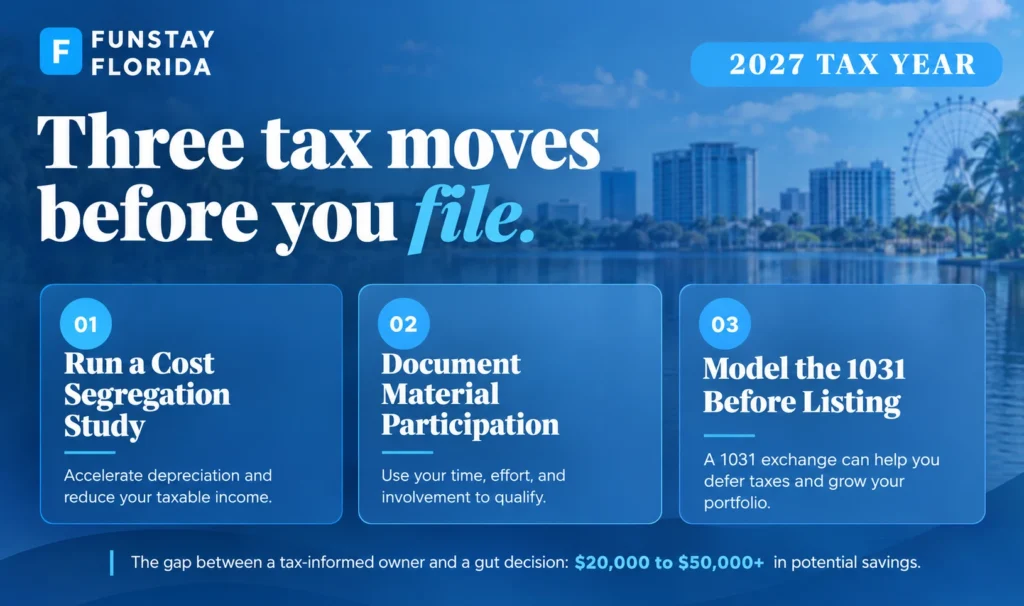
A cost segregation study is an engineering analysis that reclassifies 25-35% of your property from the 27.5-year category into 5, 7, or 15-year categories. Those reclassified components (appliances, cabinetry, flooring, landscaping, certain plumbing and electrical) now qualify for 100% bonus depreciation.
The study costs $5,000 to $10,000. The first-year tax benefit runs $30,000 to $80,000+ in accelerated deductions. FunStay manages over 100 vacation rentals across Central Florida, and owners who run a cost segregation study on their vacation rental in year one or two come out ahead on net tax position every time. It is the single most underused strategy we see.
A $5,000–$10,000 cost segregation study delivers $30,000–$80,000+ in first-year accelerated deductions. It is the single most underused tax strategy for Florida vacation rental owners.
Operating Expense Deductions
Beyond depreciation, every dollar you spend operating the rental is deductible:
- Property management fees (15-25% of gross revenue, fully deductible). See how Airbnb property management impacts profitability once you factor in the tax savings.
- Insurance premiums
- HOA and CDD fees
- Repairs and maintenance
- Cleaning and turnover costs
- Utilities
- Mortgage interest
- Property taxes (reported on Schedule E rental income, not subject to the SALT cap that limits Schedule A deductions)
- Supplies and furnishings under the $2,500 de minimis safe harbor
- Travel to the property for management or maintenance
- Professional services (CPA, attorney, tax advisor)
Owners who work with FunStay property management get monthly P&L statements that categorize every deductible expense automatically. That alone eliminates the most common mistake we see at tax time: owners who forget to deduct half their eligible Airbnb tax write-offs in Florida because they never tracked them.
The Short-Term Rental Tax Loophole
This is the strategy that makes short-term rentals more tax-advantaged than long-term rentals. If your average guest stay is 7 days or fewer and you materially participate in the rental activity, losses from the property can offset your ordinary W-2 income. Long-term landlords cannot do this. Their losses are classified as passive and can only offset other passive income.
The material participation threshold: you must spend more than 100 hours per year on the rental activity and more hours than anyone else involved, including property managers and cleaning crews. Self-managing owners pass this test more easily. Owners who use a property manager need to document their direct involvement carefully: owner communications, pricing decisions, property inspections, vendor coordination.
The short-term rental tax loophole combined with accelerated depreciation from a cost segregation study creates paper losses large enough to offset tens of thousands in W-2 income. This is fully legal and a primary reason sophisticated investors buy vacation rentals over long-term rentals.
Read more about the tax benefits of owning an Orlando vacation rental for the full keep-side analysis.
When You Sell: Capital Gains, Recapture, and 1031 Exchanges
Capital Gains Tax on a Florida Vacation Rental
When you sell your vacation rental, the profit above your adjusted basis is subject to federal capital gains tax. If you held the property longer than one year, rates are 0%, 15%, or 20% depending on your income bracket. There is no Florida state capital gains tax, which gives Florida sellers an immediate advantage over owners in California, New York, or any state that taxes capital gains.
If your modified adjusted gross income exceeds $200,000 (single) or $250,000 (married filing jointly), add the 3.8% Net Investment Income Tax. For higher-income owners, the effective vacation rental capital gains tax in Florida tops out at 23.8% on the federal side.
The real surprise is depreciation recapture.
Depreciation Recapture
Every dollar of depreciation you claimed during ownership gets “recaptured” when you sell. The IRS taxes that recapture at a maximum rate of 25%. If you claimed $100,000 in total depreciation (including accelerated depreciation from cost segregation), you owe up to $25,000 in recapture tax on top of your capital gains liability.
This is the tradeoff of accelerated depreciation: bigger deductions while you own the property, bigger recapture when you sell. Owners who skip this calculation when deciding to sell underestimate their tax bill by $20,000 to $50,000.
1031 Exchange: Defer Everything
A 1031 exchange lets you sell one investment property and buy another while deferring all capital gains and all depreciation recapture. For owners sitting on large gains, this is the most powerful exit tool available.
The rules for a 1031 exchange on a vacation rental in Florida:
- You have 45 days after closing to identify replacement properties
- You must close on the replacement within 180 days
- A qualified intermediary holds the proceeds (you cannot touch the funds)
- The replacement must be equal or greater in value and debt
For vacation rental owners specifically, the IRS safe harbor (Rev. Proc. 2008-16) requires that the property was rented at fair market value for 14 or more nights per year and your personal use did not exceed the greater of 14 days or 10% of rental days, for each of the two years before and after the exchange. If you managed your property as a true rental, you meet the safe harbor.
You can exchange into a different Florida community, a different state, or a different property type. Read the full 1031 exchange guide for Orlando STR investors for the buying side.
The Tax Math Behind Sell vs. Keep
Every sell-or-keep decision comes down to two numbers: your after-tax return from holding versus your after-tax proceeds from selling. Owners who sell or keep their Florida vacation rental without running both sides of this math are guessing.
Holding
Annual gross revenue minus operating expenses minus taxes (with all Florida vacation rental tax deductions applied). Include depreciation, cost segregation benefits, and the STR loophole value if you qualify.
Selling
Sale price minus closing costs (7-9% including agent commission) minus federal capital gains minus depreciation recapture. If you use a 1031 exchange on your vacation rental in Florida, your capital gains and recapture tax drops to zero, but you reinvest the full proceeds.
Owners with international tax obligations (FIRPTA withholding, treaty considerations) should also review our international investor tax guide before making a decision.
The owners who get this wrong are the ones who sell without understanding recapture or hold without maximizing their Florida vacation rental tax deductions. Either way, the gap between a tax-informed decision and a gut decision runs $20,000 to $50,000.
Tax-Smart Property Management
The tax strategies in this guide only work if your books are clean and your documentation is complete. FunStay manages over 100 vacation rentals across Central Florida, and the owners who capture every deduction are the ones with organized records from day one.
Monthly P&L Statements
Every deductible expense categorized automatically. No scrambling at tax time, no missed write-offs on Schedule E.
Material Participation Documentation
For owners pursuing the STR loophole, we track hours and activities so your CPA has the evidence the IRS requires.
Cost Segregation Coordination
We connect owners with qualified engineers for cost segregation studies and ensure reclassified components are documented correctly.
Day One Through Sale Day
From your first booking to a potential 1031 exchange or sale, the tax math carries through. Mike Chen handles both the management and the real estate side.
If you want someone to run the sell-or-keep numbers on your specific property, talk to Mike Chen. He handles both the management and the sale side for FunStay owners, which means the tax math carries through from day one to closing day.
Frequently Asked Questions
Get Your Tax-Smart Property Analysis
See how professional management, clean books, and the right tax strategy can change your bottom line. No commitment, just data.
Mike Chen
Owner, FunStay Florida | Florida Licensed Realtor, La Rosa Realty
(321) 430-8681 | Mike@MikeChenRealtor.com