
$50
Max Filing Fee
25 Days
Petition Window
5%
New Non-Homestead Cap
4
Counties Covered
Property tax is the single largest recurring cost most vacation rental owners never question. We manage over 100 properties across Orange, Osceola, Polk, and Lake counties, and every August, TRIM notices land showing assessed values disconnected from what properties actually sell for. A vacation rental property tax assessment that overshoots by even 10% costs you thousands every year until you challenge it.
Florida gives you a straightforward process to challenge that number. Filing a Florida property tax appeal through your county’s Value Adjustment Board takes about an hour of preparation and a filing fee of up to $50. If your assessment is too high, the math is on your side.
How Florida Assesses Your Vacation Rental Property Tax
Every January 1, your county’s property appraiser sets the “just value” of your property using eight factors defined under Florida Statute 193.011. Three of those factors matter most for vacation rental owners.
Comparable sales. The appraiser looks at recent sales of similar properties in your community. This is where problems start. A furnished vacation rental that sells for $450,000 might include $35,000 to $50,000 in furniture, electronics, and decor. Florida law requires that those furnishings be excluded from the sale price when valuing the real property. But appraisers working through thousands of parcels sometimes skip that adjustment. If your vacation rental property tax assessment looks inflated, this is the first place to check.
Income. Short-term rental revenue, net of management fees and operating costs, often supports a lower value than comparable sales alone. Most STR investors skip this when preparing a Florida property tax appeal. It should be part of every filing.
Your property appraiser’s assessed value also drives your tangible personal property (TPP) account. Furnishings and equipment should live on a separate TPP return (DR-405 form), not bundled into the real property number. If your TPP assessment looks low while your real property value looks high, the appraiser may have combined them.
When to Appeal Your Vacation Rental Property Tax Assessment
Not every high assessment is worth fighting. The first step in any Florida property tax appeal is simple math.
Start with your TRIM notice. This is the “Truth in Millage” notice your county mails in late August (roughly 55 days after the July 1 value certification). Your TRIM notice property tax summary shows your assessed value, exemptions, and taxable value.
Compare your property appraiser’s assessed value to recent comparable sales in your community. Pull three to five closed sales from the last 12 months for similar homes. Adjust for furnishings included in each sale. If the assessed value is 10% or more above adjusted comparables, you have a case.
Then calculate the savings. Multiply the difference by your local property tax millage rate. For a typical Orlando-area vacation rental with a combined rate around 18 to 20 mills, every $10,000 in reduced assessed value saves $180 to $200 per year. Against the $50 filing fee, even a modest reduction pays for itself immediately.
The vacation rental property tax bills we see across our portfolio range widely by community. Properties in Solterra, Paradise Palms, and Windsor Hills tend to be assessed conservatively. Luxury communities with fewer comparable sales, like Reunion and ChampionsGate, are where we see the biggest gaps. We’ve pulled TRIM notices in ChampionsGate showing assessments $80,000 or more above what nearby closings support. At 19 mills, that gap alone costs over $1,500 a year.
The Florida Property Tax Appeal Process Step by Step
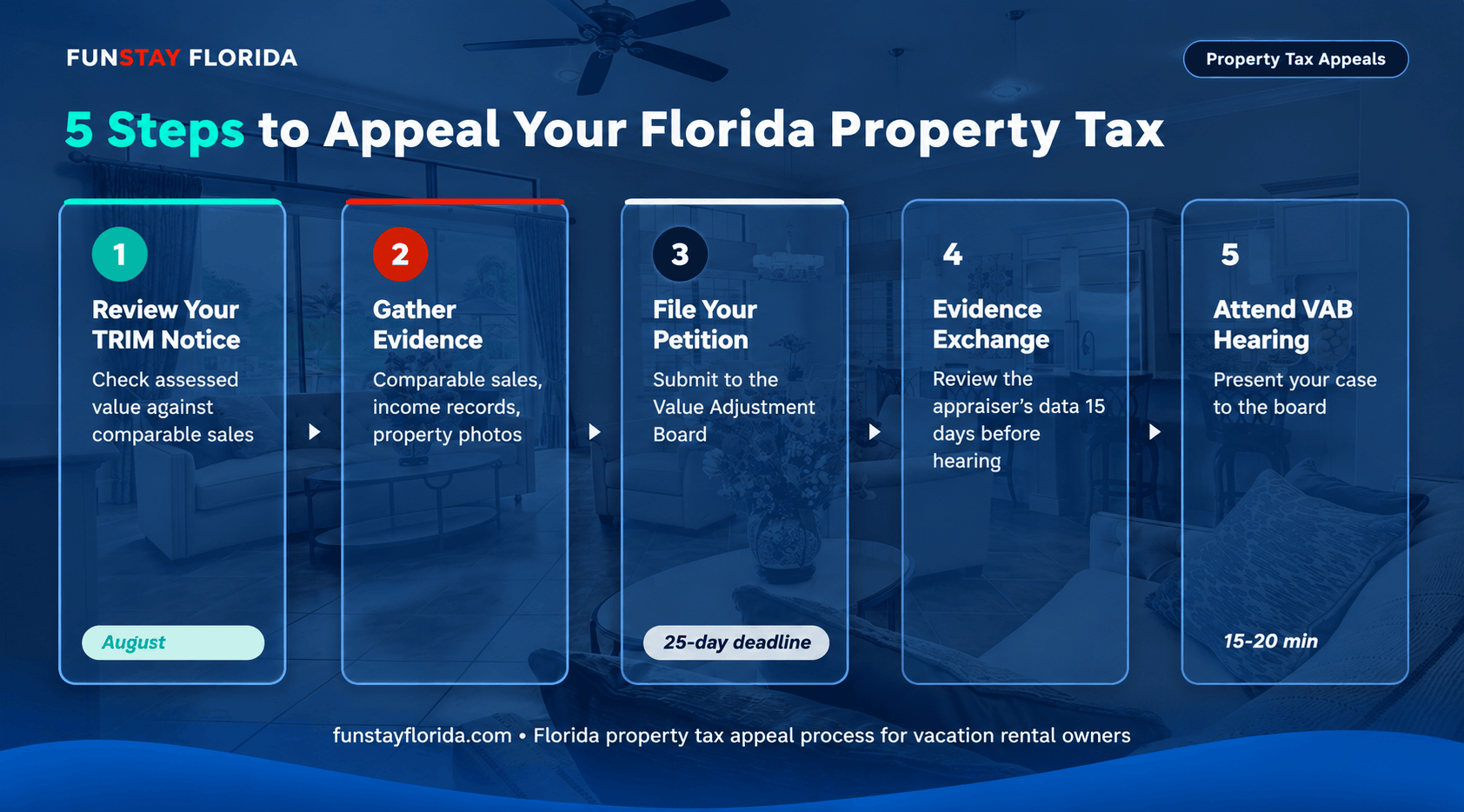
Here is what filing a Florida property tax appeal actually looks like.
1 Review your TRIM notice. Your TRIM notice property tax statement arrives by mail in late August. It lists your assessed value, exemptions, and taxable value. Your petition deadline: 25 days from the mailing date (F.S. 194.011(3)(d)).
2 Gather your evidence. The strongest appeals combine multiple data points. Pull comparable sales and adjust for furnishings. Download your property’s income and expense history for the last 12 months. Take photos of any condition issues the appraiser may not have seen.
3 File your petition. Submit the petition on DR-486, the Department of Revenue’s prescribed form. You need your parcel number (on the TRIM notice), a sworn statement, and a filing fee of up to $50 (set by each county’s VAB board). As of 2025, the fee cap increased from $15 to $50 per parcel under F.S. 194.013. Most resources still list $15, so verify with your county clerk. For multiple parcels, a joint petition costs $50 plus $5 per additional parcel.
4 Evidence exchange. At least 15 days before your hearing, you and the property appraiser exchange evidence. Review their comparable sales carefully. If they used furnished sale prices without adjusting for personal property, flag it.
5 Attend the hearing. The Value Adjustment Board in Florida is composed of two county commissioners, one school board member, and two citizen members (F.S. 194.015). Hearings typically last 15 to 20 minutes. Present your evidence and stick to the data. Don’t argue; just show the numbers. The board decides whether the appraiser proved just value. If not, they adjust your assessment.
You can also request an informal conference with the appraiser before the hearing. Many disputes settle here without ever reaching the board.
Property Tax Appeal Deadlines by County
Every county’s Value Adjustment Board runs on a different schedule. Missing these dates means your Florida property tax appeal waits a full year. For 2026, the petition deadlines were:
| County | TRIM Mailing | Petition Deadline |
|---|---|---|
| Orange | Late August | September 18, 2026 |
| Osceola | August 14 | September 8, 2026 |
| Polk | August 17 | September 11, 2026 |
| Lake | Late August | 25 days after TRIM |
Plan ahead for 2027.
All 2026 deadlines have passed. Mark your calendar for August 2027. Pull comparable sales data in spring, organize income records by June, and file the day your notice arrives. The 2027 cycle will be the first under Amendment 3’s tighter 5% non-homestead property tax cap, which makes a successful appeal even more valuable: your reduced assessment will grow more slowly under the lower ceiling.
For Orange County assessments, the Orange County Property Appraiser website has your parcel data and the comparable sales behind your assessment. Each county’s PA site offers similar tools. The Florida Department of Revenue VAB page has petition forms and filing instructions.
Millage Rates and What Your Vacation Rental Property Tax Actually Costs
Your annual tax bill is your taxable value multiplied by the property tax millage rate in your district. Orlando-area vacation rentals typically face combined rates between 17 and 21 mills, depending on county, municipality, and special districts.
That matters for a Florida property tax appeal. Say your property is assessed at $400,000 but comparable sales support $350,000. At a millage rate of 19 mills:
Appeal Savings Example (19 mills)
| Current tax ($400K x 0.019) | $7,600/year |
| Corrected tax ($350K x 0.019) | $6,650/year |
| Annual savings | $950 |
| Filing fee | $50 |
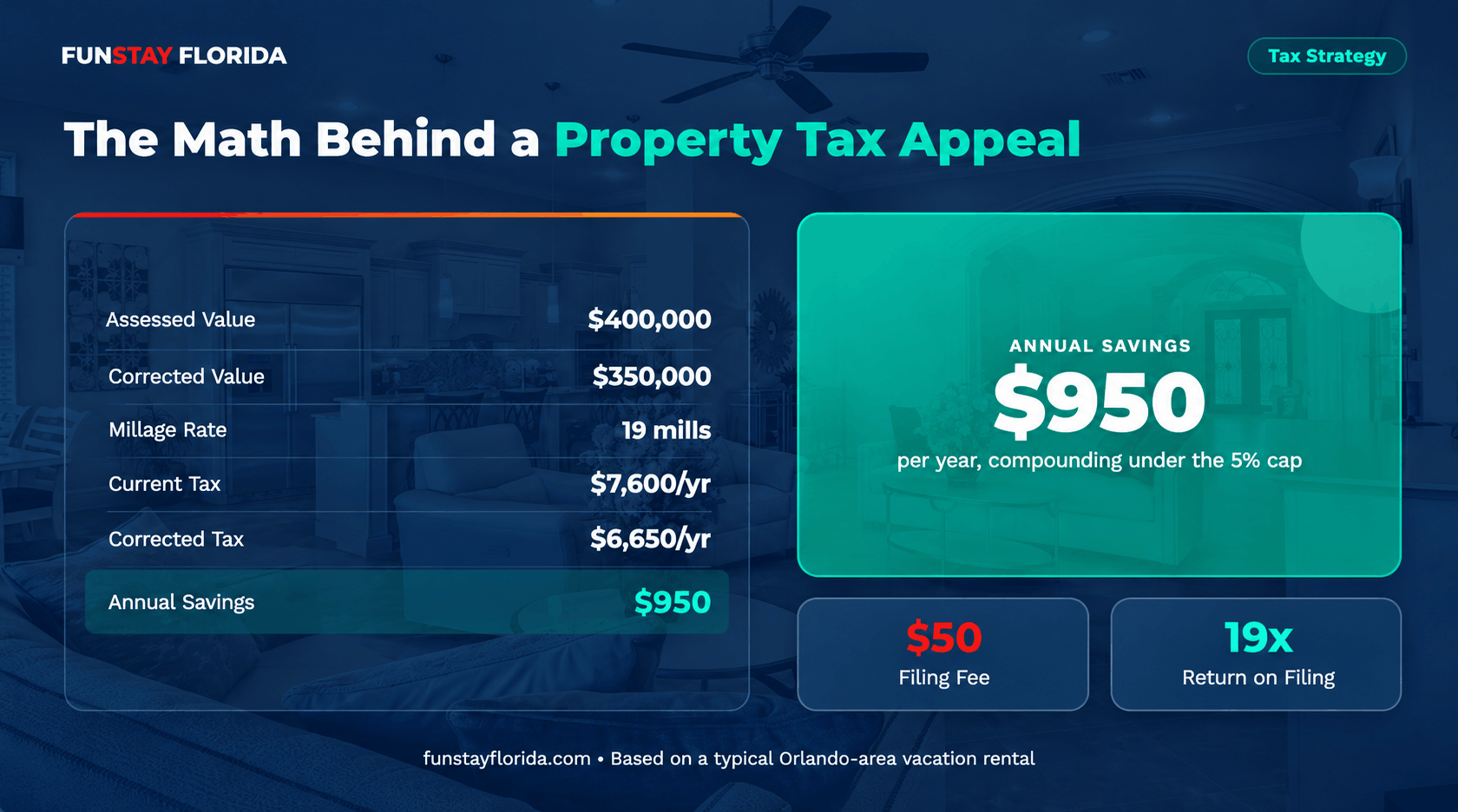
Property tax appeal savings for a typical Orlando-area vacation rental at 19 mills
That $950 compounds. Your reduced assessed value carries forward, and the non-homestead property tax cap (dropping to 5% in 2027 under Amendment 3) limits future increases from the lower base.
When you run your own vacation rental ROI calculation, property taxes are one of the biggest line items. Combined with vacation rental tax deductions like depreciation and cost segregation, a lower assessed value is one of the fastest ways to improve your net return.
Don’t forget the taxes you collect on each booking, either. Our breakdown of Florida vacation rental taxes covers the state sales tax, county surtax, and tourist development tax on each booking. For new properties, our licensing and tax requirements overview covers registration.
We Review Every TRIM Notice Across Our Portfolio
FunStay Florida manages properties across four counties. We flag over-assessed properties every August and walk owners through the appeal math.
Mike Chen
Owner, FunStay Florida | Florida Licensed Realtor, La Rosa Realty
(321) 430-8681 | Mike@MikeChenRealtor.com
What FunStay Tracks for You

We review TRIM notices across our entire portfolio every August. When we see a property assessed above what the data supports, we flag it. Owners who win bring comparable sales, rental income, expense records. That evidence turns a successful Florida property tax appeal.
Before you buy your next investment property, checking the assessed value against recent sales belongs on every due diligence checklist. An over-assessed property just means your first appeal is already lined up.
Your vacation rental property tax is negotiable. Florida built a process for exactly this. Use it.
Frequently Asked Questions