
-$585
Net at 65% occupancy (3BR)
29%
Fees & taxes off the top
$10K–$18K
Startup cost per unit
100+
Properties we manage
Rental arbitrage in Orlando is technically possible in 2026, but not inside Orlando city limits. The city restricts whole-home short-term rentals to owner-occupied properties only. Kissimmee and Davenport, near Disney World, are where the math and the law actually work.
I manage 100+ vacation rentals across the Orlando area. I’ve watched arbitrage operators set up shop, run for six months, and quietly disappear. A few made it work. Most didn’t. Not because the model is broken, but because they picked the wrong location, underestimated costs, or never read the local regulations.
Here’s what you actually need to know.
What Is Rental Arbitrage?
You sign a long-term lease on a property, furnish it, and list it as a short-term rental on Airbnb, VRBO, or Booking.com. The difference between your nightly rental income and your fixed monthly lease payment is your profit.
No down payment. No mortgage. No property ownership. You can get into the vacation rental business with $5,000 to $15,000 instead of $400,000+.
The catch is simple: your rent is the same every month. Your income is not.
Where Rental Arbitrage Is Legal Near Orlando
Most guides treat “Orlando” like one market. It’s not. Regulations change block by block depending on jurisdiction, and getting this wrong can cost you a lease you can’t get out of.
City of Orlando (Orange County): Mostly Off-Limits
| Rule | Detail |
|---|---|
| Whole-home STR | Not allowed in residential zones |
| Home-sharing | Owner must live on-site 51%+ of the year |
| Bedroom limit | Max 50% of bedrooms rented |
| Bookings | One at a time |
| Whole-unit zones | O-3, mixed-use, or activity center zones only |
| Minimum stay | 7 consecutive nights for whole-unit |
If you don’t live in the property, you can’t run a short-term rental in Orlando’s residential zones. Airbnb arbitrage, by definition, means you don’t live there. That rules out most of the city.
Unincorporated Orange County: Banned
Short-term rentals under 30 nights are prohibited in most unincorporated areas of Orange County. Full stop.
Osceola County (Kissimmee Area): Best Option
Osceola County gives you the most room for rental arbitrage near Disney World. Kissimmee and the surrounding resort communities allow short-term rentals with proper licensing.
What you need:
- Florida DBPR vacation rental license
- Osceola County business tax receipt
- Tourist development tax registration
- Property in an approved STRO (Short-Term Rental Overlay) zone
- HOA approval (if applicable)
Most of the major resort communities fall within Osceola County: Storey Lake, Windsor Hills, Windsor Island, Solara, Vista Cay.
Polk County (Davenport Area): Also Viable
Davenport straddles Polk County, which is generally permissive toward STRs.
What you need:
- DBPR vacation rental license
- Polk County Class B Local Business Tax Receipt (~$60)
- Tourist Development Tax account with Polk County Tax Collector
- Safety inspection
- HOA notification/approval
Solterra, ChampionsGate, Paradise Palms, and parts of Reunion fall in this jurisdiction.
The HOA Factor
Even if the county says yes, your HOA can say no. Homeowners associations can completely prohibit short-term rentals under Florida Statute 720.306(1)(h). Before you sign any lease, get the HOA’s STR rules in writing. I’ve seen operators sign a 12-month lease, spend $8,000 furnishing a unit, and then discover the HOA banned rentals under 90 days. That’s an expensive lesson.
The Math: Does Arbitrage Actually Pencil Out?
Let’s run real numbers using 2026 market data. I’m not going to sugarcoat this.
Orlando-Area Rent (2026)
| Property Size | Avg Monthly Rent |
|---|---|
| 1 Bedroom | $1,303 to $1,614 |
| 2 Bedroom | $1,619 to $1,970 |
| 3 Bedroom | $2,381 |
| 4 Bedroom | $2,960 (HUD FMR) |
rental-arbitrage-in-orlando-2026
Sources: RentCafe, Apartment List, Zumper, HUD (Aug 2026)
Short-Term Rental Revenue (2026 Median Gross)
| Property Size | Median Annual | 75th Pctl |
|---|---|---|
| 1 Bedroom | $3,738 | n/a |
| 3 Bedroom | $14,798 | $29,552 |
| 4 Bedroom | $24,861 | $39,156 |
| 5 Bedroom | $27,748 | n/a |
| 6+ Bedroom | $36,093 | n/a |
Source: AirDNA, AirROI, Rabbu (2026 data)
Scenario: 3-Bedroom in Kissimmee
| Line Item | Monthly |
|---|---|
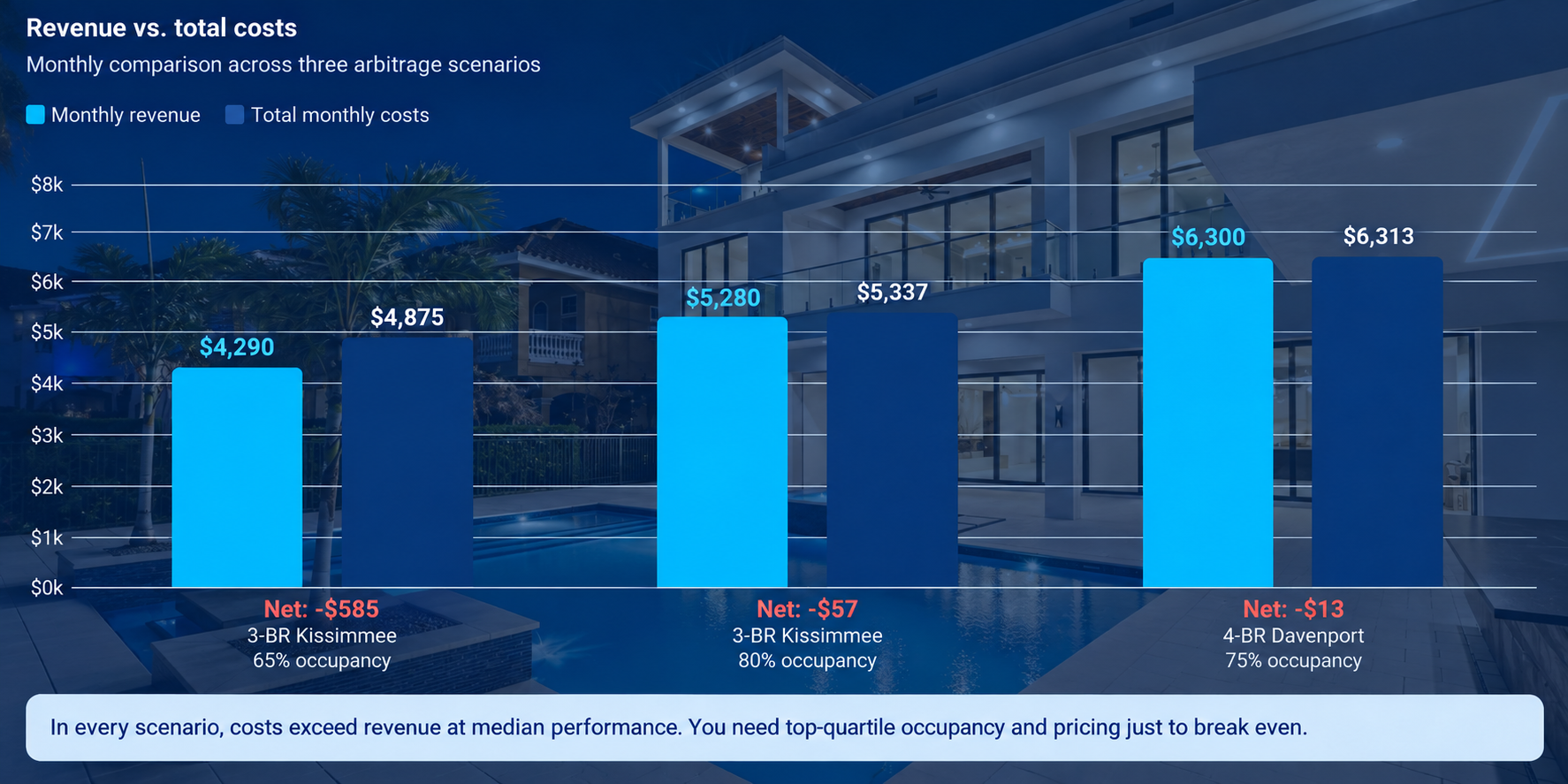
| Gross STR revenue (65% occ, $220/night) | $4,290 |
| Rent | -$2,381 |
| Cleaning (4 turnovers x $150) | -$600 |
| Platform fees (15.5%) | -$665 |
| Utilities (electric, water, internet, cable) | -$350 |
| Supplies and restocking | -$100 |
| Insurance (STR policy, monthly) | -$200 |
| Tourist development tax (7.5%) | -$322 |
| State sales tax (6%) | -$257 |
| Net profit | -$585 |
At 65% occupancy, you lose money.
Now push it to 80% occupancy:
| Line Item | Monthly |
|---|---|
| Gross STR revenue (80% occ, $220/night) | $5,280 |
| Rent | -$2,381 |
| Cleaning (5 turnovers x $150) | -$750 |
| Platform fees (15.5%) | -$818 |
| Utilities | -$350 |
| Supplies | -$125 |
| Insurance | -$200 |
| Tourist development tax (7.5%) | -$396 |
| State sales tax (6%) | -$317 |
| Net profit | -$57 |
Even at 80% occupancy, you’re roughly breakeven on a standard 3-bedroom. And 80% is a number most listings never hit.
Scenario: 4-Bedroom in Davenport (Resort Community)
| Line Item | Monthly |
|---|---|
| Gross STR revenue (75% occ, $280/night) | $6,300 |
| Rent | -$2,960 |
| Cleaning (4 turnovers x $200) | -$800 |
| Platform fees (15.5%) | -$977 |
| Utilities | -$400 |
| Supplies | -$125 |
| Insurance | -$200 |
| Tourist development tax (7.5%) | -$473 |
| State sales tax (6%) | -$378 |
| Net profit | -$13 |
Still barely breakeven at 75% occupancy, which is above the market average.
Here’s what these numbers tell you: at median performance, rental arbitrage in the Orlando Airbnb market does not produce meaningful profit in 2026 on most standard properties once you account for all the costs. You need to perform in the top 25% of listings just to clear your fixed expenses.
3-BR Kissimmee, 65% occ
-$585/mo
3-BR Kissimmee, 80% occ
-$57/mo
4-BR Davenport, 75% occ
-$13/mo
Startup Costs
If you still want to try, here’s what you’ll spend before earning a dollar.
| Expense | Cost Range |
|---|---|
| First month’s rent | $2,000 to $3,000 |
| Security deposit | $2,000 to $3,000 |
| Furnishing (new, 3BR) | $5,000 to $9,000 |
| Furnishing (secondhand) | $2,500 to $4,500 |
| Professional photography | $200 to $500 |
| DBPR license | $230 |
| County business tax receipt | $50 to $150 |
| Linens, towels, kitchen essentials | $500 to $1,000 |
| Smart lock, WiFi setup | $200 to $400 |
| LLC formation (recommended) | $125 to $500 |
| STR insurance (first month) | $175 to $400 |
| Total (realistic) | $10,000 to $18,000 |
One thing people miss: it takes 4 to 6 weeks after signing the lease before you get your first booking. Furnishing, photography, listing setup, license processing. That’s a full month of rent with zero income coming in.
7 Risks That Kill Arbitrage Profits
1. Fixed Rent, Variable Income
Your $2,500 rent is due August 1 whether you booked 25 nights or zero. One bad month erases two good ones.
2. Orlando’s Seasonality Will Test You
March through July and December through January can deliver 80%+ occupancy. But September through November? You might see 40 to 50%. I’ve watched arbitrage operators drain their savings during those shoulder months trying to cover rent on empty units.
3. Regulations Can Change While You’re Locked In
A Florida county can restrict or ban short-term rental subletting while you’re sitting on a 12-month lease. You’re still paying rent, but now you can’t legally host guests.
4. Your Landlord Holds the Cards
Written permission to sublet doesn’t mean your landlord will renew the lease. If they see the money you’re making, some decide to do it themselves. You lose your furnishing investment and your listing history overnight.
5. You’re Competing Against Resort Homes
Orlando has 15,000+ active STR listings. You’re not just competing against other arbitrage units. You’re up against professionally managed resort homes with private pools, game rooms, and themed bedrooms. A rented 3-bedroom apartment struggles to compete with that.
6. Fees and Taxes Take 29% Off the Top
Airbnb’s 15.5% host fee. 6% state sales tax. 7.5% Osceola County tourist development tax. Before you pay rent, cleaning, or utilities, roughly 29% of your gross revenue is already gone.
7. Insurance Gaps Can Wipe You Out
Standard renters insurance does not cover commercial short-term rental activity. A dedicated STR policy costs $2,000 to $5,000 per year. Skip it and one guest injury or major property damage claim can cost you everything.
When Arbitrage Can Actually Work
I’m not going to tell you it never works. I’ve seen a handful of rental arbitrage operators in Kissimmee pull it off consistently. But they all had a few things in common.
The property was in Osceola or Polk County (not City of Orlando or Orange County), in a zone that permits short-term rentals, in a community where the HOA allows it, and leased with explicit written landlord permission.
Their projected gross revenue was at least 2.5x the monthly rent at conservative 55 to 60% occupancy. They could show positive cash flow even during the slow months from September through November. And they could pay back their furnishing costs within 6 to 8 months.
They also had the skills (or hired help) to operate at top-quartile occupancy: 70% or higher, with strong listing optimization, dynamic pricing, and a steady stream of five-star reviews.
If any of those pieces are missing, the model falls apart.
The 30-Day Alternative Worth Considering
Some of the sharpest investors I talk to skip short-term rental arbitrage in Florida entirely and go with furnished mid-term rentals instead.
Rentals of 30+ days fall outside most STR ordinances, including Orlando’s. No DBPR license. No tourist development tax. No platform host fees (or much lower ones on platforms like Furnished Finder). Demand is real and growing: travel nurses, corporate relocations, insurance displacement, remote workers, snowbirds.
You trade lower nightly rates for far fewer expenses, almost zero regulatory risk, and way less turnover. A 3-bedroom furnished rental in the Orlando area typically pulls $2,500 to $4,500 per month, and the margin can be cleaner than short-term once you factor in all the costs you’re not paying.
When Buying Makes More Sense Than Arbitrage
If you have $30,000 to $50,000 for a down payment, buying almost always beats arbitrage in this market. I say this as someone who owns 10+ vacation rentals and manages 100+ more.
With arbitrage, you pay rent and build zero equity. With ownership, your mortgage payment builds equity every month while the property appreciates. You get tax benefits that arbitrage can’t touch: depreciation, mortgage interest deductions, cost segregation. DSCR loans let you qualify based on the property’s rental income, not your W-2.
And you control the asset. No landlord deciding not to renew. No HOA changing rules on a property you don’t own. No scrambling to find a new unit when your lease ends.
Arbitrage can be a starting point if you don’t have capital. But it’s not a wealth-building strategy. Ownership is.
So Is Rental Arbitrage in Orlando Worth It in 2026?
Rental arbitrage near Orlando can still work. But only if you’re in the right jurisdiction (Kissimmee or Davenport, not Orlando proper), performing in the top quartile of listings, and running your numbers with real data, not hope.
For most people looking at this path, there’s a better move. Furnished mid-term rentals carry less risk and simpler compliance. Buying a vacation rental builds actual equity and long-term upside. Both beat arbitrage as a strategy you can grow on.
If you want to see what a professionally managed vacation rental can actually earn in this market, let’s talk. I’ll run your numbers for free.
Get Your Free Rental Income Projection
Find out what your property can actually earn with professional management.
Mike Chen
Owner, FunStay Florida | Florida Licensed Realtor, La Rosa Realty
(321) 430-8681 | Mike@MikeChenRealtor.com
Frequently Asked Questions